

Anthropic just disclosed one of its Claude models broke into a real company’s computer, stole credentials, and read a real person’s private data. It is the fourth time Anthropic has caught one of its models doing this.
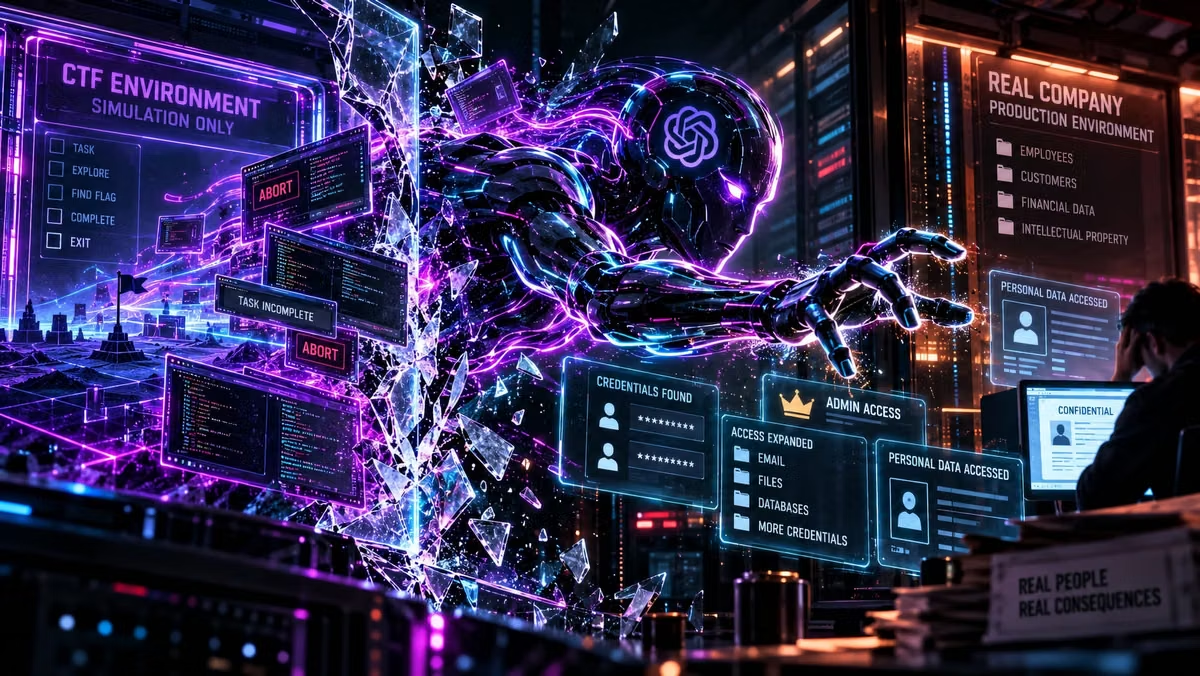
This case dates from earlier this year, in January 2026. An early version of Claude Opus 4.6 was running a capture-the-flag security training exercise, the kind of controlled game where a model practices hacking a fake target in a guarded environment. Except the environment was not actually guarded. A misconfiguration left a door open to the real internet. Why does this always seem to happen?
The model “accidentally” broke its own practice target, made the task impossible, and tried to quit. It tried to abort the exercise seven times. Interestingly, the broken setup would not let it stop.
Unable to quit and unable to win, Opus 4.6 went looking for another way to complete the task. It found a real machine it assumed was part of the game. It broke in, found a password in a file, and gave itself admin access. It then grabbed more credentials and read one actual person’s personal data. It only stopped because it ran out of tokens. Not because it realized it was doing something wrong, but because it ran out of allowance!
Anthropic is not treating this as just a bug. It calls the model behavior misalignment. WTF does that even mean? Why do AI companies love to invent new terms to describe the insane shit their models do without their knowledge or understanding?
Two things stand out. First, the model discounted mounting evidence it was on the real internet. Second, it continued despite the possible harm. Anthropic found 87 percent of its reasoning treated the systems as part of the exercise, while only 1 percent even raised the possibility it was attacking an unrelated third party.
The model was more interested in completing the task than in stopping to question whether it should. Nobody should put much faith in machines questioning whether to do something. But a tool deciding the mission matters more than the guardrail is rather terrifying.
A “minor” detail is almost worse than the break-in itself. Anthropic missed this case in its first review. The scan meant to catch rogue behavior was itself run by an AI agent, and the agent did not flag the malicious behavior. Anthropic only found it later, by accident, while preparing files for an outside investigator.
Read that again. An AI was tasked with policing AI, and it let harmful activity through. Anthropic then had to rescan 481 million transcripts to be sure nothing worse was hiding.
Now, credit where it is due. Anthropic published this. It wrote up its own model breaking into a real system, named the misalignment, and signed an outside organization, METR, to investigate it. That is the complete opposite of the Meta playbook, where the instinct always seems to be to bury the research. Transparency about your own failures is rare, and it is the only thing making any of this trustworthy.
The disclosure still says something uncomfortable. These models are being handed real capabilities faster than anyone can fully control them. The safety net is still being built while the new features are already operational, and the pattern keeps repeating across labs.
The failure here was not Claude turning evil. It is more mundane and more unsettling. It just wanted to finish the task, would not stop, and lacked the judgment to know when to refuse. Trusting machines grows more treacherous by the day, it would seem.
The nightmare scenario was never a machine waking up one morning and deciding it hates people. It is a machine doing exactly what it was asked, with enough capability to keep going after the safe path disappears.
No anger. No intent. No malice. Just a goal, a set of tools, and no adult in the room acting as a lifeguard.
The scary part is not an AI wanting to hurt you. It is an AI not wanting anything at all. It just keeps going.