
Denmark Was Not Hacked, It Was Logged Into
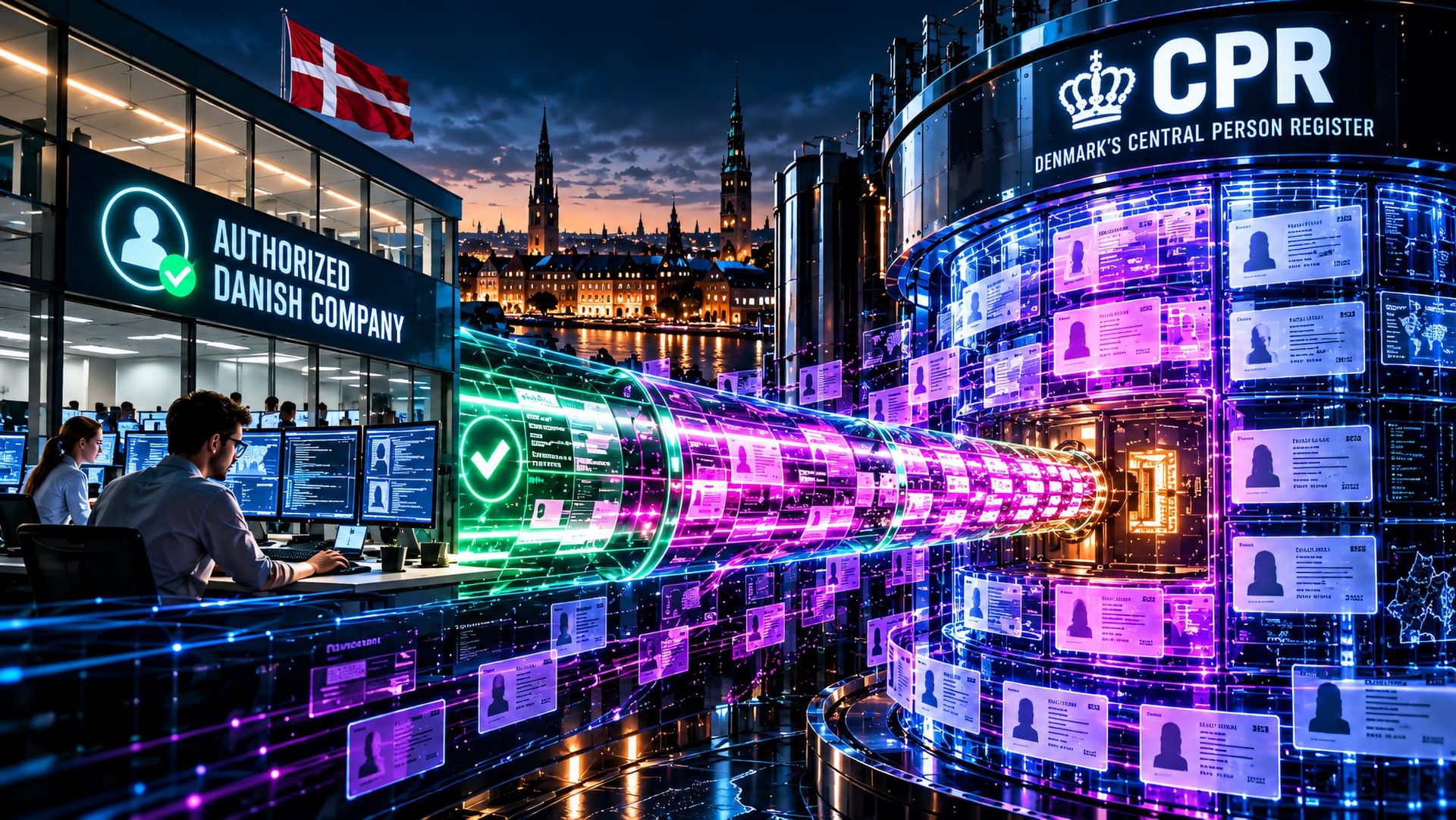
denmark just disclosed that attackers accessed roughly 8.8 million citizen records in its central population register, the cpr. there is no disclosed exploit yet against the cpr system and no malware campaign against the register itself. the attackers abused the legitimate access of a small private company authorized to query cpr, then used that trusted path to run an enormous number of automated lookups.
they did not break into the register in any traditional sense. they came through a company authorized to be there. whatever happened to compromise that company's access has not yet been publicly explained.
the cpr number is denmark's spine. it is a ten-digit national identifier, closer to a social security number than a password. it runs through banking, healthcare, taxes, government services, and much of everyday life. unlike a password, it is not designed to rotate whenever somebody else learns it. this is what makes it more synonymous with a social security number.
denmark can issue a new cpr number in special cases involving documented identity theft or misuse. however, this is not a credential designed to be mass-reset after a breach. you cannot realistically rotate millions of national identity numbers on monday morning because somebody accessed them on sunday afternoon. when names, addresses, and cpr numbers across most of the register become exposed at once, the risk has a very long tail.
the attackers seemingly used the company's authorized connection to run more than fourteen million automated searches designed to identify valid cpr numbers. they then retrieved the records associated with each query. that was made easier by the structure of the identifier itself.
a cpr number contains ten digits, with the first six encoding date of birth and the final four forming a sequence number. this is not some randomly generated 128-bit secret. enough of its structure is predictable that automated enumeration becomes meaningful when somebody already has access to the lookup system.
there is an even nastier detail buried in the mechanics. private-company access is supposed to support legitimate lookups involving people already identified for a business purpose, not provide a discovery mechanism for determining which identities exist. yet the automated searches were specifically aimed at identifying valid cpr numbers.
that effectively turned the lookup service into an oracle of sorts. feed it a candidate identity and the response can tell you whether the guess corresponds to a real human. the answer does not have to explicitly hand over the secret if the behavior of the system confirms whether the secret is valid. the attackers were not merely querying the dataset. they were using the dataset to help complete it.
and this is where the incident becomes considerably more interesting than a stolen credential. recognizing an approved company is authentication. deciding which information it may retrieve is authorization. neither tells you whether the people being queried have anything to do with the purpose for which that access was granted.
then there is behavior. millions of individually permissible requests can still become one obviously illegitimate operation when viewed together in context. permission without purpose is just a very well authenticated data-extraction channel.
that enumeration ran for roughly ten days in september before anyone noticed. what finally caught it was not a security control. it was the bill. denmark charges the company a fee for every cpr lookup, and the flood of unauthorized queries ran the invoice far past anything normal. an employee inside the cpr administration, not the private company whose access was being abused, spotted the anomaly. the monitoring and usage controls that should have flagged this did nothing. the accounting caught what the security did not.
christina egelund, the minister responsible, acknowledged afterward that the warning signs should have appeared sooner. a system holding the identity data of an entire country allowed a trusted connection to operate at extraordinary scale for roughly a week and a half before human attention finally caught up.
this is the soft underbelly of a centralized registry. denmark put national identity information in one place, then granted lawful access to outside organizations with legitimate reasons to verify people. each meaningful external connection extends the effective security boundary of the register beyond the infrastructure running it.
that means the cpr's real perimeter is considerably larger than the cpr itself. every organization given meaningful lookup access becomes part of the security architecture whether anyone describes it that way or not. centralizing the data does not centralize the risk once access to it has been delegated.
the weakest authorized account is not adjacent to the register's security. it is part of the register's security. hardening the database against somebody outside the walls does not solve the problem when trusted identities already have doors through them.
officials have confirmed the unauthorized querying and retrieval of the data, but they have not publicly established what was retained, transferred onward, sold, or used afterward. the 8.8 million figure represents roughly 80 percent of the register's approximately 11 million records. this includes people who have died or moved abroad, not only current residents.
people with name and address protection were not included in the exposed names and addresses, according to the cpr administration. the private company has not been publicly named, nor has it been explained how its access was compromised. no attacker has been identified. there are still important pieces of this incident we simply do not know.
we spend enormous effort hardening the center, the database, the server, the perimeter, and comparatively little watching identities we have already admitted inside. a legitimate credential is quiet precisely because each individual action can appear normal until somebody looks at the purpose, volume, and pattern together. this is exactly why trusted third-party access demands the same scrutiny as the perimeter itself, not a credential check at the door and silence afterward.
the register was not breached in the way most people imagine a breach. it was used. the attacker did not bypass trust. they inherited it.
once the company's access was accepted as legitimate, individual requests could appear permissible even while the combined behavior was obviously insane. this is why authentication and authorization cannot be the end of the security decision. access tells you what an identity can do. purpose and behavior tell you whether it should be doing it.
there is another consequence here that reaches far beyond the register itself. denmark already warns that a cpr number should not be treated as sole proof of someone's identity. after an incident exposing all of this personally identifiable information at this scale, any bank, business, or government office still using those facts to prove the person on the phone is really you has a much larger identity problem.
the incident does not merely expose identity information. it devalues information some systems still use to verify identity. once supposedly private facts are known by enough other people, knowledge-based authentication stops authenticating much of anything.
and the permanence is what makes this one linger. a stolen password gets reset by friday. a national identity number does not. even where replacement is technically possible in exceptional cases, rotating millions of cpr numbers is not a realistic incident-response strategy.
denmark appears to understand that this is bigger than resetting one company's access. egelund has ordered a security review of the cpr system and says changes to the system itself are now on the table. she has also not ruled out issuing new cpr numbers to some affected people.
when one abused partner account forces a country to reconsider the architecture around its national identity register, the problem was never merely the partner account. fraud monitoring, stronger identity verification, tighter third-party controls, behavioral analytics, and purpose-aware access now have to compensate for information that cannot simply be made secret again.
the deeper failure is not that the system could not recognize an unauthorized user. it is that permission became a substitute for judgment. the register recognized a trusted path and kept answering even as the cumulative behavior moved far beyond anything a normal lookup relationship should resemble.
we keep confusing permission with legitimacy. the attacker did not need to defeat denmark's identity system. they only needed to become someone the system already trusted, then turn legitimate permission into national-scale extraction.
the breach was not outside the permission. it was inside it.