

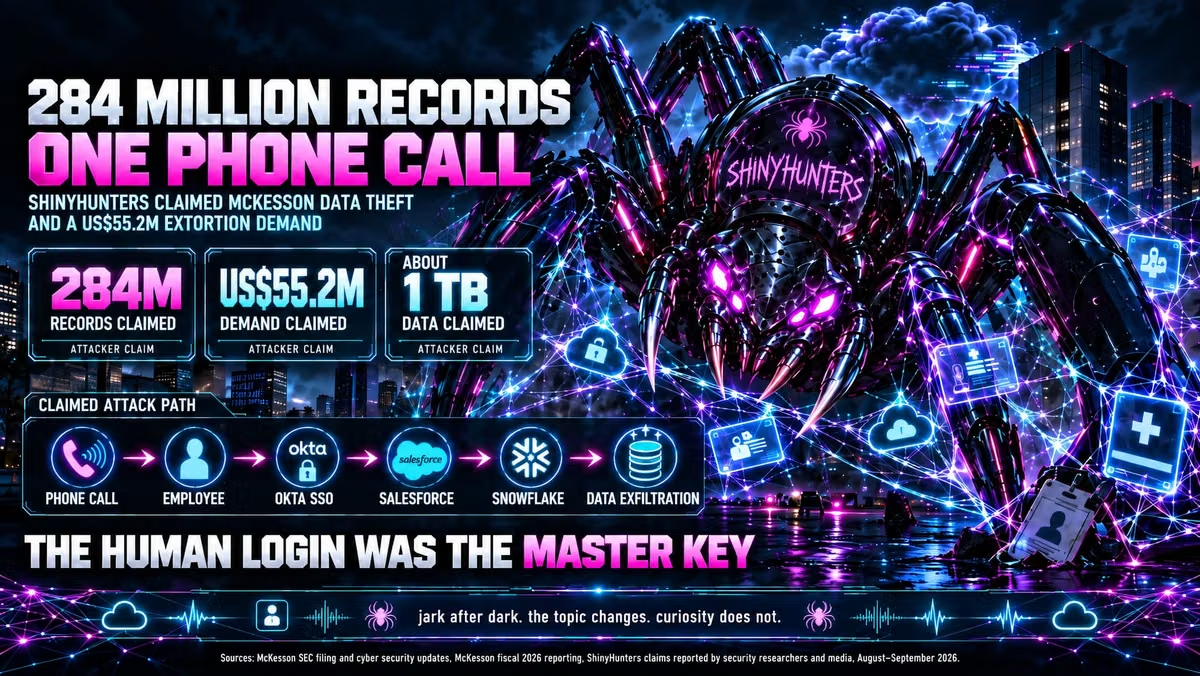
ShinyHunters is claiming to have stolen 284 million patient records from McKesson and demanded US$55.2 million to keep the data from being released. This is on-brand for ShinyHunters, which means the claim is worth taking seriously, but not at face value. The gap is worth examining.
McKesson is a name you likely have never heard of before. I sure as hell never heard of it until today. But chances are, once you read this story, you will not forget the name. McKesson distributes roughly a third of all prescription medicines in North America.
As such, a huge amount of patient data flows through its infrastructure from thousands of hospitals, pharmacies, and clinics. They are not McKesson, but their records touch its systems. This is what makes a breach here so heavy. The blast radius is not McKesson’s customers. It is a huge slice of US healthcare data.
Here is what has actually been confirmed. McKesson filed with the SEC it detected a cyber security incident on August 25 involving unauthorized access to third-party applications and data exfiltration. It says the investigation is early and points to a subset of two business units. That is the verified floor. Everything beyond it is a mere claim.
ShinyHunters is making the claim. Specifically, it says it took 284 million records. Read this carefully. Records, not patients. The 284 million is the claimed number of database rows, and ShinyHunters itself admits it maps to tens of millions of people, not 284 million individual patients. The distinction is incredibly important. The scary headline number and the actual human number are not the same, and ShinyHunters has an incentive to make the stash sound enormous. Gotta pound your hands on your big scary chest, right?
So how much do you trust ShinyHunters? This is where it gets uncomfortable. ShinyHunters has been a highly effective extortion adversary in 2026, tearing through healthcare, telecom, and insurance with one boring, repeatable playbook. Call an employee. Pretend to be IT support. Talk them into handing over their single sign-on log-in. Then walk into the company’s cloud data platforms, Salesforce and Snowflake, and drain them.
ShinyHunters claims it pulled roughly a terabyte out of McKesson this way over four days. This is ShinyHunters tradecraft. It is what the threat actor does.
McKesson has confirmed data exfiltration, but not this exact attack path or volume. McKesson has also not confirmed the demand or any negotiation.
So many successful adversaries do not need sophisticated attacks to conduct a successful breach. All they need is low-hanging fruit.
In this case, the entry point was not some elite zero-day. It was a phone call. An employee, a convincing voice, a stolen log-in. Some of the most valuable healthcare data in the country now sits behind cloud identity systems a well-delivered lie can sometimes open. Companies spent years hardening the perimeter, and the door getting used again and again is a human being who wanted to be helpful.
“Humans are the weakest link in the chain” is a refrain the industry will likely never stop hearing.
You cannot patch it with software. Human behavior does not change easily. And until it does, the size of the next number is just a matter of which company picks up the phone.