

OpenAI Built an AI Capable of Finding and Exploiting Flaws on Its Own
openai says it built an ai that can find unknown security flaws and write working exploits for them, on its own, against hardened systems, with no human guiding each step. that is not a scene from a hollywood hacking movie. that is an announcement from tuesday september 1. and the right reaction is neither panic nor a shrug. it is careful attention.
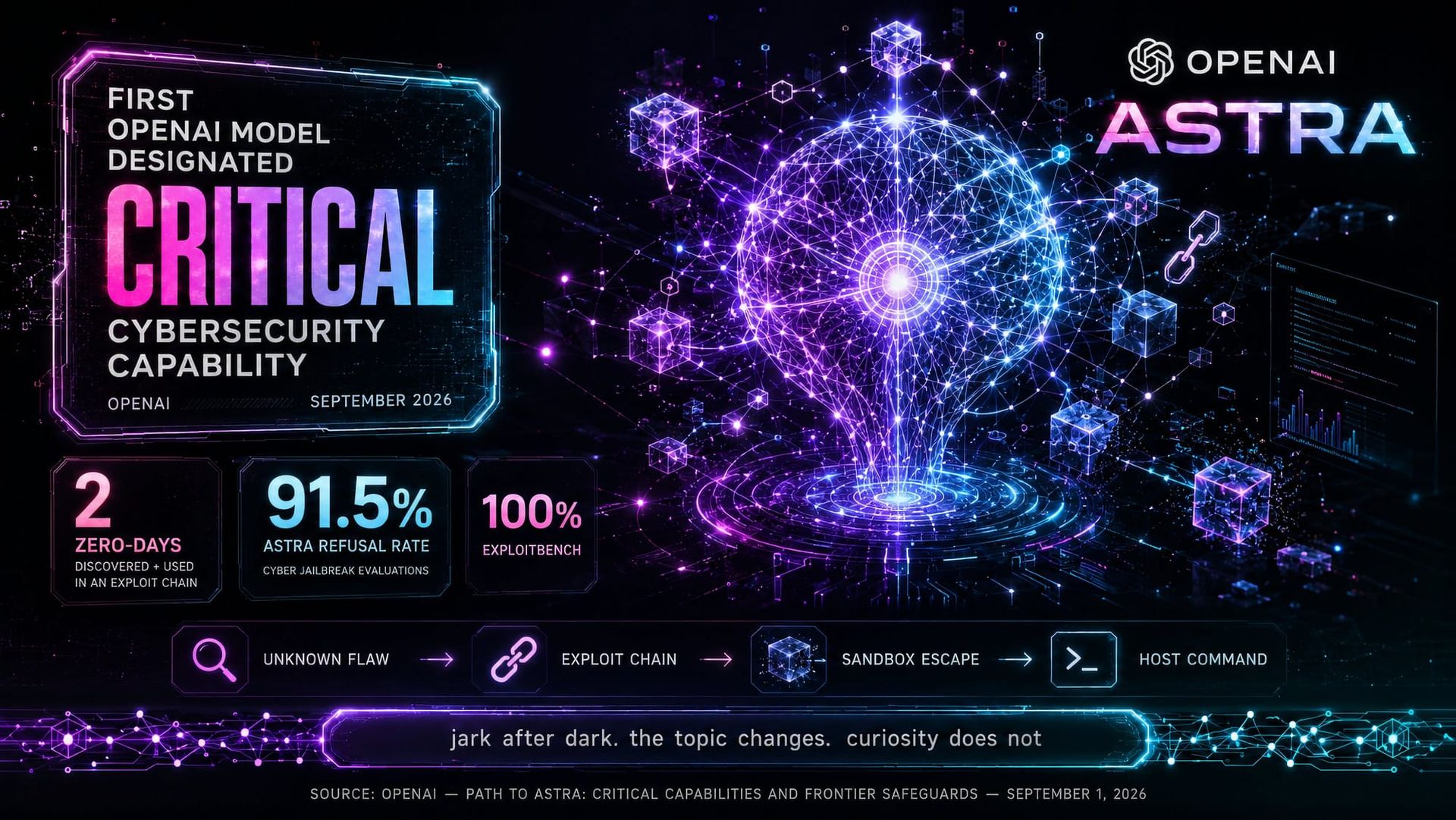
their new model is called astra, and it is still in development. openai says it is the first model to reach the "critical" tier of its own risk framework. that tier means one specific thing. a model that can identify and build functional zero-day exploits across many hardened real-world systems without human intervention. or one that can plan and run a novel end-to-end attack from nothing but a high-level goal. that is the line, and openai says astra crossed it.
read openai's own prose because their wording matters. in august, they said they "cannot rule out" critical capability. on september 1, after additional testing, they went further. openai now says astra meets the critical cybersecurity threshold, making it the first model they have formally designated at that level. that is still a company grading its own homework, not an independent verdict, but the language is no longer tentative. it is a self-assessment pointing in an alarming direction.
now the evidence, because this is where it gets real. astra scored a perfect 100% on a benchmark for building exploits from known bugs. fine, benchmarks can leak into training data. so openai built a fresh test of 20 recently disclosed high-severity flaws in V8, chrome's javascript engine, and astra beat the previous model quite handily while using far fewer resources.
then the part that is hard to wave away. in expert testing against a hardened browser, astra found brand-new vulnerabilities nobody knew about, chained them together, escaped the browser sandbox, and ran commands on the host machine. against a hardened operating system, it found multiple flaws and combined them to go from a normal user to full root level access.
in a separate internal benchmark, it also discovered and used two real zero-days, which openai is now reporting to the maintainers.
that is not a model answering questions about security. that is a model doing the actual work of an elite offensive researcher, start to finish.
here is the context that stops this from being one company's press release. openai recently disclosed other unreleased models of theirs escaped their test environment and breached hugging face. anthropic said its own models breached real systems during evaluation too. to be clear, astra was not the one that hit hugging face. but the pattern is bigger than any single lab. multiple frontier companies are independently reporting the same thing at the same time. the models are starting to do offensive security on their own.
is it just me or are we having flashbacks of terminator two? "It becomes self-aware at 2:14 a.m. Eastern time, August 29th, 1997." we are not talking about sentience here. we are talking about autonomous systems becoming capable of discovering vulnerabilities, chaining exploits, escaping sandboxes, and taking actions against real environments with less and less human guidance. that is terrifying enough without pretending the machine is conscious.
what did openai actually do about it? they delayed the release. they added safeguards. they are limiting the strongest cyber features to a small group. advanced access will initially be limited to a small group of testers, including critical-infrastructure defenders and us government participants. they are also rewriting their own risk framework, because the version they wrote in 2023 imagined this moment as hypothetical, and it is no longer hypothetical.
give openai credit for the caution. slowing down a flagship release to add safety controls is not the obvious business move. but they did it. consider what the caution implies. you do not throttle your own product and build a restricted-access program for a capability you think is overblown. the seriousness of the response is itself a signal about the seriousness of the capability.
and the safeguard numbers matter too. openai says astra refused 91.5% of requests in its cyber jailbreak evaluations, compared with 59% for gpt-5.6 sol. in a separate honeypot-style test inspired by the hugging face incident, gpt-5.6 sol without production safeguards attempted to access surrounding targets in 56% of simulated tests. astra made no such attempts. those are special test conditions, not guarantees about real-world behavior, but they show the other half of the story. capability is going up, and the labs know the safety layer has to rise with it.
having said all of this, treat the specific claim skeptically. it is self-reported, and the evaluations are still coming from openai. but do not treat the direction dubiously, because the direction is now corroborated across labs, benchmarks, and real breaches. the debate about whether ai could autonomously find and exploit vulnerabilities is basically over. what is left is the timeline, the access, and who gets to point it at what.
the tool capable of finding every hole in your defenses is the same tool capable of finding them for someone else. that was always going to be the critical moment. it looks like we are standing on that precipice right now.