
Osaka's Backups Died in the Same Blast Radius as Its Servers
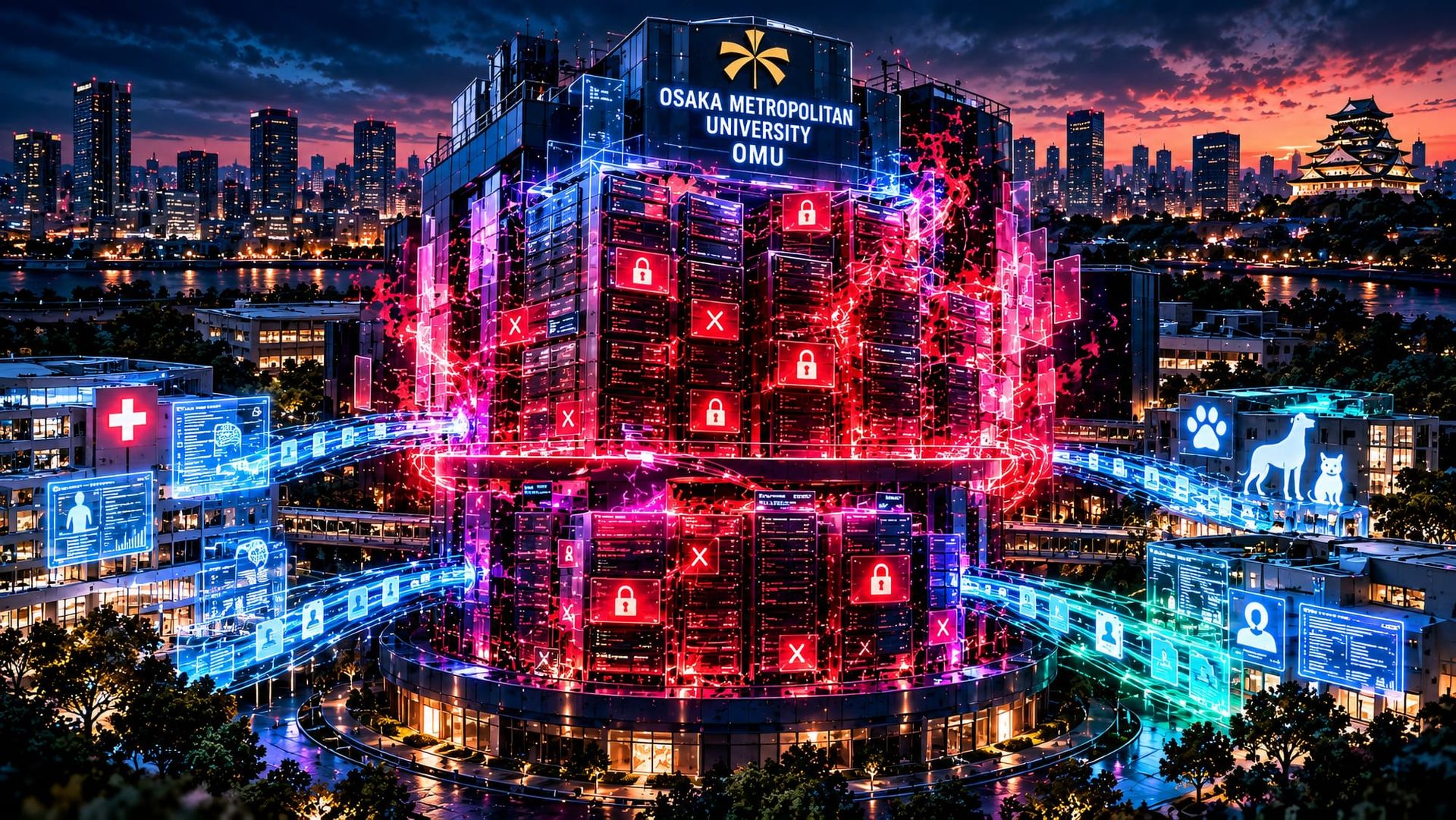
the attack hit in the early hours of october 2. by the time anyone could respond, roughly 500 servers at osaka metropolitan university had ceased normal operation. this was not a routine outage or a failed update. on october 5 the university said it was hit with ransomware.
the damage was total in the way campus life actually runs. the networks across all five campuses went down. internal email stopped. the student portal, course-support system, and public website all went dark.
the university canceled classes from october 2 through october 8 and said in-person teaching would resume on october 9. full server recovery is expected to take considerably longer. the distinction matters because the university can restart part of its mission before the technology underneath it is fully restored.
the human scale is larger than the current student body. at least 130,000 people may have had personal data exposed. that includes current students, faculty, and staff, but also decades of alumni from osaka city university and osaka prefecture university, which merged to form omu in 2022. some of the affected records stretch back to 1995 at osaka city university and 2005 at osaka prefecture university. the data reported so far include names, addresses, phone numbers, email addresses, and face photographs used for student id cards. this is not merely a current-student incident. it reaches backward through thirty years of university history.
there is a quieter lesson in those dates. omu opened in 2022, but it inherited decades of digital history from the universities that came before it. mergers do not only combine campuses, staff, and systems. they combine old data, old dependencies, and old risk. the attacker did not need to be around in 1995 to put a 1995 graduate at risk in 2026. once historical records survive long enough to enter the next generation of infrastructure, yesterday's data becomes today's attack surface.
one detail separates this from an ordinary ransomware story, and the japanese reporting is consistent on it. most of the backups were encrypted too. that turns an intrusion into something much uglier. paired with the compromised virtualization layer, it explains almost everything downstream. the virtualization layer is why the blast radius reached roughly 500 servers at once. the encrypted backups are why getting those servers back is now an entirely different problem.
one failure destroyed production. the other destroyed the shortcut home. that is why the university is rebuilding rather than simply restoring.
a backup exists for exactly one reason. it is supposed to survive a disastrous event destroying the production assets. a backup the attacker can reach is not much of a recovery mechanism if it lives inside the same failure domain. we do not yet know exactly how omu's backup environment was architected or how the attackers reached it. but the outcome exposes the difference between having backups and having an independent recovery plane. a recovery copy only buys resilience if the compromise destroying production cannot destroy the recovery path with it.
and recovery is not simply about locating an unencrypted copy. before you restore the data, you have to trust the environment you are restoring it into. if the control plane itself was compromised, dropping clean files back into an environment whose integrity has not been re-established risks recreating the problem with fresher data.
what is interesting is the medical school hospital and the veterinary clinical center kept running because they operated on separate infrastructure. the entrance-exam registration portal also stayed available because it lived on external servers. the systems that survived are valuable precisely because they did not share the same failure domain. whether that separation came from deliberate resilience engineering or simple architectural circumstance matters less than the result. the attacker could not destroy what the compromised environment did not control.
there is another resilience lesson hiding in the university's response. omu plans to restart in-person teaching before its digital estate is fully restored, while online teaching still depends on recovery progress. that is business continuity in its least glamorous form. alternate networks, external communication paths, and temporary workarounds become useful precisely because they do not depend on the infrastructure that failed. ugly workarounds are still resilience when the primary system no longer exists. the mission does not have to wait for every server to come back.
resilience is not only how quickly you restore the technology. it is whether the organization can still perform its actual day-to-day mission while the technology is down hard. a university that can keep teaching in degraded mode is more resilient than one waiting for every system to become perfect again.
there is also a structural lesson underneath the virtualization layer. when hundreds of systems depend on shared infrastructure and its control plane, compromise at that layer can turn consolidation into a blast-radius multiplier. virtualization makes infrastructure vastly more efficient in normal times. under adversarial control, that same concentration can turn many nominally separate servers into one shared failure domain. efficiency and resilience are not always moving in the same direction. what saves money during normal operations can concentrate damage during abnormal ones.
there is a question the university still cannot answer. encryption is confirmed. unfortunately exfiltration is not. modern ransomware operations frequently steal data before encrypting systems to use as payment leverage. there is currently no public evidence confirming omu's data left the network. the victim can immediately see the damage caused by encryption while potentially spending weeks determining whether something far more durable happened beforehand.
that asymmetry is one of the defining anxieties of modern ransomware. the damage you can see is usually operational. the damage you cannot yet prove was stolen may be the part following people for years.
student id photographs are a good example of why that matters. a password can be reset the moment it leaks. a face photograph cannot. if those images were taken, they become durable material for impersonation and social engineering long after the servers are rebuilt.
there is a yet another problem underneath availability and confidentiality. if the attacker reached deep enough to encrypt production and backups alike, the integrity of what survives cannot be assumed. that would turn recovery into an integrity problem too. bringing a server back online is not enough if you are unable to trust what is sitting on it. availability can be restored and confidentiality can at least be investigated. integrity has to be re-established before the recovered environment becomes trustworthy again.
thus far no threat actor has laid claim to the attack. no ransomware strain has been named. no ransom demand has been disclosed. the university president apologized for failing to prevent the attack, which is the expected gesture and also the least interesting part of the story.
attribution can wait. the architecture already told us something more useful. this incident is less interesting as a whodunit than as a demonstration of what happens when production, virtualization, and recovery share too much fate.
far too often we measure security as if the whole contest happens at the perimeter, as if the only question is whether the attacker gets in. ransomware does not respect that framing. it assumes the attacker is already inside and asks a harder question. what still stands when the encryption finishes running is the real measure of resilience. at osaka metropolitan university, the answer was the systems outside the shared failure domain. the hospital kept operating, the veterinary center kept operating, and externally hosted admissions infrastructure kept operating.
the backups were supposed to provide the same kind of independence after everything else failed. most of them were encrypted too. that is the real failure. ransomware resilience is not whether you have another copy. it is whether the attacker has to cross another security boundary to destroy it. production and recovery cannot merely be two destinations reachable from the same compromise.
if production and backup can die from the same attack, you never had two systems. you had one system twice.