

Your ATM Was Encrypted, Until It Was Not
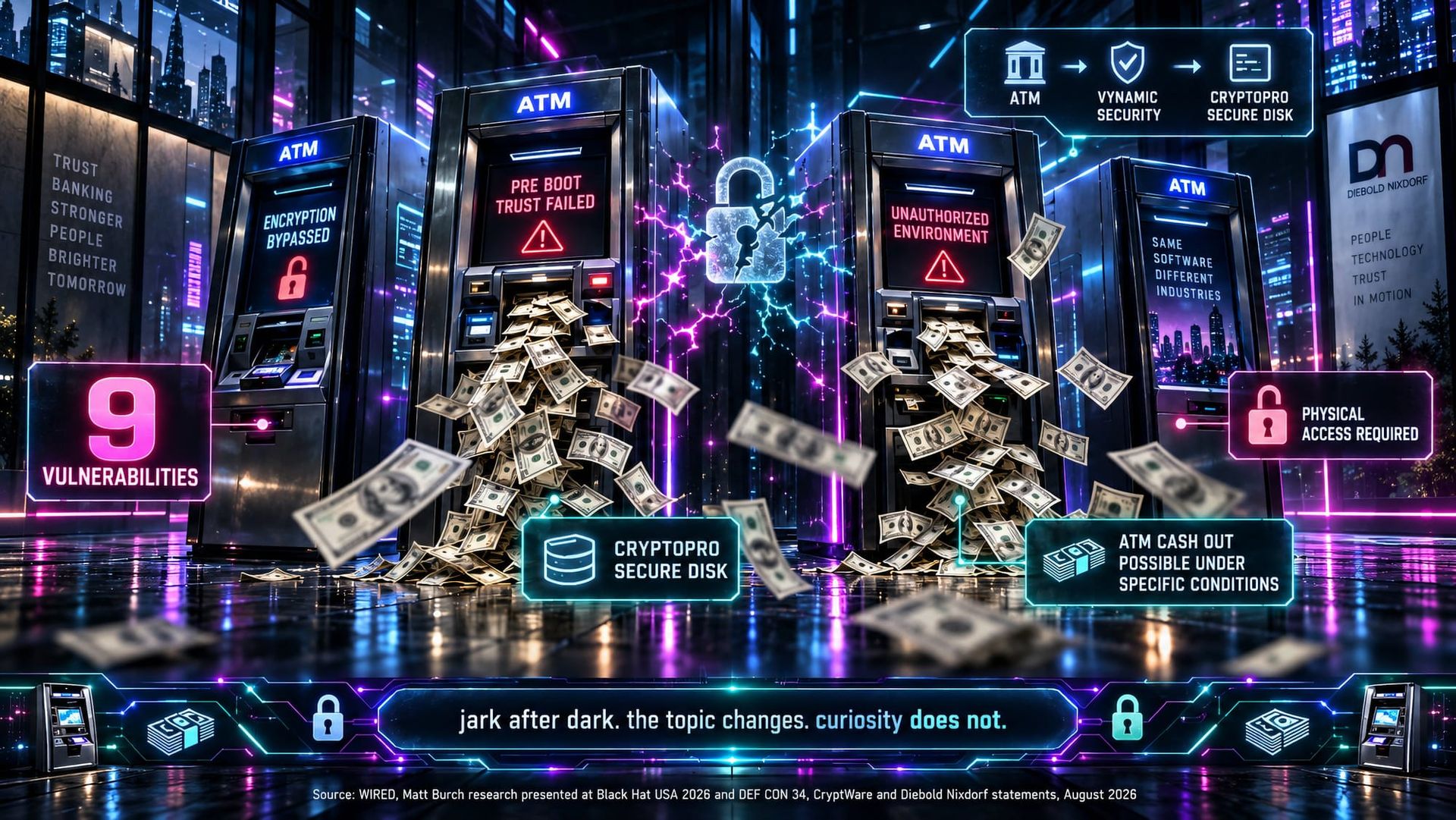
researcher matt burch found nine ways to defeat the encryption protecting some atms after five years digging into atm security. the flaws are already fixed. and the fix is not the story. the story is that once software like this disappears inside someone else's product, the people downstream may have almost no visibility into what was ever broken or whether the fix reached them.
at black hat and defcon this year, he laid out nine vulnerabilities in a product called cryptopro secure disk. it is full-disk encryption and pre-boot authentication, the layer that is supposed to protect an atm's data even if someone rips the drive out or tampers with the machine. burch found ways to make that protection fail.
the specifics are ugly. in certain failure states, the software would mount the disk in plaintext, the encryption simply off. it stored key material and configuration data on the same disk it was meant to protect. and its secure boot setup could be abused to run an attacker's own linux environment on the machine before windows even loaded. chain it together and you can bypass the encryption wholesale, execute your own code, pull the keys, and in the right conditions, make the atm spit out cash. that last trick is what is referred to as jackpotting.
there are some important nuances to this though. this is not a remote attack. you need physical access to the machine. and cryptware, to its credit, fixed all nine flaws quickly, across versions 7.7.2 in november and 7.7.3 in december. burch confirmed the fixes actually work. so the immediate danger is low. do not picture atms across the country waiting to be emptied at will, spitting cash all over the ground.
in addition, burch describes cryptopro as foundational to the hard-disk encryption component inside diebold nixdorf's vynamic security suite. diebold says only two of the nine flaws ever applied to its systems, and those were patched in december. so how much this touched real atms in the field is genuinely contested. burch and diebold disagree on this point.
if the bugs are fixed and the impact is disputed, why does this matter? because of the part burch named his whole talk after. the cost of security through obscurity.
cryptopro does not publicly publish its patch notes. and this is not niche software sitting in one atm product. cryptware says hundreds of customers use it across banking, government, healthcare, automotive, manufacturing, finance, research, and other embedded systems. it does not clearly announce when it fixes a security flaw.
so a company that builds cryptopro into its own product, and there are many, across many industries, may never learn that a component buried deep in its stack was vulnerable and quietly patched. the people further downstream cannot apply a fix they never knew they needed. they cannot assess a risk they do not know exists. the flaw gets fixed at the source and stays open everywhere downstream, silently, because nobody had half a clue there was ever a security issue.
that is the real weakness. modern systems are built from components inside components inside components, most of them made by someone else, many of them invisible to the people shipping the final product. you are not just trusting your vendor. you are trusting every vendor your vendor trusted, all the way down, and you usually cannot even see the bottom of that stack.
this is the software supply chain problem in its purest form, and here is what makes it uniquely nasty. every other kind of risk, someone owns it. this one has no owner. the vendor fixed its bug and moved on. the manufacturer that embedded it may not know it existed. the bank running the machine cannot see three layers down to the component that failed. so the responsibility dissolves at every hop, and the risk just sits there, unowned, because no single party can see the whole chain they are all standing in.
burch pointed out that in the age of ai, an attacker no longer needs to deeply understand a piece of obscure software to break it. the tools can do the understanding. so the old defense, being too niche and too buried for anyone to bother, is expiring.
obscurity was never security. it was just a bet that nobody would look. that bet gets worse every year, particularly as ai continues to evolve at such a rapid pace.
yes, the atm was the way in. the lesson is you cannot secure what you cannot see, and most organizations have no idea what is actually running inside the products they depend on.