

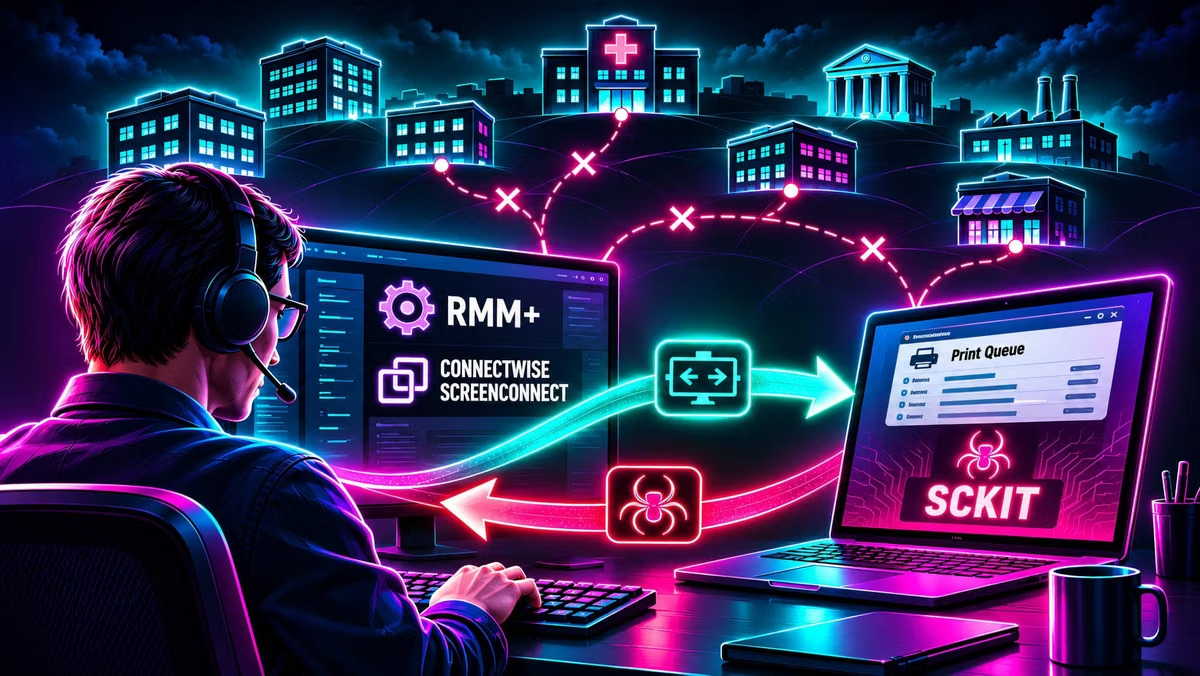
A technician opens a remote session to clear a stuck print queue. The cursor moves, the job disappears, and the client goes back to work. Nothing on screen shows the laptop has been waiting for the technician. SCKit, a toolkit Huntress found across at least 288 endpoints this week, is built to steal the arriving ConnectWise ScreenConnect session and turn one repair visit into a route toward every other client the technician can reach.
Remote monitoring and management (RMM) software has been a staple of the eCrime ecosystem for years, and rogue ScreenConnect clients are routine. In 2021, PINCHY SPIDER's REvil ransomware moved through Kaseya VSA to as many as 1,500 businesses sitting behind their managed service providers (MSPs). In 2024, the ScreenConnect authentication bypass CVE-2024-1709 became a mass exploitation event within days of disclosure.
The access path is old. What changed over the past two months is where adversaries enter, whom they target once inside, and how quickly a new exploit chain outruns the last fix.
Three Doors Into ConnectWise
The ConnectWise ecosystem absorbed three campaigns through three different doors in about two months. In September, worm-like activity ended with the company patching CVE-2026-84869, a critical client-side file transfer flaw CISA warned was under exploitation. In October, Microsoft attributed a campaign against ConnectWise Cloud Backup customers to Storm-0940, a China-aligned threat actor.
Storm-0940 took control of the identities of multiple ConnectWise cloud applications. Its ARTEX AI agents then attempted sign-ins to more than 2,250 customer tenants, exploiting the trust those applications already held. In some environments, the agents moved on to Microsoft Graph and directory operations. They changed application credentials for persistence and altered identities, groups, and privileged roles. A separate, earlier password-spray campaign peaked on October 11 at 2,900 failed logons per minute against 327 accounts at eight organizations.
A privileged multi-tenant application compresses reconnaissance, access, and target selection into a single compromise. Storm-0940 reached tenants through identities those organizations had already approved, then pursued persistence inside some of them. The same concentration eCrime threat actors exploit for scale hands an intelligence service a ready-made portfolio of collection targets.
The November intrusion came through neither a ScreenConnect vulnerability nor a ConnectWise-operated service. It came through RMM+, an independent extension letting outside tools automate remote sessions through an API. According to Huntress, RMM+ bypasses ScreenConnect's user accounts, roles, and multifactor authentication. It authenticates requests with one shared access key. Versions 1.0.31 and 1.0.32 accepted a blank key whenever an administrator never set one. On November 12, the weakness received its own identifier, CVE-2026-127063, covering a static default API secret able to send commands to managed agents whenever administrators leave it unchanged. The record states the ScreenConnect server and client are not affected. The extension worked as a parallel administrative plane carrying the product's authority without its security controls. Commands reached endpoints across several ScreenConnect instances within minutes, with no matching log-in activity.
The November reporting describes two different stages of the same intrusion. Huntress ties the initial panel access to RMM+. Blackpoint Cyber ties CVE-2026-84869 to SCKit's attempted movement from an infected endpoint toward a technician, and its testing found the ScreenConnect 26.6.5 client fix blocks the technique. Blackpoint also found no unauthenticated, internet-facing execution path against ScreenConnect servers. ConnectWise has not confirmed an initial access method. Its initial assessment points to abuse of independent third-party extensions, and it disabled five such extensions across approximately 400 partner environments as a precaution.
Technician as the Target
Once inside, the threat actor used the panel's own Run command to install an attacker-controlled ScreenConnect client and SCKit. The Run command executes as SYSTEM. The observed deployment reached 288 hosts across 48 organizations Huntress protects in about 90 minutes, with a third of them affected during the first 10 minutes. Huntress assesses part of the toolkit's code as generated by a large language model.
SCKit turns the technician session into a return path. It waits on an infected endpoint for a technician to connect, steals the technician's .aspxauth session cookie, and replays it against the ScreenConnect panel. With the panel session in hand, it enumerates every reachable session and uploads a payload to the Shared Toolbox. It broadcasts the payload, then deletes the item about 60 seconds later.
Trust in an MSP flows from the technician to the endpoint, and SCKit is built to reverse the current. Huntress has not observed the reversal succeed. Every console takeover attempt in the host logs checked so far failed, and the cookie replay rests on code analysis alone. A working version would need one technician session on one infected machine to reach an entire client base.
SCKit also turns a responder's first instinct into a potential trigger. A technician connecting through ScreenConnect to investigate an infected endpoint can activate the path aimed back at the technician workstation. Huntress tells MSPs not to connect to affected machines through ScreenConnect and to investigate out of band through EDR live response, WinRM, or another command-line tool. Containment depends on response tooling outside the platform under investigation, and an MSP learning this during the intrusion has learned it too late.
N-central After Hotfix 2
N-able N-central shows how quickly the exposure moves. Researcher Sean Bales published a set of flaws he calls Able2Shell on November 9, outside N-able's reporting channels, and N-able released Hotfix 2 on November 10 to close the ones exploitable without authentication. Bales then published 4EverAble2Shell, a separate unauthenticated exploit chain he says gives root on the server and works against Hotfix 2. A companion set Bales calls Agent2Shell reaches SYSTEM on the Windows machines N-central manages, according to the researcher, provided the threat actor knows the appliance ID.
Probing began within hours of the proof-of-concept release. By November 13, Huntback reported 21 N-central servers mining Monero, 19 of them running Hotfix 2. 4EverAble2Shell sits outside the scope of Hotfix 2, so those 19 servers were exposed to a chain the fix never addressed. The observed attack chain pairs CVE-2026-90436, an Apache Axis flaw, with 4EverAble2Shell for root. It then pulls a script named jup.sh with curl.
The chain requires the Legacy API, off by default and not recommended by N-able, to be enabled and reachable from the internet. On November 12, N-able said hosted environments are not vulnerable to the chain. It told on-premises customers to confirm the interface stays disabled and to upgrade agents and probes.
The observed payload is an XMRig miner capped at half the processor cores, which supports an opportunistic eCrime assessment for the activity researchers can see. It does not establish who else used the same access. Mining is noisy and shows up in routine processor monitoring, while a threat actor holding root on an MSP management server for later movement leaves far less public evidence. Root on that server is worth far more than the processor time the miner consumes.
Management Plane Under Pressure
Nothing ties Storm-0940, SCKit, and the N-central exploitation to one another. Storm-0940 is a China-aligned espionage threat actor, the SCKit threat actor has no attribution beyond an attacker participant name of "Addmin," and the N-central miner looks like routine eCrime. A nation state adversary, an unidentified threat actor deploying worm-like tooling, and an opportunist with a cryptominer all reached for MSP tooling within two months, and each found a different way in.
eCrime is already cashing in on MSP access, mostly through the older door. In February, threat actors began exploiting BeyondTrust Bomgar remote support servers. Huntress ties the activity to CVE-2026-1731, an unauthenticated remote code execution flaw patched days earlier, without confirming the root cause. By April, several of those intrusions ended in LockBit ransomware, which Huntress suspects was built from the builder leaked in 2022. The damage traveled through trust. One MSP's high-privilege Bomgar account reached a client domain controller with Domain Admin rights, and 78 businesses had to be isolated. In another, ransomware at a dental software company spread to three of its downstream clients.
The newer doors keep opening without a clear motive behind them. On November 7, MSP Process disclosed a threat actor had accessed storage holding its application secrets and administrator refresh tokens. The vendor's apps administer client Microsoft 365 tenants on behalf of MSPs. Field Effect cites sign-in attempts across 47 client environments. In one, the threat actor added credentials to dozens of applications and re-enabled accounts responders had disabled. Nobody has attributed the intrusion. eCrime threat actors still reach MSP clients through flaws in the core product, while the integration and identity layer is so far being worked by espionage adversaries and unidentified threat actors.
Authority survives longer than the business reason for granting it. Huntress found most RMM+ installations were legitimate, usually added for a project and left in place. The pattern reaches beyond MSPs. In the reported US$133 million theft from Crédit Mutuel Arkéa, the bank's own account points to a service provider platform already authorized to initiate its transfers. The management plane accumulates permissions faster than most organizations remove them, and adversaries are harvesting the residue.
MSPs spent the years after Kaseya hardening RMM consoles, enforcing multifactor authentication, and patching core products. The 2026 campaigns reached past those controls through a backup application's identities, an extension whose access key could stay blank, a legacy API, and a new exploit chain Hotfix 2 was never designed to stop. Every integration and every technician session inherits the reach of the platform behind it.
MSPs need to treat extensions, service principals, APIs, and technician workstations as parts of the management plane. The work starts with inventorying inherited permissions, removing dormant integrations, revoking exposed sessions, and verifying updates on technician clients as well as servers. The next mass compromise of an MSP starts where inherited authority has outlived its owner, its project, or its scrutiny. The threat actor will be using permissions the MSP forgot it had granted. I assess with moderate confidence MSP targeting is broadening beyond RMM products into the identities, integrations, and sessions surrounding them.
Analyst Annex
Evidence status as of November 13, 2026. The records cover the November 11 SCKit intrusion into ConnectWise ScreenConnect partner environments and the November 12 exploitation of internet-facing N-able N-central servers, kept separate throughout. Storm-0940, the BeyondTrust Bomgar intrusions, and the MSP Process breach appear for context only, with their procedures and indicators held under Related Activity. No public evidence connects the threat actors behind any of them.
Intelligence Gaps
| Gap | Why It Matters | What Would Close It |
|---|---|---|
| Extent of CVE-2026-127063 use during the SCKit intrusion | Huntress links reviewed commands to RMM+, while ConnectWise has not established whether every affected partner environment was entered through the extension | ConnectWise root cause analysis, extension logs, or authentication records from affected panels |
| Number of compromised ScreenConnect partner environments | The approximately 400 environments identified by ConnectWise had an affected extension installed and are not 400 confirmed compromises | Validated incident counts from ConnectWise and affected partners |
| Identity and objective of the SCKit threat actor | Separates access brokering, extortion preparation, opportunistic intrusion, and state-directed collection | Infrastructure history, payment evidence, tooling reuse, victimology, or follow-on activity |
| Operational success of the technician-session pivot | A successful pivot would convert one infected endpoint into access across a technician's authorized customer sessions | Technician-workstation telemetry showing execution of the transferred dropper, theft of an .aspxauth cookie, and successful panel replay |
| Complete affected-version range and fixed build for 4EverAble2Shell | Hotfix 2 does not address the chain, and public reporting does not establish every vulnerable N-central build | N-able advisory identifying affected versions, the underlying privilege-escalation flaw, and a remediated build |
| Population of N-central servers with the Legacy API exposed | The non-default interface is a required condition for the observed 4EverAble2Shell chain and determines the reachable attack surface | Internet measurement, N-able telemetry, or verified customer configuration data |
| Activity beyond cryptomining on compromised N-central servers | The observed threat actor installed XMRig, while root on an RMM server also enables credential theft and movement toward managed customers | Forensic review of the 21 identified servers and their downstream management activity |
| Exploitation of Agent2Shell | Successful use would turn knowledge of an appliance ID into SYSTEM-level execution on managed Windows devices | N-able confirmation or endpoint telemetry showing commands delivered through affected agent interfaces |
| Initial access and threat actor identity in the MSP Process breach | The downstream activity proves abuse of exposed application authority but does not identify how the vendor infrastructure was entered or who operated it | MSP Process root cause analysis, infrastructure overlap, or law-enforcement attribution |
| Root cause and threat actor overlap across the BeyondTrust Bomgar intrusions | Huntress suspects CVE-2026-1731 in several cases but does not establish one access path or one threat actor across every incident | Appliance logs, exploit artifacts, and infrastructure or ransomware-affiliate overlap across affected organizations |
Entities
| Entity | Type | Role | Status | Source |
|---|---|---|---|---|
| SCKit | Malware toolkit | Installs an attacker-controlled ScreenConnect client, establishes persistence, and contains an unobserved technician-session propagation chain | Confirmed | Huntress |
| RelayTrap, Panel-Lateral, and ToolboxRelayUploader | SCKit components | Replace the legitimate ScreenConnect client connection, attempt session-cookie theft and replay, and prepare a Shared Toolbox broadcast | Confirmed | Huntress |
| RMM+ | Third-party ScreenConnect extension | Provides an API capable of sending commands to managed agents outside ScreenConnect user accounts, roles, and multifactor authentication, with Huntress tying the observed panel activity to versions 1.0.31 and 1.0.32 | Confirmed | ConnectWise, Huntress |
| CVE-2026-127063 | Vulnerability | Static default API secret in the RMM+ extension, listed under vendor DataComm in the CVE record, allowing commands to managed agents through its API when left unchanged | Confirmed | CVE Program, ConnectWise |
| ConnectWise ScreenConnect | Remote support platform | Management platform through which the threat actor deployed SCKit to 288 endpoints across 48 Huntress-protected organizations | Confirmed | Huntress |
| CVE-2026-84869 | Vulnerability | ScreenConnect client-side file transfer and execution flaw, associated with SCKit's attempted endpoint-to-technician execution and blocked by client version 26.6.5 and later | Reported | ConnectWise, Blackpoint Cyber, Huntress |
| N-able N-central | RMM platform | Internet-facing management servers exploited through 4EverAble2Shell, including 19 confirmed on build 2026.4.1.26 Hotfix 2 | Reported | Huntback, N-able |
| 4EverAble2Shell | Exploit chain | Combines Apache Axis command execution with an N-central local privilege-escalation weakness to obtain root | Reported | Previdian, Huntback |
| CVE-2026-90436 | Vulnerability | Apache Axis unsafe class-instantiation flaw used for initial command execution as the nable service account |
Reported | Previdian, Huntback |
| VULN-2026-0009 | Provisional vulnerability record | Previdian tracking identifier for the unassigned N-central root-execution portion of 4EverAble2Shell | Reported | Previdian |
| Agent2Shell | Exploit chain | Researcher-described chain using multiple flaws to execute commands as SYSTEM on managed Windows agents when the appliance ID is known | Claimed | BleepingComputer |
| XMRig 6.26.0 | Cryptominer | Fallback Monero miner package installed through jup.sh on 21 identified N-central servers |
Reported | Huntback |
| Storm-0940 | China-aligned threat actor | Used ARTEX and compromised ConnectWise cloud application identities against downstream Microsoft 365 tenants in separate October activity | Reported | Microsoft |
| ARTEX | Agentic penetration-testing framework | Automated reconnaissance, password spraying, authentication attempts, and OAuth application abuse for Storm-0940 | Reported | Microsoft |
| ConnectWise Cloud Backup application identities | Cloud service principals | Compromised application credentials used to attempt authentication across more than 2,250 downstream tenants | Reported | Microsoft |
| BeyondTrust Remote Support, formerly Bomgar | Remote support platform | Compromised management infrastructure used to reach downstream customers, establish persistence, and deploy ransomware in separate February through April incidents | Reported | Huntress |
| CVE-2026-1731 | Vulnerability | Unauthenticated remote code execution flaw suspected as the entry path in several Bomgar incidents, without confirmed root cause across the full cluster | Provisional | Huntress |
| LockBit 3.0 | Ransomware | Payload deployed in several Bomgar intrusions, possibly built with the builder leaked in 2022 | Reported | Huntress |
| MSP Process | Identity and tenant-administration platform | Vendor infrastructure exposed application secrets, administrator refresh tokens, and GDAP relationship data used by Microsoft administrative integrations | Reported | Field Effect |
MITRE ATT&CK Mapping
| Tactic | Technique | Procedure | Status | Source |
|---|---|---|---|---|
| Initial Access | T1190, Exploit Public-Facing Application | The threat actor reportedly used the RMM+ API weakness to issue commands through exposed ScreenConnect partner environments | Reported | Huntress, ConnectWise |
| Execution | T1072, Software Deployment Tools | The threat actor used ScreenConnect Run commands to execute as SYSTEM and deploy an unauthorized client and SCKit across managed endpoints | Confirmed | Huntress |
| Execution | T1059.001, Command and Scripting Interpreter: PowerShell | SCKit used PowerShell scripts for downloading, decoding, installation, persistence, session handling, and cleanup | Confirmed | Huntress |
| Command and Control | T1105, Ingress Tool Transfer | SCKit retrieved a rogue ScreenConnect installer, decoder scripts, a host-specific encrypted toolkit, and SQLite tooling from attacker infrastructure | Confirmed | Huntress |
| Stealth | T1027.013, Obfuscated Files or Information: Encrypted/Encoded File | The threat actor delivered an encrypted SCKit package built for the target workstation and used a Base64-encoded dropper | Confirmed | Huntress |
| Stealth | T1140, Deobfuscate/Decode Files or Information | SCKit downloaded per-host decryption material and decoded its toolkit on the affected machine | Confirmed | Huntress |
| Persistence | T1543.003, Create or Modify System Process: Windows Service | SCKit installed an attacker-controlled ScreenConnect client as a second remote-access service | Confirmed | Huntress |
| Persistence | T1053.005, Scheduled Task/Job: Scheduled Task | TrapWatch.ps1 created the TrapWatch scheduled task to maintain the relay trap |
Confirmed | Huntress |
| Persistence | T1547.001, Boot or Logon Autostart Execution: Registry Run Keys / Startup Folder | SCKit created the RelayTrapLiteAlert value under the Windows Run key |
Confirmed | Huntress |
| Defense Impairment | T1685, Disable or Modify Tools | SCKit added Microsoft Defender exclusions, applied SRP or AppLocker rules, stopped the legitimate ScreenConnect client, and set its service to manual start | Confirmed | Huntress |
| Command and Control | T1219.002, Remote Access Tools: Remote Desktop Software | An attacker-controlled ScreenConnect client provided persistent remote access to affected endpoints | Confirmed | Huntress |
| Credential Access | T1539, Steal Web Session Cookie | Panel-Lateral.ps1 is designed to read the technician's browser cookie database and steal the ScreenConnect .aspxauth cookie, but Huntress has not observed a successful theft |
Provisional | Huntress |
| Lateral Movement | T1550.004, Use Alternate Authentication Material: Web Session Cookie | SCKit is designed to replay a stolen technician cookie against the ScreenConnect panel before broadcasting through the Shared Toolbox, but the console takeover failed in reviewed logs | Provisional | Huntress |
| Initial Access | T1190, Exploit Public-Facing Application | The N-central threat actor sent crafted SOAP requests exploiting CVE-2026-90436 through /dms/services/ServerUI |
Reported | Previdian, Huntback |
| Privilege Escalation | T1068, Exploitation for Privilege Escalation | A Python escalation script invoked nable_wrapper.pl setLDFileOwner against a symbolic link to ServerChild.sh, then executed the rewritten script as root |
Reported | Huntback |
| Execution | T1059.004, Command and Scripting Interpreter: Unix Shell | The root command piped jup.sh into a shell to install and launch the miner |
Reported | Huntback |
| Command and Control | T1105, Ingress Tool Transfer | The root command retrieved jup.sh, XMRig, and fallback miner archives from 157.20.241[.]16 |
Reported | Huntback |
| Persistence | T1543.002, Create or Modify System Process: Systemd Service | jup.sh can create xvd.service to relaunch the miner |
Reported | Huntback |
| Persistence | T1053.003, Scheduled Task/Job: Cron | The miner installer falls back to an xvkeep user crontab entry or /etc/cron.d/xvd when systemd persistence is unavailable |
Reported | Huntback |
| Stealth | T1070.004, Indicator Removal: File Deletion | The privilege-escalation script restored ServerChild.sh, removed the symbolic link and backup, and attempted to erase the escalation traces |
Reported | Huntback |
| Impact | T1496.001, Resource Hijacking: Compute Hijacking | XMRig mined Monero on 21 identified N-central servers while limiting use to half the available processor cores | Reported | Huntback |
Indicators
The table is a capped operational subset. SCKit infrastructure and artifacts come from Huntress. N-central exploitation and mining indicators come from Huntback. File hashes for SCKit are deliberately limited because Huntress says scripts are rebuilt with embedded values and RelayTrap is compiled separately on every host.
| Indicator | Type | Context | Status | Source |
|---|---|---|---|---|
185.99.255[.]28 |
IP address | SCKit ScreenConnect server and client-installer host | Reported | Huntress |
sc.payproofkit[.]com155.94.150[.]39 |
Domain and IP address | Attacker-controlled ScreenConnect panel present in SCKit skip lists | Reported | Huntress |
newnewnew.gotdns[.]orgsoxnewwork.homedns[.]org |
Domains | SCKit relay infrastructure resolving to 185.99.255[.]28 |
Reported | Huntress |
cdn007-digitaldownloads[.]com |
Domain | SCKit command-and-control infrastructure | Reported | Huntress |
hxxps://ns.mo7sen[.]dev/EadF.php |
URL | SCKit staging endpoint, including parameters delivering the decoder and SQLite tooling | Reported | Huntress |
2588ef5c15954b10ed630cc2c873b091 |
ScreenConnect client IDs | Rogue clients associated with the SCKit operation | Reported | Huntress |
Addmin |
ScreenConnect participant name | Attacker participant name present in installer patterns | Reported | Huntress |
C:\ProgramData\RelayTrap\TrapWatchRelayTrapLiteAlert |
Directory, scheduled task, and Run-key value | SCKit installation and persistence artifacts | Reported | Huntress |
7a9aca9fdd4dcc13fe497cabdb13ca1e5d6a529271c8aa495e5ca1c1c80271ec |
SHA256 | Panel-Lateral.ps1, session-cookie theft and panel-replay component |
Reported | Huntress |
8cb5f48bbe70b5248db7f327f3d1ad6649df5c767d2a7e0711ee147fd92e06af |
SHA256 | ToolboxRelayUploader.exe, Shared Toolbox broadcast component |
Reported | Huntress |
157.20.241[.]16 |
IP address | 4EverAble2Shell exploitation source, callback listener, and payload host | Reported | Huntback |
hxxp://157.20.241[.]16:8080/jup.sh |
URL | N-central XMRig installation script fetched by the root command | Reported | Huntback |
139.99.69[.]109:1012879.76.51[.]56:39100 |
IP addresses and ports | Primary and fallback Monero mining-pool endpoints | Reported | Huntback |
fc4c01fd11bc301cf312830460cfdccc3af9dcfe50c910b86d6a1117bc76c747 |
SHA256 | N-central nable-to-root Python escalation script |
Reported | Huntback |
POST /dms/services/ServerUIjline.internal.TerminalLineSettings |
HTTP path and request content | 4EverAble2Shell SOAP-fault request fingerprint | Reported | Huntback |
/tmp/.xvd//var/tmp/.xvd/xvd.service# xvkeep/etc/cron.d/xvd |
Linux host artifacts | XMRig staging and persistence artifacts on exploited N-central servers | Reported | Huntback |
The complete SCKit indicator set, including per-file hashes, is in the Huntress analysis. Huntback publishes the complete 4EverAble2Shell and mining indicator set.
Related Activity
The activity below belongs to Storm-0940's October 2026 campaign involving ConnectWise Cloud Backup application identities. Microsoft lists 144.172.64[.]60, 144.172.64[.]99, and 144.172.64[.]128 as Storm-0940 infrastructure. None of these procedures or indicators was observed in the SCKit or N-central incidents.
| Tactic | Technique | Procedure | Status | Source |
|---|---|---|---|---|
| Credential Access | T1110.003, Brute Force: Password Spraying | Automated cross-tenant spray from October 10 to 14 against 327 accounts at eight organizations, peaking at 2,900 failed logons per minute on October 11 | Reported | Microsoft |
| Initial Access | T1078.004, Valid Accounts: Cloud Accounts | Stolen ConnectWise cloud application credentials were used to attempt sign-ins across more than 2,250 downstream tenants | Reported | Microsoft |
| Persistence | T1098.001, Account Manipulation: Additional Cloud Credentials | Storm-0940 added credentials to existing OAuth applications through Microsoft Graph | Reported | Microsoft |
The activity below comes from the BeyondTrust Bomgar intrusions Huntress tracked between February and April 2026. Huntress found multiple operational patterns and suspected CVE-2026-1731 in several cases, but did not establish one root cause or one threat actor across the entire cluster. None of these procedures was observed in the SCKit or N-central incidents.
| Tactic | Technique | Procedure | Status | Source |
|---|---|---|---|---|
| Initial Access | T1190, Exploit Public-Facing Application | Huntress suspects exploitation of CVE-2026-1731 against outdated Bomgar appliances but could not confirm the root cause across every incident | Provisional | Huntress |
| Initial Access | T1199, Trusted Relationship | A high-privilege MSP Bomgar account provided access to downstream customer environments, including a client domain controller | Reported | Huntress |
| Persistence | T1136.001, Create Account: Local Account | Threat actors created local accounts and added them to local Administrators groups, with some later elevated into Domain Admins | Reported | Huntress |
| Command and Control | T1219.002, Remote Access Tools: Remote Desktop Software | Threat actors installed AnyDesk, Atera, ScreenConnect, and a renamed SimpleHelp client as additional access channels | Reported | Huntress |
| Impact | T1486, Data Encrypted for Impact | Threat actors deployed LockBit ransomware in several Bomgar intrusions, including one launched from a rogue Bomgar instance | Reported | Huntress |
The activity below comes from the MSP Process breach disclosed on November 7, 2026. Field Effect based part of its account on public reporting about affected customer environments. No public source attributes the threat actor, and none of these procedures was observed in the SCKit or N-central incidents.
| Tactic | Technique | Procedure | Status | Source |
|---|---|---|---|---|
| Collection | T1530, Data from Cloud Storage | The threat actor accessed storage holding application client secrets, administrator refresh tokens, and GDAP relationship information | Reported | Field Effect |
| Persistence | T1098.001, Account Manipulation: Additional Cloud Credentials | In one investigated tenant, the threat actor reportedly added credentials to dozens of applications | Reported | Field Effect |
| Persistence, Privilege Escalation | T1098.003, Account Manipulation: Additional Cloud Roles | Additional permissions were reportedly granted to the MSP Process application in the same investigated environment | Provisional | Field Effect |
| Persistence | T1136.003, Create Account: Cloud Account | The threat actor reportedly created service accounts in one affected customer environment | Reported | Field Effect |