
Dyson Put a Beautiful Camera in Your Mouth and a Trap in Your Bathroom
ai this. ai that. for crying out loud. everyone is putting ai in everything right now, whether it belongs there or not. the fridge, the microwave, the water bottle, and now, apparently, the toothbrush. most of it is a sticker on a spec sheet, a way to justify a higher price for a thing that worked fine before anyone taught it to think.
and now dyson. they just announced a $499 ai toothbrush, and my first reaction was likely the same one you just had. wtf? absurd. a solution in search of a problem, at a price insulting the problem.
then i read the details, and annoyingly, it is not completely absurd. it is actually clever. sort of.
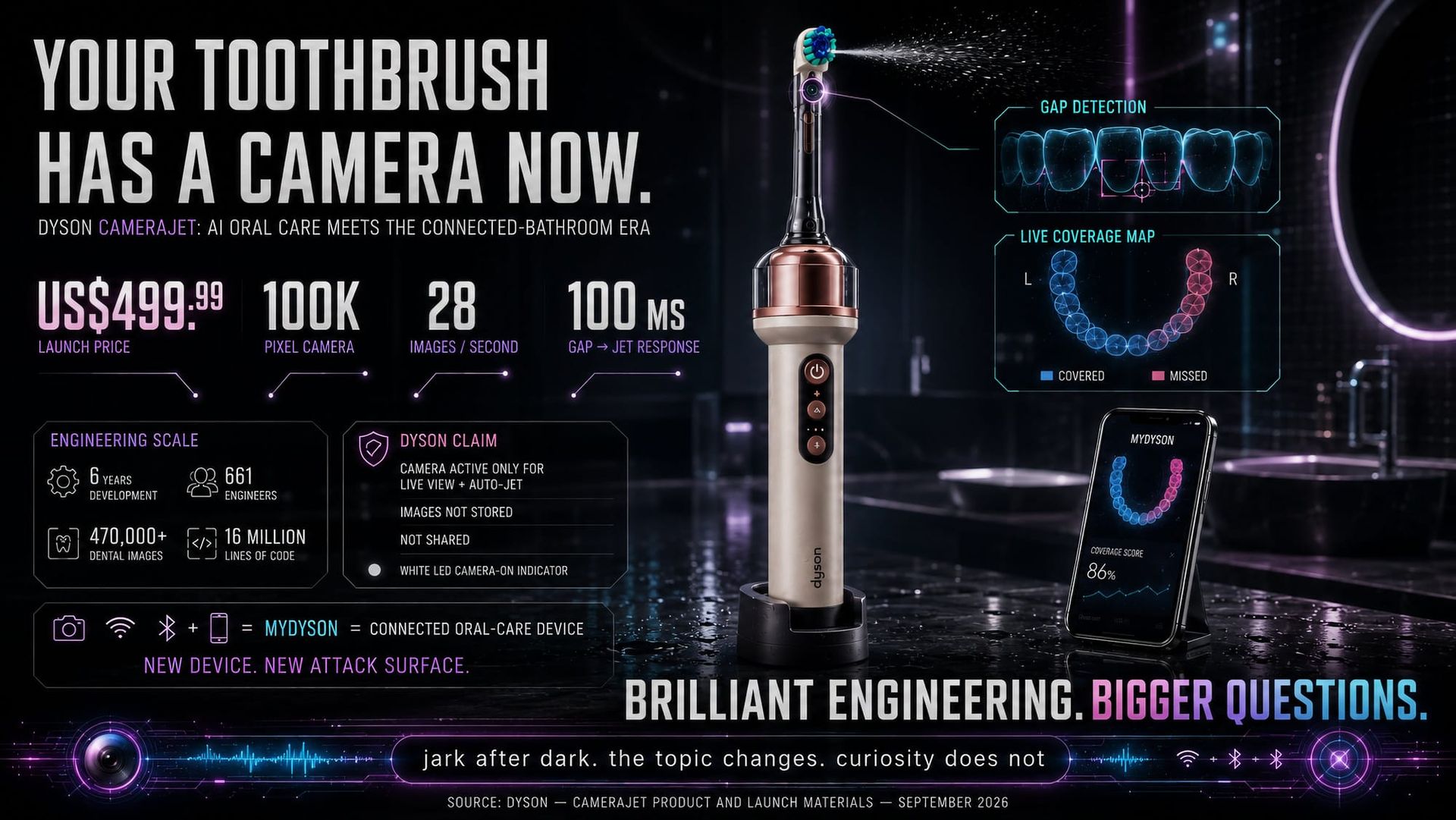
the dyson camerajet puts a 100,000-pixel camera in the brush head, runs ai over 28 images every second to find the gaps between your teeth, and fires a jet of mouthrinse at them in about a tenth of a second. it brushes and flosses in one motion. six years of development, 661 engineers, an ai trained on 470,000 images of the inside of people's mouths. allegedly 16 million lines of code.
this is not a gimmick bolted onto a normal toothbrush. the ai appears to be doing real work, in real time, solving a real problem, which is that almost nobody flosses correctly and most of us have no idea where we are missing. dyson also says a six-week clinical study involving 204 participants found the camerajet removed up to 69% more plaque than market-leading premium electric toothbrushes. that is dyson's own testing, not independent validation, but as an engineering achievement, it is hard not to admire.
but here is where the skeptic in me wakes up. there is a camera. in your mouth. in your bathroom. the most private room in your home, now home to a networked lens.
to dyson's credit, they got ahead of this. they say the camera is only active during live viewing or auto-jetting, and the images are never stored or shared. not on the device, not in the cloud. ostensibly.
if true, that is the right answer. but a claim is not a fact, and this is exactly the kind of claim requiring independent verification rather than taken on faith. i am not accusing dyson of lying. i am merely saying "trust us bro, the bathroom camera does not store data" is a sentence deserving an audit, not a nod. someone outside dyson needs to confirm what the camera captures, when, and where it goes.
however, the camera is only half of it. this is a connected device with a companion app, and that means it is an attack surface. this is the question no gadget reviewer is going to ask, so i will. how secure is the brush firmware? how secure is the mydyson app? a camera, paired to an app, tied to your identity, is precisely the kind of consumer device that gets popped when someone finds the inevitable flaw. "the images stay on the device" means very little if the device itself can be compromised. before i put a camera in my mouth, and my bathroom, i want to know who else can reach it.
now follow the data, because the images are not the whole story. the mydyson app does coverage mapping, brushing insights, personalized feedback over time. that is a detailed behavioral record of your oral hygiene, tied to you, accumulating every single day.
dyson says this data is private. maybe it is. but here is the question the product raises. i am not being paranoid, i am looking one step down the road. what happens when a company holds a running record of exactly how well, and how often, you take care of your teeth? that data has obvious and enormous value to dental insurers and providers. i am not saying dyson is selling it. i am saying we have watched this movie with fitness trackers and health apps, and this kind of data can eventually become interesting to the people who price your risk. the trajectory and the creep are the concerns, not today's privacy policy, which can change with a single update.
and then, because it is dyson, there is the business model, and this is the part that made me laugh. the camerajet works best with dyson's own toothpaste and mouthrinse. they conveniently sell these products, formulated specifically to foam less because excessive foam can interfere with the camera. third-party products can be used, but dyson recommends compatible non-foaming or low-foaming formulations for best performance.
so they built something that looks suspiciously like the razor-and-blades model backwards. the whole point of that model is the razor is cheap so they can sell you expensive blades forever. dyson charges $499 for the razor, and still wants to sell you overpriced blades. they engineered an ecosystem strongly favoring their own consumables around a device already costing more than most people's monthly grocery bill. it is almost impressive as a piece of business design, in the same way a very elegant trap is impressive.
so where does all of this land?
this is a genuinely beautiful piece of machinery. the engineering is real, the problem it solves is real, and dyson does not put out junk. well, except for their extremely weird af headphones-with-mask combo.
if you have $499 and a deep hatred of flossing, and james dyson built this because he personally hates flossing, it will probably work. you will probably admire it every morning. you may fall in love with it. i am not going to pretend it is stupid, because it is not.
but it is also a camera in your bathroom with an unaudited privacy claim. an unexamined addition to the attack surface. a slow drip of intimate health data with unanswered questions about where it could eventually go. and a $499 device designed around an ecosystem of recurring consumables.
all of that is true at the same time as the beauty and engineering marvel that is this product. that is the whole point. the era we are in is not one where the tech is bad. it is one where the tech is genuinely good. generally good enough we stop asking the uncomfortable questions, because the thing works and it is beautiful and everyone else already bought one.
dyson is not betting on your teeth. they are betting that a device this well made will make you forget to ask what it can see, where the data goes, and who else is in the room.
admire the machine. just do not let the craftsmanship answer the questions the camera should have to.