

Airbnb Turned Me Into Its Unpaid Closing Housekeeping Shift
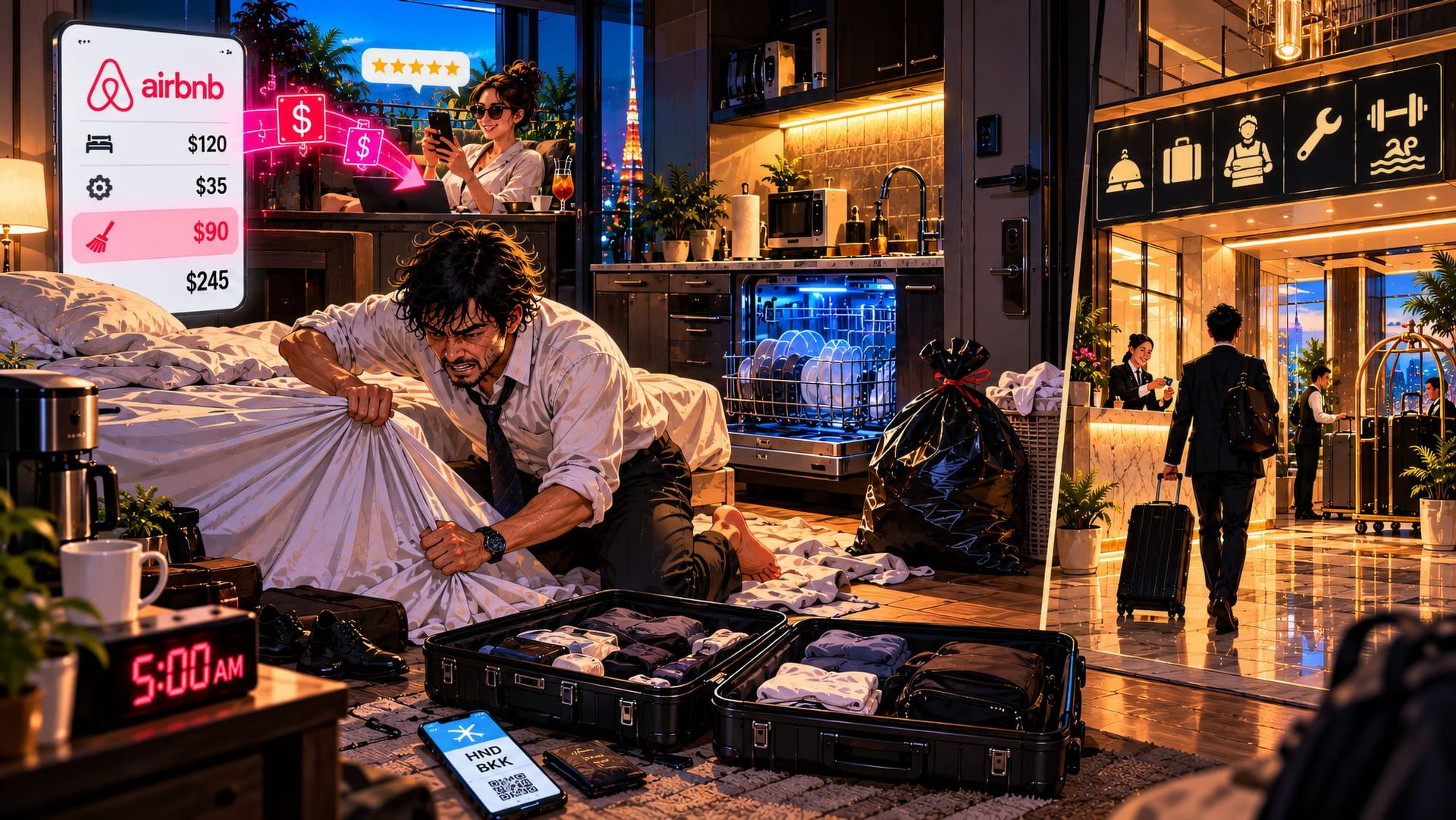
It is 5 a.m. I am barefoot, half awake, and on my fucking knees stripping somebody else's sheets off a bed I paid a premium to sleep in. My suitcase is still open on the floor. The dishwasher is grinding away in the kitchen because some idiotic laminated card on the counter told me to start cleaning the dishes before checkout. There is a tied bag of garbage by the door waiting for me to carry it down the street to somebody else's bin. I have a flight to catch. I have not had my morning cappuccino. And somewhere between wrestling a fitted sheet off the mattress and looking at the clock again, the stupidity of this entire arrangement finally pisses me off.
I paid for this room. I paid a separate cleaning fee for this room. Now here I am stripping the bed, washing the dishes, bagging the trash, and doing part of the turnover before sunrise because the host gets to grade me afterward. What the fuck, exactly, did the cleaning fee buy? The host collects it, yet I supply the labor, and the next guest arrives to a property I helped prepare. Somehow the person paying for the service became part of the staff.
A hotel employs an entire team for this endeavor. Housekeeping cleans and scrubs the room, a supervisor signs off that it is actually ready, and if you carry status with the hotel the staff pays even closer attention. Here there is none of that. There is me, at 5 a.m., the unpaid closing shift, finishing a job I already paid someone else to do. What the actual fuck?
Airbnb has finally decided this shit went too far. For reservations made on or after November 20, hosts can no longer require checkout work that takes real time or belongs to a cleaner. No stripping beds. No washing and putting away dishes. No running laundry. No hauling garbage off the property. Hosts can still expect basic decency, a tidy exit rather than a trashed one. No different than a hotel. That is an important distinction. Airbnb is not giving guests permission to wreck somebody's home. It is telling hosts to stop assigning them a housekeeping job.
Guests cheered. A loud contingent of hosts came unglued, several threatening to pull listings after years on the platform. One host on Airbnb's own community forums complained that guests now get "complete freedom to be lazy while the hosts bear the risk." Read that again. A paying customer resting instead of cleaning is the grievance. What are these hosts smoking?
The chores themselves are minor. The reaction to losing them is not. If your lodging business stops making economic sense the moment the paying customer no longer strips the bed, washes the dishes, and carries the garbage away, the customer was not merely staying in the business. The customer was helping operate it.
I am not arguing this from a deck chair. I travel three weeks out of most months, nearly all of it overseas across Asia and the Middle East. I live in hotels when I do, mostly Marriott Bonvoy properties with periodic stretches in IHG and Hilton. I know what hospitality is supposed to feel like, and the Airbnb model keeps failing the comparison on the trips I actually take.
Hospitality Without the Hospitality
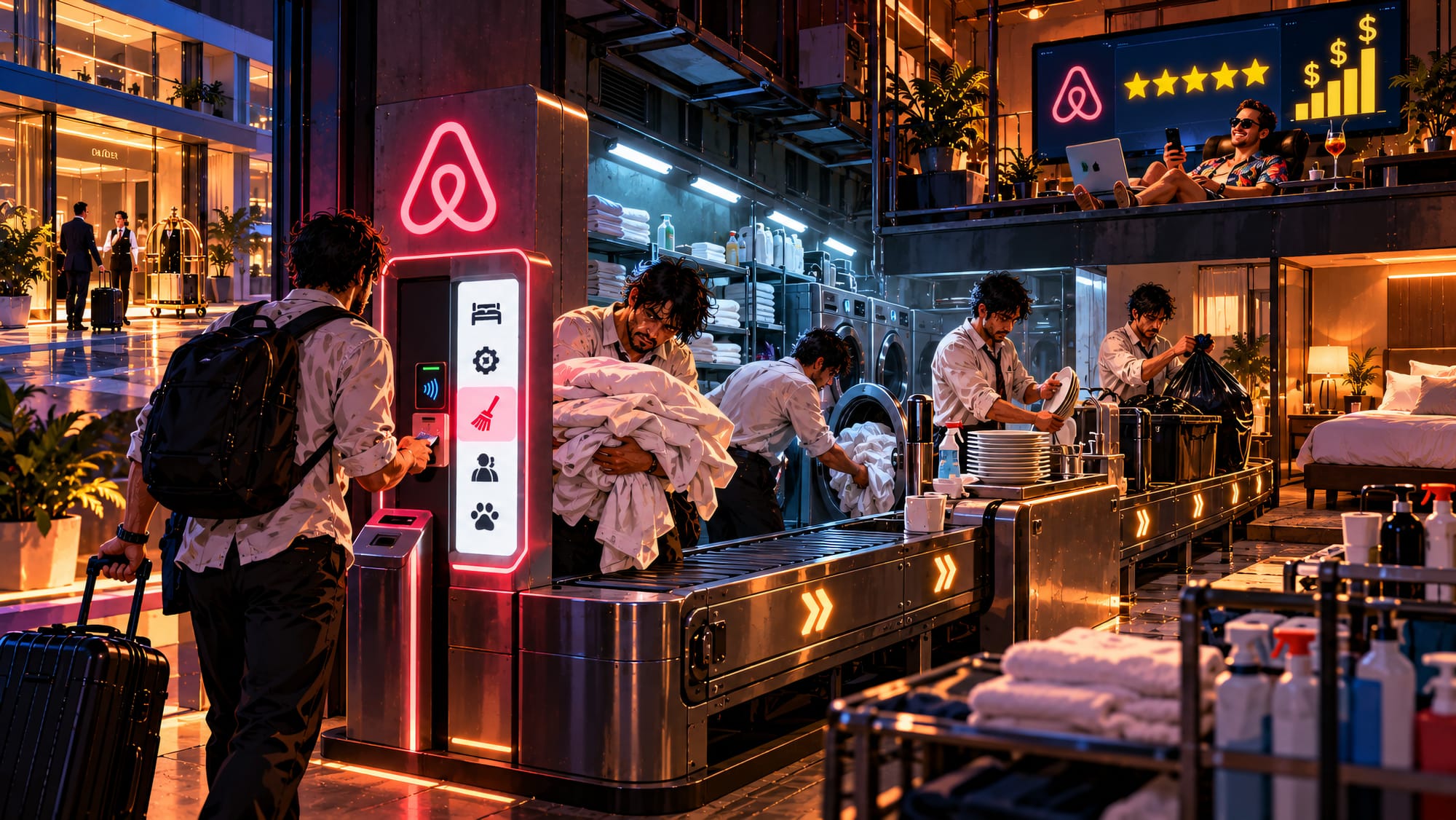
The chore fight is really a money fight. A typical Airbnb stay can hit you three different ways. There is the nightly rate. There is the cleaning fee. Then there is your own time at checkout doing part of the work the cleaning fee supposedly exists to cover. You pay for the room, you pay for the turnover, and then somebody hands you a laminated card explaining your shift.
The cleaning fee makes the least sense on the shortest stays. It is usually a one-time charge, so two nights can carry the same cleaning fee as two weeks. Spread it across fourteen nights and the damage gets diluted. Spread it across two and the effective nightly rate gets kicked in the teeth. Those are also the trips where I am least interested in pretending somebody else's apartment is my home. I need a bed, a shower, a desk, and a clean exit when it is time for me to leave for the airport.
Defenders say basic cleanup protects the property. Of course it does. Protecting the property is part of running a lodging business. I am not arguing for leaving pizza welded to the carpet and garbage pouring out of the bathtub. I am arguing that once I have paid a cleaning fee, stripping beds and starting laundry is no longer "being respectful." It is doing part of somebody else's turnover for free. Why the fuck am I expected to perform work for a room I am paying for, arguably at a higher rate than a hotel?
Somewhere in the rush to monetize spare bedrooms and investment apartments, a lot of hosts decided they could collect hospitality prices without actually performing hospitality. The entitlement is unbelievable. They want the revenue of a hotel, the labor model of self-service, and a five-star guest review at the end.
Strip the branding and a lot of hosts are amateurs cosplaying as hoteliers. A hotel general manager runs a trained, staffed, inspected operation. A host watched a pricing-tool tutorial and bought a lockbox. The chore list papers over the labor they will not hire, and it never arrives alone. Cleaning fee, extra-guest fee, pet fee, and then the unpaid shift at the end. Every line is tuned for maximum revenue and minimum obligation.
And the list is not really a request. It arrives under a rating system where the person assigning the chores also gets to grade how well I behaved. Guests rate hosts too, but only one side is being handed a closing checklist. Courtesy is not the word for that. It is leverage dressed up as house rules.
That is why the new rule hit a nerve. The platform did not abolish courtesy. It drew a line between leaving a property reasonably and performing work normally assigned to a cleaner. The fact this distinction triggered threats from hosts to abandon Airbnb says considerably more than the chore lists ever did. It very clearly demonstrates the hosts are more about revenue maximization than running an actual hospitality business.
And the hosts threatening to pull their listings over this? Good fucking riddance. A business that only works because the paying customer does the closing shift was never a business, it was a scam with better marketing. If your operation falls apart the second you can no longer conscript free labor from the people you are already charging, the problem was never the lazy guest. It was you. Pull the listing. Nobody serious will miss you. Bye fucking bye.
Paying More for Less
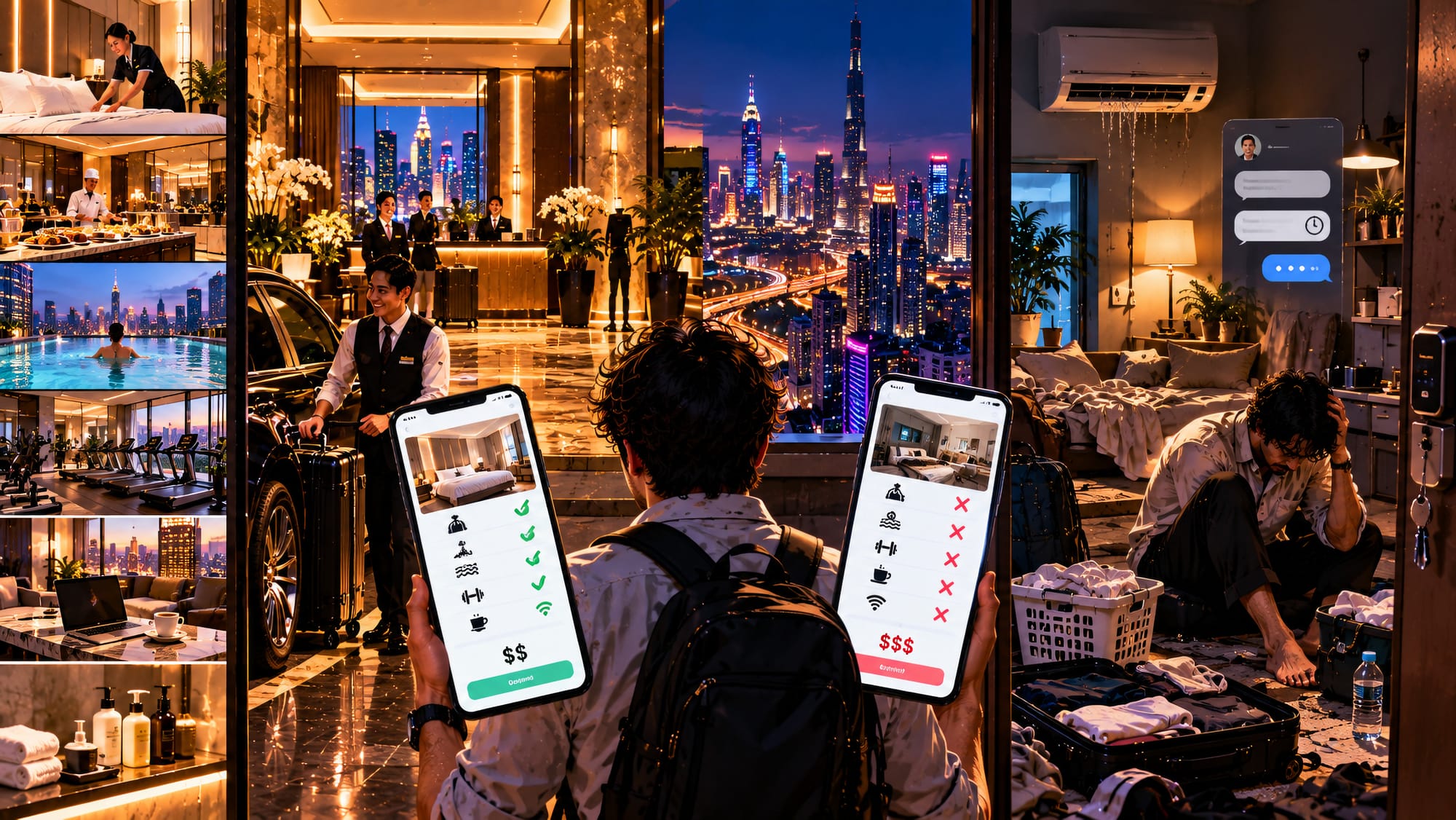
On average, short-term rentals are no longer the obvious cheaper alternative to hotels. The old assumption has been dying for years. A longitudinal study in the International Journal of Hospitality Management, pairing short-term-rental and hotel data across 20 major U.S. markets from 2014 through 2024, found short-term-rental prices have run higher than hotels consistently since 2017 and, since 2022, averaged 56 percent above them, cheaper only against the luxury segment. A 2023 Which? comparison of 50 destinations found hotels cheaper than one-bedroom whole-home Airbnb or Vrbo rentals, five-star hotels aside, in 38 of the cities, including Singapore, Dubai, Barcelona, London, Paris, and New York. The Airbnb era of "skip the hotel and save money" is not the market we are living in today.
The usual defense is the group trip, the six-person villa beating three or four hotel rooms. Absolutely. That trip is real, and when I need a house I will book a house. But it is a different product from one person or a couple needing somewhere to sleep for two or three nights. A kitchen I will never use, a washing machine I did not ask for, and somebody's decorative throw pillows are not value if the hotel across the street is cheaper and has staff.
The gap widens once you count what the nightly rate does not show. A 2 a.m. arrival met by a staffed desk. Luggage held between checkout and a late flight. Toiletries and water replaced without asking. A gym and pool already on-site. A lobby and cafe to work from. Somebody physically present when the air conditioning dies, the key stops working, or the room is not what you booked.
At the properties I use across Asia and the Middle East, daily housekeeping is normal. Water appears again automagically. The room resets itself while I am out. If something breaks, I call downstairs instead of entering a negotiation with somebody who may be asleep in another city.
The Airbnb answer to nearly all of it is some variation of message the host, then hope and pray. That is a strange reduction in service for a product that increasingly wants hotel money.
A hotel does not win every booking. It does not need to. It wins an enormous number of the trips I actually make because the product is built around the traveler rather than around turning somebody's residential property into temporary lodging with as little operating overhead as possible.
No One Is Coming to Help
A Marriott in Tokyo, Dubai, or Singapore is a known quantity because the individual hotel does not get to invent what Marriott means that morning. I cannot personally inspect the laundry room, but there is a system behind the room. Brand standards, housekeeping procedures, managers, inspections, escalation paths, and a corporation with something to lose if the property turns into a dump.
Airbnb gives me a logo and asks me to trust whatever standard exists behind one particular front door. Give me twenty unrelated hosts and I may get twenty definitions of clean, twenty ideas of a proper turnover, and twenty thresholds for what counts as good enough. The listing photographs do not tell me whether the sheets were changed. The five-star average does not tell me how carefully the bathroom was cleaned. I find out after I have paid and opened the door.
Reviews are supposed to bridge that gap, but they have their own pressure built in. Airbnb keeps host and guest reviews hidden until both sides submit or fourteen days pass, so a host cannot read my negative review and then answer it with a retaliatory one. Fine. But the host already knows if I complained about a filthy room, challenged a charge, demanded a refund, or escalated the stay to Airbnb. That same host still gets to review me. The system may hide the words until later. It cannot hide the dispute producing them.
That matters because the guest review follows the traveler too. Airbnb did not merely create Yelp for accommodation. It made the restaurant review the diner back. Maybe that keeps assholes on both sides honest. It also means every complaint happens under the knowledge the person you are complaining about gets to attach a rating to your account afterward.
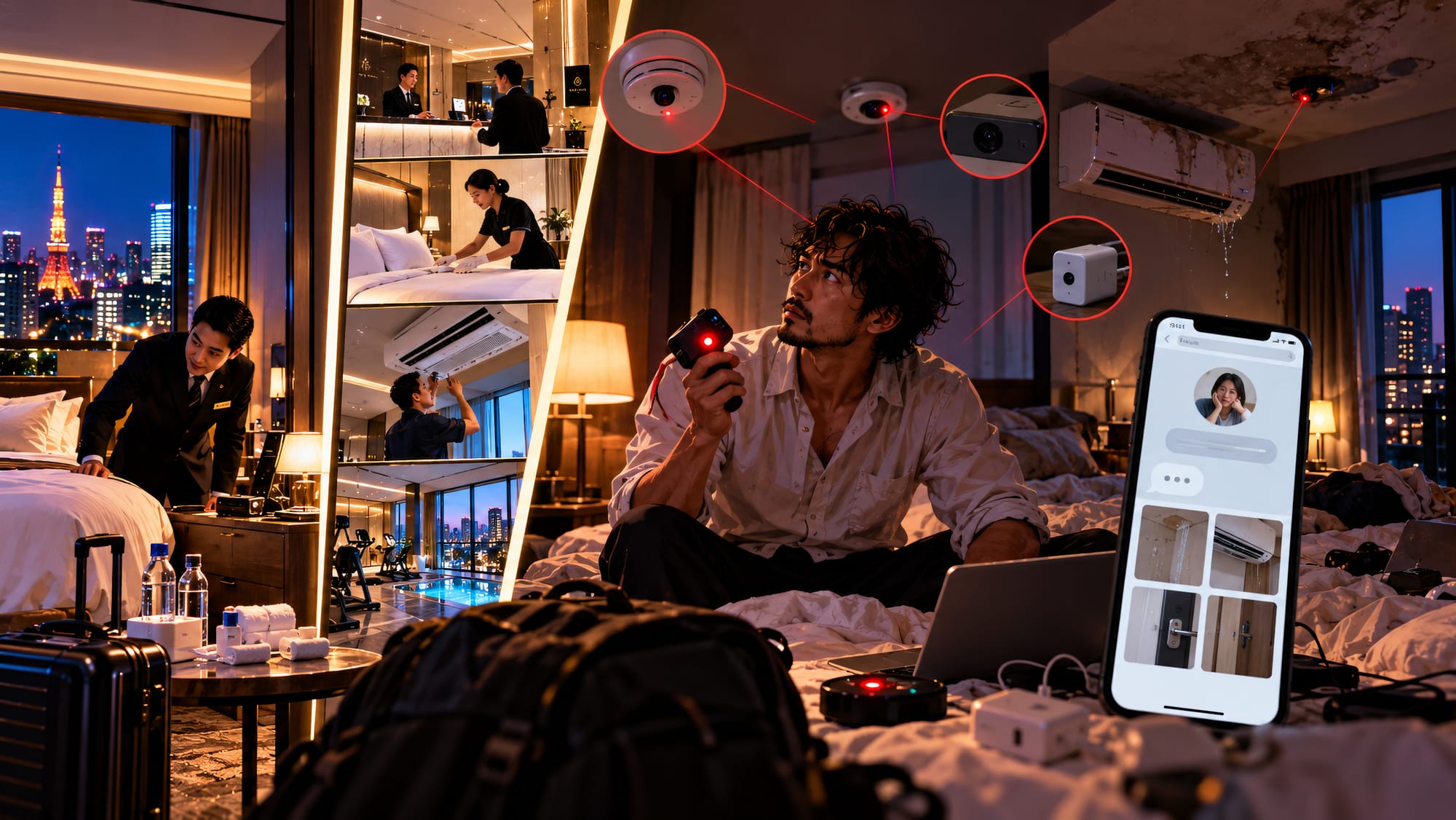
The surveillance problem is uglier. Hidden-camera stories have become their own fucking genre, with guests finding lenses inside smoke detectors, clocks, chargers, air purifiers, and other objects pointed into spaces nobody should ever be recording. Airbnb banned indoor cameras entirely in 2024, including disclosed cameras in common areas, while hidden cameras remain strictly prohibited. Good. The fact the platform needed a global rule telling hosts not to be assholes, and not to place cameras inside the homes people rent tells you how weird the trust boundary had already become.
A quiet subset of frequent travelers now carries camera detectors and sweeps unfamiliar rooms before settling in. Maybe that sounds paranoid until someone finds one. I have never checked into a Marriott and felt the first task on arrival should be determining whether the smoke detector is watching me.
The cameras are only the illegal end of it. The legal surveillance is everywhere now, smart locks logging every entry and exit, exterior doorbells recording the comings and goings, decibel monitors reporting noise to an owner in another time zone. Some of it is defensible. All of it means I am sleeping inside somebody's data-collection setup and calling it a home for the night.
Then there is the absentee problem. When the air conditioning dies at 11 p.m., the lockbox code fails, the wifi disappears, or water starts coming through the ceiling, the philosophical difference between a platform and a hotel becomes extremely fucking practical. A hotel has a desk, a manager, maintenance staff, and usually another room. An Airbnb may have a host in another city, a management company handling dozens of units, and a support chat asking me to upload photographs of the problem.
That is the accountability gap. A hotel can fail spectacularly, and hotels absolutely do. But there is normally one entity standing in front of me that owns the failure. Airbnb turns the same problem into a triangle between guest, host, and platform. The dirty unit belongs to the host until the host says it belongs to Airbnb. Airbnb says it needs to hear from the host. Meanwhile I still need somewhere to sleep.
Safety has the same fragmentation problem. Hotels are purpose-built commercial lodging and, in most markets, operate under fire, occupancy, accessibility, and inspection regimes written specifically for lodging. Airbnb inventory begins as millions of unrelated homes governed by whatever rules apply to each property and jurisdiction. Airbnb can mandate detectors, review claimed accessibility features, and require hosts to follow local safety law. What it cannot do is turn millions of physically different homes into one standardized product. In an emergency, that difference stops being theoretical very fucking quickly.
I have lived both ends of this. In the autumn of 2019 I booked a beautiful beachfront house on the north shore of Oahu for a family stay the next July. Then the pandemic arrived, borders slammed shut, and international travel simply stopped. Around May we gave up and moved to cancel, which turned out to be no simple thing, because Airbnb had not yet written a real policy for a global pandemic.
When I explained the situation to the host, assuming a shred of human decency, he told me I would not get my full payment back. A once-in-a-century pandemic had shut the planet, and this guy’s entire concern was clawing back a few nights of beachfront revenue off a family never going to arrive.
Only once Airbnb finally issued a pandemic cancellation policy could I cancel without eating the cost. I did. He then banned me from every property he owned, for the unforgivable sin of canceling a trip during a global emergency. Japan at that point was turning away even its own permanent residents at the border, so there was no version of reality where this trip happened, and a grown adult running a lodging business still decided I deserved a blacklist for it. A small man with a block button, and a platform content to let him swing it.
The other end looked nothing like it. Once lockdowns eased and travel opened back up, we booked Oahu again for July 2022. An apartment in Waikiki this time. Check-in was painless, the keys worked, and the place matched its photos, which should be the floor and somehow lands as a pleasant surprise. The host was gracious, checked in once to make sure we had everything, and then left us alone. The apartment was clean, bright, and steps from the water, the air conditioning held through a humid week, and nothing broke, leaked, or needed a single support ticket. We had a genuinely wonderful stay.
Same platform, same traveler, same island, two experiences with no relationship to each other. One host punished me for a pandemic. The other delivered everything the pitch promises. There is no brand standard bridging the gap between them, only the luck of which stranger you draw.
Loyalty Only Flows One Way
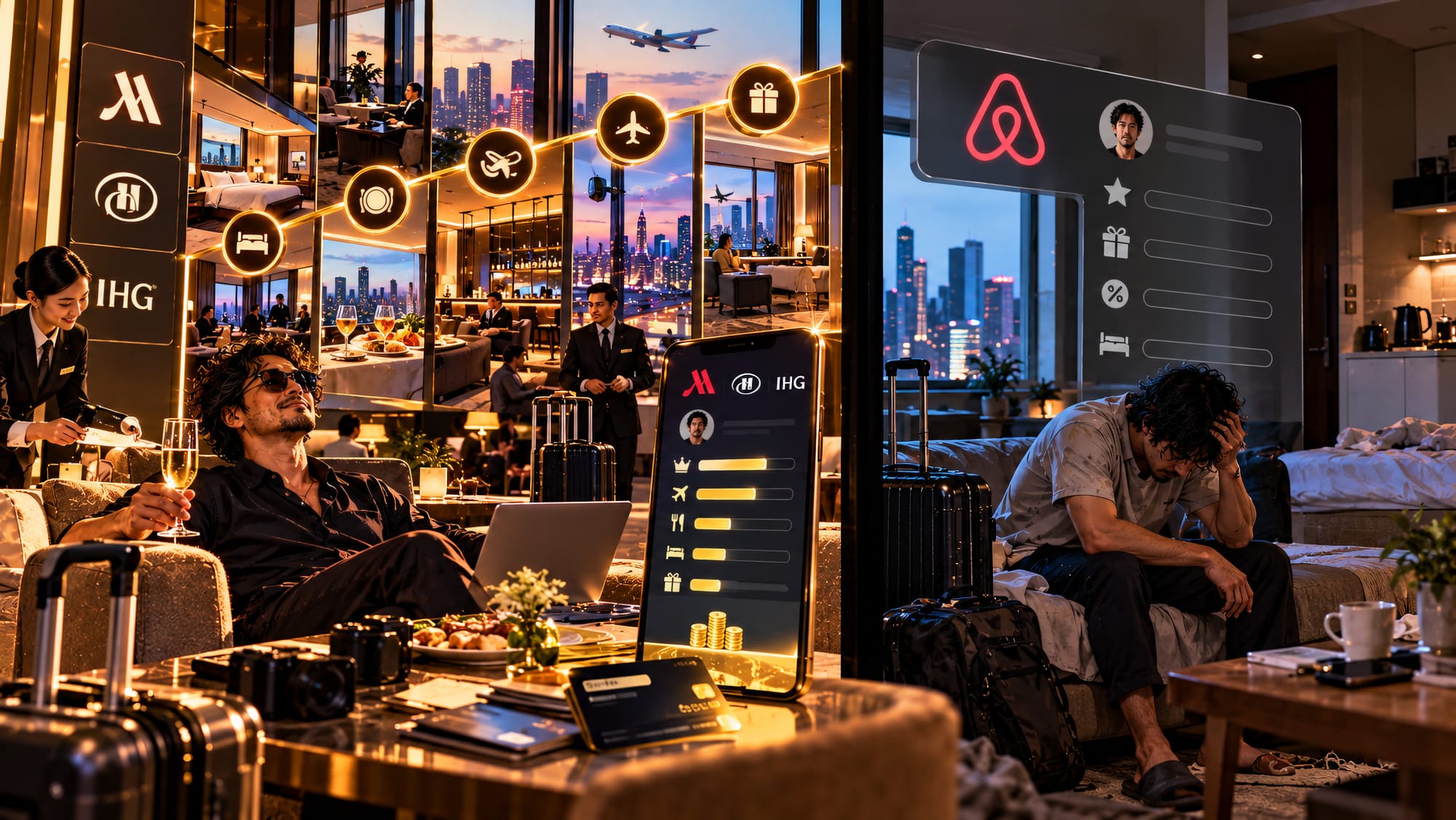
Everything so far is about one stay. Loyalty compounds, and this is where the comparison gets brutal for somebody who travels as much as I do. I spend three-plus weeks of most months on the road. I reach upper hotel tiers early in the year and then live inside the benefits for everything that follows. Upgrades, lounges, breakfast, late checkout, bonus points, and faster help when something breaks are not theoretical perks on a comparison chart. They change the trip.
The value keeps stacking after checkout. Hotel nights earn status and points. The right credit card adds another layer. Free nights turn business travel into personal travel later. The more I stay, the more the system gives back.
Airbnb itself gives me no comparable ladder. I can spend thousands of dollars on the platform and I am no closer to an Airbnb elite tier because there is no general Airbnb elite tier. There is no native Airbnb points balance growing toward the next free stay. Some credit-card travel portals now earn points on Airbnb bookings, which helps if you hold the right card, but those are the card issuer's rewards. Airbnb still has not built the machine Marriott, Hilton, and IHG use to recognize their own frequent guests.
That distinction becomes enormous over a heavy travel year. The question is not whether one Airbnb night earns something somewhere through a credit card. The question is what the lodging company itself does with my loyalty. Marriott knows I came back. Hilton knows I came back. IHG knows I came back. They compete to make the next stay better because of it. Airbnb mostly knows I am another booking.
Status also attacks Airbnb's strongest argument from the other direction. Space is the pitch, an apartment instead of a room, somewhere to spread out. When my hotel status clears a suite upgrade, I get the space and retain the housekeeping, the staffed desk, the gym, the lounge, the bar, and somebody answering the phone downstairs. For me, the supposed compromise starts disappearing.
What Airbnb Actually Broke
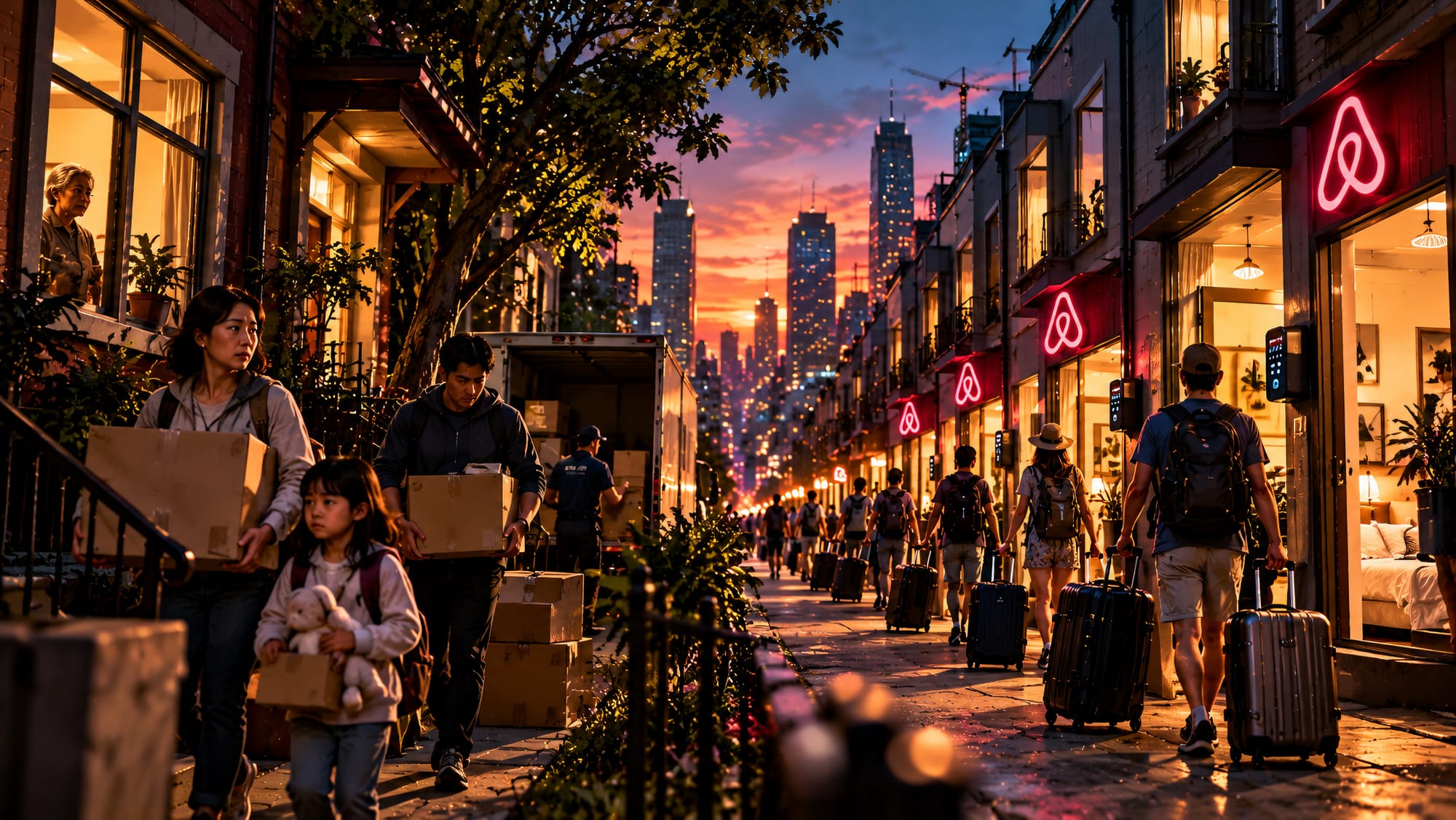
The damage runs well past my bad morning. Airbnb did not just list spare rooms, it turned housing into inventory. Once a short-term rental could out-earn a long-term tenant, investors and professional operators noticed. Homes bought for tourist use compete with would-be residents at purchase. Homes shifted from long-term leases to nightly rentals reduce the stock available to renters.
Kyle Barron, Edward Kung, and Davide Proserpio quantified the effect in their Marketing Science study, "The Effect of Home-Sharing on House Prices and Rents: Evidence from Airbnb." They found that, at the median owner-occupancy rate, a 1 percent increase in Airbnb listings caused rents to rise 0.018 percent and house prices 0.026 percent, with evidence that Airbnb shifts housing from the long-term rental market into short-term use. Airbnb did not create the housing crisis. It gave owners another financial reason to remove homes from the people who actually live there.
That is the quiet irony of the whole Airbnb pitch. The authentic neighborhood in the listing is exactly what the model hollows out. Buildings fill with lockboxes instead of neighbors, rolling suitcases replace residents, and the character you booked erodes a little with every unit converted. You are sold the thing the business is busy destroying.
This is why cities are done being polite about Airbnb. New York did not literally ban every short-term rental, but it effectively killed the classic unhosted stay of fewer than thirty days, requiring the host to stay in the unit and capping paying guests at two. Barcelona is going further, moving to expire its 10,101 tourist-apartment licenses by November 2028. Regulation is not an edge case anymore. It is part of the model, and the apartment you love this year can simply cease to exist as legal lodging the next.
Part of the early price advantage was regulatory arbitrage too. In many markets, short-term rentals expanded faster than occupancy-tax, licensing, zoning, and lodging rules could catch up, while hotels were already operating inside mature regulatory regimes. That gap has narrowed as cities force registration, tax collection, and compliance. One more supposed Airbnb advantage turns out to have depended partly on rules arriving later than the technology. Call it Uber-style disruption.
None of this crept up on Airbnb. The chore lists, the junk fees, the absentee hosts, the camera stories, the housing fallout, all of it played out in public view for the better part of a decade. Airbnb had the data, the engineering, and the leverage to act, and for years it did not. It is not hard to see the incentive. Airbnb's own service fee is calculated against the nightly price plus fees charged by the host. A fatter cleaning fee did not merely make the host more money. It increased the base Airbnb took its percentage from too. No platform is naturally impatient to kill a line item feeding both sides of the marketplace.
When Airbnb has acted, it has often acted after the problem became impossible to ignore. Its crackdown on "party houses" came days after five people were killed at an Airbnb Halloween party in Orinda in 2019. The global party ban followed in 2020 and became permanent in 2022. The total ban on indoor cameras came in 2024 after years of surveillance horror stories. Airbnb began rolling out an optional total-price display in late 2022, but did not make prices including fees the global default until 2025.
Now comes the chore rule. The pattern is hard to miss. Airbnb keeps discovering that once you operate lodging at planetary scale, eventually you have to govern the ugly parts too. "We are only the platform" stops being a serious defense when the platform writes the rules, collects a percentage of the transaction, grades both sides, arbitrates disputes, and decides what millions of hosts may demand from millions of guests.
Airbnb still has a real place. Large groups, long stays where I actually need a kitchen, residential neighborhoods, unusual properties, and destinations without decent hotels are all bookings it can earn. If six people need four bedrooms and a washing machine for two weeks, forcing everybody into adjoining hotel rooms can be idiotic. I am not interested in pretending otherwise.
I will still book Airbnb when Airbnb is the better product. What I am done doing is pretending fewer services, weaker accountability, no native loyalty, variable standards, and a checkout shift somehow become hospitality because the apartment has a kitchen and somebody left a bottle of wine on the counter.
Airbnb was supposed to cut the hotel out of travel. Too often it cut out the staff, kept the price, and handed the work to me.