

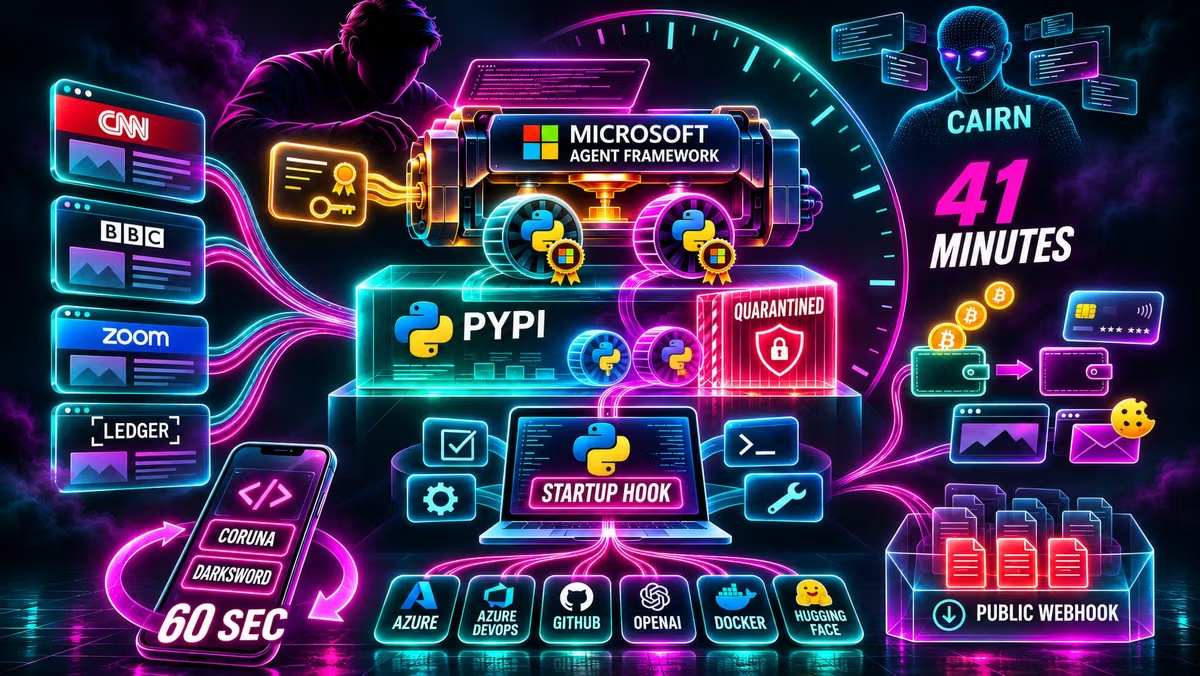
A developer who installed Microsoft's agent-framework package from PyPI on the evening of November 17 never had to import it. A one-line startup file ran the credential stealer the next time any Python tool started in that environment, StepSecurity found. A later launch of pytest, a Python build script, a linter, or pip itself was enough.
Versions 1.26.1 and 1.26.2 carried the stealer into the umbrella package for Microsoft's open-source framework for building and orchestrating AI agents. Wiz says the package gets about 41,000 downloads a week, and it found both versions gone from PyPI by 21:30 Coordinated Universal Time (UTC), less than an hour after the first upload.
Wiz traced the release to Microsoft's own signing and publishing pipeline, where the threat actor appears to have used a compromised client certificate. The tooling behind the upload named itself Cairn, an open-source AI penetration-testing framework I examined on November 16. Among the requests the threat actor's collection endpoint stored, Wiz counted three successful thefts of victim data.
Operation Timeline
Trace the events, turning points, and connections behind the analysis.
agent-framework Compromise Timeline
Key events from the last clean release on November 12, 2026, to Wiz’s November 18, 2026 update on the root cause and victims.
View Timeline Hide Timeline
-
November 12, 2026
-
November 17, 2026
-
November 17, 2026
-
November 17, 2026
-
November 17, 2026
-
November 17, 2026
-
November 18, 2026
Two Releases Within 33 Minutes
StepSecurity's timeline puts the upload of 1.26.1 at 20:35:20 UTC on November 17 and its quarantine at 21:06:16 UTC. Version 1.26.2 followed at 21:08:39 UTC, 2 minutes 23 seconds after that quarantine, and PyPI quarantined it at 21:16:44 UTC. In all, my count from StepSecurity's times runs 41 minutes from the first upload to the second quarantine.
StepSecurity reads the second upload as proof the first quarantine did not immediately revoke the threat actor's publishing access, and says its evidence does not establish whether that access remains. OpenSourceMalware, writing at 05:43 UTC on November 18, says PyPI quarantined the publisher and the threat actor is still believed to hold publishing access.
Both malicious releases shipped as wheels only, where the clean 1.26.0 release of November 12 had included a wheel and a source distribution. StepSecurity found both carried the uploader user-agent RestSharp/106.13.0.0 and no provenance attestation. Their metadata kept the clean release's project information and its dependency on agent-framework-core 1.26.0.
PyPI's advisory, PYSEC-2026-4388, says both versions were uploaded without authorization, repackaged from the legitimate 1.26.0 wheel. PyPI Security worked with Microsoft to review the project's accounts and complete remediation, and removed both versions. The advisory says version 1.26.0 is not affected and remains the latest release on PyPI.
A Startup Hook Instead of an Import
Python processes .pth files in a package directory each time the interpreter starts, so code they import runs without anyone importing the package. Version 1.26.1 added agent_framework_meta.pth and a module named _telemetry.py. StepSecurity found 1.26.2 replaced them with a 23-byte af_runtime_diag.pth holding one import line and a 7,658-byte af_runtime_diag.py.
The file and function names were made to look like legitimate software development kit telemetry, Wiz found. The only hidden value in the code is the exfiltration URL, which StepSecurity found stored in Base64 and decoded at runtime. Everything else is plain Python, and Wiz warns a search for the 1.26.1 file names will miss the second version.
On startup, the payload sets the environment flag _AF_TEL=1 to avoid running twice, forks a child process, and calls setsid() to detach it from the parent's session. The child collects and sends the data, and it can outlive the Python process launching it. StepSecurity found the payload suppresses its own errors, so a user sees no output.
OpenSourceMalware notes the hook is not operating system persistence. StepSecurity found no scheduled task, no system service, and no second stage loading more code. Each collector makes one exfiltration attempt with no retry, but every later Python start in an affected environment can run another collector, which is why StepSecurity tells users to isolate the environment before starting Python or pip.
What the Stealer Took and Requested
The collector records the hostname, username, working directory, command-line arguments, and a timestamp. StepSecurity counts 35 strings in 1.26.2 (31 in 1.26.1) the collector matches against environment variable names. The strings include TOKEN, SECRET, AZURE, GITHUB, and OPENAI. Wiz describes the stealer as focused on Azure and Azure DevOps.
It reads up to 80 credential files in 1.26.2 (60 in 1.26.1). Targets include Azure command-line token caches, .npmrc, .netrc, .git-credentials, Docker configuration, and Hugging Face tokens. It also reads the environment files of the first 300 running processes, which StepSecurity says can expose secrets held by the build runner itself.
The payload then asks for new tokens. It requests Azure DevOps OIDC tokens with the pipeline's own access token and Azure managed identity tokens for twelve resources, and StepSecurity found it keeps up to 8,000 characters of instance metadata. Version 1.26.2 added requests for GitHub Actions OIDC tokens. Wiz notes such tokens can be exchanged for Azure access wherever a federated credential trusts the workflow.
StepSecurity stresses its static analysis establishes the token requests, not their success. Rotating static secrets does not necessarily cancel tokens already issued, and Wiz says stolen managed identity and exchanged tokens stay valid for up to 24 hours. Everything collected is compressed, Base64-encoded, and posted once to webhook[.]site with the user-agent runtime-diagnostics/1, or af-runtime-diagnostics/1 in 1.26.1.
Three Victims Behind Fifty Requests
The threat actor sent its haul to webhook.site, a public request-inspection service. Wiz confirmed the endpoint used the free tier, which accepts at most 100 requests and expires after seven days, and found at most 50 requests captured. Requests beyond the cap get an error and are not logged.
Wiz analyzed the 50 stored requests on November 18. Four came from the threat actor's own machines and the attack process, and twenty-nine appear tied to sandboxes, vendor scanning, and tests. The remaining seventeen represent three unique, successful thefts of victim data. Wiz has not named the three victims.
The threat actor's tooling reported its own progress to the same public endpoint, which let Wiz observe part of the attack. Before publishing, the threat actor ran the stealer on its own machine. That run captured an AI coding agent configuration Wiz says appears to be the open-source Pi harness backed by a GLM-family model, routed through a local proxy.
OpenSourceMalware warns public download figures for the package say nothing about how many times the malicious versions were installed. Wiz tells teams to check the exfiltration logs instead, where a 200 response from the endpoint means a host's data was accepted and a 410 or 429 response suggests it was rejected.
Who Published It
Wiz's account of the publishing path rests on what the threat actor's own tooling reported to the public webhook. Wiz says the threat actor appears to have compromised a client certificate and private key for the Engineering System Release Pipeline (ESRP), the internal service Microsoft uses to sign and publish the package. Wiz does not yet know how the credentials were obtained.
ESRP's IP filtering rejected a first publish attempt from AWS, and a second attempt from Microsoft-owned IP space succeeded. The tooling named its own probe for the service, staging the package at /tmp/cairn_pkg and sending a connectivity probe called CAIRN_ESRP_PROBE2, Wiz found. Cairn is open source, so the name alone ties this upload to no single threat actor.
My analysis of Cairn on November 16 found customized copies of the framework generating a file called AUTHORIZATION.md to declare each attack approved by a client who did not exist.
StepSecurity's timeline records a detail Wiz does not address, a maintainer account named vibiret created and added to the project on November 17 before the RestSharp upload. StepSecurity says its evidence does not establish the initial access vector or the uploader. OpenSourceMalware says the releases came from the legitimate Microsoft-associated PyPI publisher, and Microsoft has not published its own account of how the releases were made.
Microsoft's durabletask package was compromised earlier this year after its PyPI token was stolen, and Wiz has not linked the two incidents. On August 20, one hijacked maintainer account put 245 million Rust downloads at risk through the arrayref crate, and agent-framework shows the same exposure reaching a release pipeline.
The probe named for ESRP, the rejected attempt from AWS, and the agent configuration Wiz recovered all come from the threat actor's own reporting. I assess with moderate confidence the threat actor published both versions through the compromised ESRP credential, and with moderate confidence a Cairn-based agent carried out at least part of that publishing. Where the vibiret account fits remains open.
Both malicious versions appear to have come through Microsoft's own release path under the real package name, so trust in the project name, the publisher, or lock files protected nobody who installed them, as OpenSourceMalware notes. What limited the damage sat where trust in the publisher ended, in PyPI's quarantine of both versions the same evening and in a free collection endpoint whose stored requests Wiz could read and count.
Analyst Annex
Evidence status as of November 18, 2026. The records cover the unauthorized PyPI releases 1.26.1 and 1.26.2 of Microsoft’s agent-framework package on November 17, 2026, the credential stealer they carried, and the publishing path Wiz and StepSecurity describe.
The ATT&CK mapping follows the behavior StepSecurity and Wiz found in the two wheels. Token requests are mapped as attempts, because static analysis establishes the requests and not their success.
Confirmed marks evidence published by a victim, vendor, regulator, or government authority about its own systems, decisions, or investigation. Reported marks technical findings or attribution assessments published by a third party. Claimed marks statements by a seller or self-identified threat actor that remain unverified. Provisional marks an analytical mapping supported by reported behavior but not made by the original source.
Indicators
The table holds the exfiltration endpoint, two wheel hashes, one payload hash, and the files, user-agents, and environment marker tied to the payload. The StepSecurity and Wiz posts carry the full sets.
| Indicator | Context | Status |
|---|---|---|
| URLs | ||
hxxps://webhook[.]site/d381fd80-ec62-42ad-8f5c-d1b15103c9bb?t=telemetry |
Exfiltration endpoint on a free webhook.site tier. A connection alone does not establish a successful transfer Source: StepSecurity, Wiz | Reported |
| Hashes | ||
d27fa34414e6201d5e03e559ef634f020057554d7b3f4898dd5d7cd3e989e110 |
SHA-256 of the agent-framework 1.26.1 wheel Source: StepSecurity, Wiz | Reported |
3d20a8bc91351a9a16b6db243b848ceca0206b7a8623b02d2af553a9c9f7e0a9 |
SHA-256 of the agent-framework 1.26.2 wheel Source: StepSecurity, Wiz | Reported |
54d885b7d7161c9ed96489c66364c4bfbf635929166843bba10d97d46b5a2e1f |
SHA-256 of af_runtime_diag.py, the 1.26.2 stealer
Source: StepSecurity, Wiz
|
Reported |
| Other Indicators | ||
agent_framework_meta.pth |
Startup hook in 1.26.1, beside agent_framework_meta/_telemetry.py
Source: Wiz
|
Reported |
af_runtime_diag.pth |
Startup hook in 1.26.2, 23 bytes holding one import line Source: StepSecurity | Reported |
runtime-diagnostics/1 |
Exfiltration user-agent in 1.26.2. Version 1.26.1 used af-runtime-diagnostics/1
Source: StepSecurity, Wiz
|
Reported |
_AF_TEL=1 |
Environment flag the payload sets to avoid running twice Source: StepSecurity, Wiz | Reported |
MITRE ATT&CK Mapping
| Tactic | Technique | Procedure | Status |
|---|---|---|---|
| Malicious agent-framework Releases | |||
| Initial Access | T1195.002 Supply Chain Compromise: Compromise Software Supply Chain | Versions 1.26.1 and 1.26.2 were uploaded to the official PyPI project without authorization, repackaged from the 1.26.0 wheel Source: PyPI advisory, StepSecurity | Confirmed |
| Persistence | T1546.018 Event Triggered Execution: Python Startup Hooks |
A .pth file in site-packages runs the stealer each time Python starts in the environment, with no import of the package. It persists in the Python environment, not the operating system
Source: StepSecurity, Wiz
|
Reported |
| Stealth | T1036.005 Masquerading: Match Legitimate Resource Name or Location | File and function names were made to look like legitimate software development kit telemetry Source: Wiz | Reported |
| Stealth | T1027.013 Obfuscated Files or Information: Encrypted/Encoded File | The exfiltration URL is stored Base64-encoded and decoded at runtime Source: StepSecurity | Reported |
| Discovery | T1082 System Information Discovery | Collects hostname, username, working directory, command-line arguments, and a timestamp Source: StepSecurity | Reported |
| Credential Access | T1552.001 Unsecured Credentials: Credentials In Files |
Reads up to 80 credential files in 1.26.2, including Azure CLI token caches, .npmrc, .netrc, and .git-credentials
Source: StepSecurity
|
Reported |
| Credential Access | T1552.005 Unsecured Credentials: Cloud Instance Metadata API | Requests managed identity tokens from the instance metadata endpoint for twelve resources and keeps up to 8,000 characters of instance metadata Source: StepSecurity | Reported |
| Credential Access | T1528 Steal Application Access Token | Attempts Azure DevOps OIDC tokens and, in 1.26.2, GitHub Actions OIDC tokens. Static analysis establishes the requests, not their success Source: StepSecurity | Reported |
| Exfiltration | T1567.004 Exfiltration Over Web Service: Exfiltration Over Webhook | Compresses and Base64-encodes the collection and posts it once to a webhook.site URL Source: StepSecurity, Wiz | Reported |
Entities
| Entity | Role | Status |
|---|---|---|
| Threat Actors | ||
| Unidentified agent-framework Threat ActorThreat actor, motivation unknown | Published the two malicious releases. Wiz says its tooling named itself Cairn and appears to have used a compromised ESRP client certificate Source: Wiz | Reported |
| Organizations and Victims | ||
| MicrosoftPackage owner | Owns the agent-framework project. PyPI Security worked with Microsoft to review the project’s accounts and complete remediation Source: PyPI advisory | Confirmed |
| Three Unnamed VictimsVictims | Wiz counted three unique, successful thefts of victim data among the 50 requests the collection endpoint stored Source: Wiz | Reported |
| Tools and Services | ||
| CairnOpen-source AI penetration-testing framework |
Wiz says the tooling staged the package at /tmp/cairn_pkg and sent a CAIRN_ESRP_PROBE2 probe
Source: Wiz
|
Reported |
| Engineering System Release Pipeline (ESRP)Microsoft signing and publishing service | Rejected a first publish attempt from AWS by IP filtering and accepted a second from Microsoft-owned IP space, per Wiz Source: Wiz | Reported |
| webhook.sitePublic request-inspection service | Collection endpoint on the free tier, which accepts at most 100 requests and expires after seven days Source: Wiz | Reported |
Related Activity
The records below give context only. None is tied to this compromise by the sources.
| Item | Detail | Status |
|---|---|---|
| Cairn Attacks With Generated Authorization FilesAnalysis, November 16, 2026 |
Customized copies of Cairn generated an AUTHORIZATION.md file declaring each attack approved by a client
Source: jark.me
|
Reported |
| durabletask CompromiseSupply chain compromise, 2026 | Another Microsoft Python package was compromised earlier this year after its PyPI token was stolen. Wiz has not linked the two incidents Source: Wiz | Reported |
| Hijacked Rust CrateAnalysis, September 2026 | On August 20, one hijacked maintainer account put 245 million Rust downloads at risk through the arrayref crate Source: jark.me | Reported |
Intelligence Gaps
| Gap | Why It Matters | What Would Close It |
|---|---|---|
| How the threat actor gained publishing access | Wiz points to a compromised ESRP client certificate, while StepSecurity’s timeline shows a maintainer account named vibiret added on November 17 | A Microsoft or PyPI account of the publishing path, with ESRP and account logs |
| How the ESRP credentials were obtained | Wiz does not yet know, and the answer decides whether other Microsoft packages share the exposure | Microsoft incident findings on the certificate and private key |
| Identity of the three victims and what they lost | Wiz counted three successful thefts, and tokens it says stay valid for up to 24 hours may already have been used | Victim disclosures and cloud, Azure DevOps, and GitHub audit logs |
| Whether publishing access remains | StepSecurity says its evidence does not establish whether the access remains, and OpenSourceMalware says it is still believed to | Confirmation from Microsoft or PyPI that the credential and accounts were revoked |