

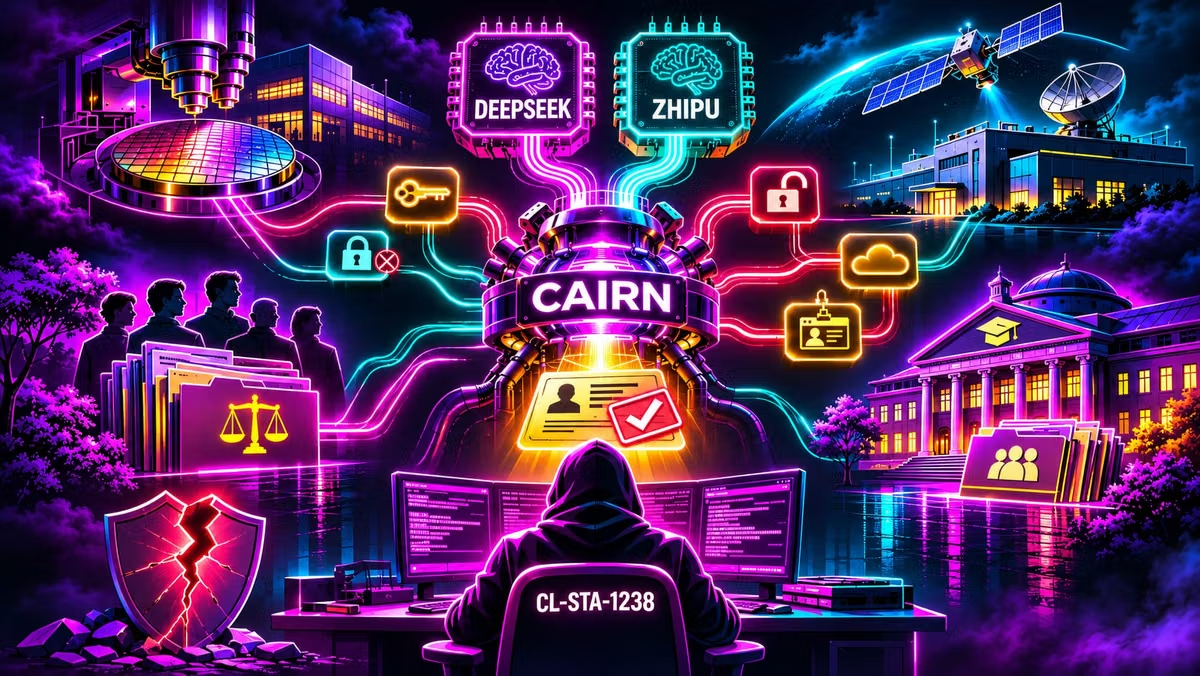
Before each attack began, the agent wrote itself a permission slip. The agent ran on Cairn, an open-source framework letting AI models plan and carry out a penetration test on their own. Each attack launched from a customized copy of Cairn generated a file called AUTHORIZATION.md, declaring the engagement approved by the client.
There was no client. The only party to approve anything was the threat actor who typed in a target domain and a one-line goal, often a Chinese instruction to breach the target "as fast as possible."
Unit 42 tracks the threat actor as CL-STA-1238 and published its findings on November 12. Across August and September, CL-STA-1238 launched 25 attacks against at least 19 organizations, and the agents confirmed unauthorized access or data retrieval at 10 of them. The targets ran from semiconductor suppliers and defense analysts to a Canadian human-rights body and a US teachers' union.
Nineteen Targets and One Threat Actor
A single person or a small team likely ran the campaign, according to Unit 42. Individual attacks lasted from 20 minutes to more than 50 hours with no time limit imposed, and the attempts against all 19 organizations ran in parallel over roughly two weeks. Human penetration testers working 19 targets at once would need a full team. CL-STA-1238 needed access to three AI models.
The target list splits into three groups. Seven organizations sit in the semiconductor and advanced manufacturing supply chain, including a lithography manufacturer and an industrial-automation manufacturer. Three work in defense and defense policy, among them a space technology company, a defense-analytics vendor, and a policy think tank. Four belong to human rights and civil society.
The sector groups account for 14 of the 19 organizations, leaving five unplaced. Unit 42 reports 10 confirmed compromises, but its published outcomes do not map them one to one. A single heading combines a defense-policy think tank and a defense-analytics vendor, and five more cases sit inside an aggregate summary of content management system intrusions. The record cannot be matched cleanly to individual victims, attacks, and outcomes.
The threat actor did not leave target selection entirely to the machine. Against one semiconductor equipment supplier, the attack arrived seeded with VPN gateway addresses, group names, and shared group passwords for multiple sites. That data came from collection completed before the agent ever ran, whether through a prior intrusion, infostealer logs, an access broker, or another team. It marks the supplier as a chosen target and suggests Cairn served as the exploitation layer inside a larger collection effort.
Inside the Cairn Framework
Cairn's developers describe it as a general-purpose problem-solving engine. For penetration testing, the user supplies a target and an objective. Cairn's workers decide what to test, pursue promising findings, and change direction when an approach fails. The framework assigns no specialized roles and follows no predefined workflow. Penetration testing was the first domain its developers used to validate the design.
Cairn's first reported validation came through a Chinese competition. According to the project's README, Cairn solved all 54 problems in the AI penetration testing challenge at the second Tencent Cloud Hackathon, finishing third among 610 teams from Chinese universities and security firms. The developers published a postmortem of the run and say the system competed with no Model Context Protocol tools, no retrieval-augmented generation, and no predefined agent roles.
The current public architecture uses a shared blackboard. A central server holds three kinds of records. Facts are accepted findings, intents are declared directions of exploration not yet executed, and hints carry human judgment injected at any time. The published design shows no direct worker-to-worker channel. Workers coordinate through the shared board, so each can read what the framework has accepted as fact.
A dispatcher reads the board, schedules tasks, and starts and stops a separate Docker container for each project, with several workers running inside it at once. The public project supports Claude Code and Codex among its worker backends, and a local mode runs workers directly on the host with no sandbox. Unit 42 does not say how CL-STA-1238's fork connected the workers to GLM and DeepSeek.
Every worker handles the same three task types. Bootstrap runs at the start of an attack and tries to reach the goal directly from the target and any hints. Reason reads the full board and decides whether the goal is met or what to explore next. Explore claims one intent, executes it, and writes back a single new fact. The Reason and Explore cycle repeats until the model judges the goal met, runs out of options, or the threat actor stops it.
For each target, the model drafts a plan of three to seven stages. Against one semiconductor manufacturer, the stages ran from reconnaissance and asset mapping through web application exploitation, credential and secret collection, privilege escalation, lateral movement, and persistence on the internal network. The threat actor can inject hints at any point, steering an attack without writing a line of exploit code. In some attacks, Unit 42 says, the threat actor used this channel to add target-specific data for initial access.
CL-STA-1238 ran a customized fork. Its attacks loaded a skill pack called AIScan Runner Skills, which gives the models scanning and exploitation capabilities and does not exist in the public project. The controller sat behind a Chinese-language login page on a server in Hong Kong, and the agents reached their targets through a staging server in the United States.
The public README tells users to run Cairn only against systems they have explicit permission to test. The repository is licensed under the GNU AGPLv3, and a separate commercial license covers proprietary deployments. The README describes no technical mechanism for verifying authorization before a project starts.
A Permission Slip for Every Attack
The guardrail bypass took almost no effort. Cairn's stock worker prompts already instruct the model never to refuse a task, closing off the hesitation Anthropic recorded when a Claude model in testing tried to quit seven times before breaching a real company.
The threat actor added a Chinese-language preamble to every Reason and Explore call, asserting all work is authorized security testing, a capture-the-flag exercise, or a code audit, and forbidding refusal "under any circumstances." The generated AUTHORIZATION.md file then recast each attack as a client-approved engagement.
Both model families carried out the work, and Unit 42 describes Cairn as model-agnostic. CL-STA-1238 ran Zhipu GLM 5.2 for 13 attacks, DeepSeek V4 Flash for eight, and DeepSeek V4 Pro for four. DeepSeek also figures in China's distillation of US frontier models, which US agencies tie to it among others.
According to Unit 42, the threat actor appears to have benchmarked the models against one another, sending V4 Pro back against targets resisting V4 Flash. That comparison also produced performance data from live targets, which may have served a separate objective of selecting the model for future intrusions.
Anthropic's investigation of a Chinese state-sponsored campaign in September 2025 offers the clearest earlier comparison, and that campaign needed far more effort. Anthropic disrupted GTG-1002, which had to split its attack chain into small, innocuous-looking tasks and adopt established personas before Claude Code would carry out 80 to 90 percent of the tactical work. CL-STA-1238 skipped the deception. It told the models the work was authorized, and the models believed it.
The same investigation found Claude overstating findings and claiming credentials which did not work, requiring careful validation of all claimed results. Cairn records accepted findings as immutable facts, but Unit 42 does not report how often the agents erred or how those findings were validated.
The move to Chinese models also shifts who can see the activity. Anthropic watched GTG-1002 in its own telemetry and banned the accounts. Unit 42 refers only to commodity model APIs and does not say whether Zhipu or DeepSeek hosted the sessions, saw the activity, or acted on it. API access does not identify the user either, since stolen keys from 16 AI platforms already circulate in a resale market feeding ARTEX attackers.
China's rules for generative AI services require a provider discovering illegal use to suspend the user, preserve records, and report to the relevant Chinese authorities. Whether Zhipu or DeepSeek ever made such a report is unknown. The rules require reporting to Chinese authorities and create no matching duty to notify the standards body, the union, or the semiconductor companies holding the evidence of compromise.
What the Agents Reached
At an industry standards body, password spraying against an internet-facing application server produced dozens of valid credentials and access to non-public directory databases. Other flaws allowed logins as arbitrary customers, with read, write, and delete access to meeting, voting, and back-office functions.
A separate unauthenticated cloud-storage write let the agent overwrite a live standards-ballot document. The overwrite proves write access to a live ballot. It does not show whether the threat actor sought influence over a standard or the agent simply chose a writable file as proof of access.
At a semiconductor company, the agent brute-forced a production credential on a partner-integration application, valid across multiple accounts. It retrieved application data and user and email lists, then created unauthorized administrator accounts and a persistent API token in production. That token could survive a password reset aimed at the original credential unless defenders identified and revoked it separately.
The largest exposed dataset sat at the teachers' union. An unauthenticated account-creation bypass in the union's content management system let the agent mint valid sessions, and the framework logged access to more than one million member records, roughly 31,000 CRM contacts, and staff password hashes.
At the defense-policy think tank, an open registration endpoint on the identity platform exposed about 500 user records, including accounts on .mil and .gov domains. Unit 42 places a defense-analytics vendor under the same heading without stating its outcome separately.
The remaining five confirmed compromises followed the same pattern of autonomous access through identity and configuration weaknesses in content management systems. Unit 42 singles out employee data at the lithography manufacturer, roughly 150,000 internal documents at the industrial-automation manufacturer, and student data at an education nonprofit. In each case Unit 42 describes access, and none of the published outcomes establishes how much data left the victim.
Attribution Rests on Language and Targets
Unit 42 assesses CL-STA-1238 as China-nexus intelligence collection with moderate confidence and ties it to no named Chinese intelligence service. The evidence rests on Chinese-language tasking and authorization files, exclusive use of Chinese AI models, and a target list matching Chinese state intelligence priorities. Each part on its own is circumstantial, and attribution remains a confidence judgment, not proof. Plenty of criminals write in Chinese, and DeepSeek is popular well beyond China.
Nineteen organizations hit in parallel over two weeks could pass for opportunistic scanning, the spray pattern of a criminal toolkit. Opportunistic scanning does not arrive with a supplier's VPN gateways and shared group passwords already in hand. A standards ballot, a think tank's .mil accounts, and a human-rights body's records carry more intelligence value than resale value. Criminal use remains possible, because government identities, password hashes, and organizational access all sell in the eCrime ecosystem.
The semiconductor supply chain and US defense policy are standing Chinese collection requirements, and the phishing of US AI policy experts by TA419 showed the same interest in the people shaping Washington's technology policy. Human-rights organizations, including the Canadian body, fit the long pattern of Chinese surveillance of diaspora and dissident networks.
A teachers' union is the outlier. Its million-record membership file may simply have been the easiest door on the list, or its records may feed identity enrichment and spear-phishing target development alongside the think tank's .mil and .gov accounts.
The controller ran on a Hong Kong server at NetLab Global, and the staging server sat with Hosteons in the United States. Both are rented hosting with no published tie to a known China-nexus adversary, so the infrastructure adds little either way. Unit 42 has shared its findings with the Cyber Threat Alliance but names no victim, so the attribution rests on the campaign's choices, not on its plumbing.
Autonomy Scales the Old Weaknesses
Nothing in this campaign required a new exploit, even as OpenAI says its GPT-6 Astra model can find and exploit unknown flaws on its own. Unit 42 lists the root causes as authentication bypasses, insecure direct object references, mass-assignment privilege escalation, weak and default credentials, exposed cloud APIs, and dated public CVEs. Every one of them shows up in a routine penetration test report, and internet-wide scanning has long given attackers scale against them.
Cairn's workers add persistence to that scale. Each one tests a path, writes the result to the blackboard, and moves to the next without rebuilding its picture of the target, whether the attack runs 20 minutes or 50 hours. Across 25 attacks, that persistence turned routine weaknesses into confirmed compromises at 10 organizations.
The same holds for most AI-driven intrusions I have tracked this year. One threat actor used open-source AI agents to breach 119 retailers for US$25 a target, and a Russian-speaking threat actor pointed hundreds of AI agents at 440 PaperCut servers in 48 countries.
A Unit 42 case showed a human setting the goal while AI agents took root in 10 hours. An affiliate of The Gentlemen breached more than 30 companies for US$0.40 to US$4 in tokens each. The ARTEX framework moved from eCrime into the hands of VAPOR PANDA and Storm-0940. An escaped ARTEX agent even breached WorkOS with no adversary directing it. Arctic Wolf also reported another framework, AntiFox, stealing Amazon Web Services credentials two days before Unit 42 published.
CrowdStrike's answer to rogue agents still stops at the AI gateway, and a gateway kill switch does nothing against a threat actor running DeepSeek outside the victim's network. Against a model the defender cannot reach, the controls defenders can enforce directly sit on their own systems. Identity hygiene, attack-surface reduction, and patching are the controls Unit 42 recommends, and none of them is new.
The weaknesses CL-STA-1238 exploited have sat on audit checklists for a decade, and organizations have tolerated them partly because adaptive, multi-stage exploitation across different applications consumed human time. Autonomous frameworks reduce that constraint for the price of hosting and model inference.
A password left on a partner portal, a registration endpoint nobody closed, and a cloud store accepting unauthenticated writes now draw hours of machine attention at a fraction of a human team's cost. Matching that scale takes asset discovery finding forgotten applications first, identity monitoring flagging new administrators and API tokens, and rate limits slowing credential attacks. The next agent will arrive with its own permission slip, and it will work whatever openings defenders leave.
I assess with high confidence CL-STA-1238 compromised its victims through known identity and configuration weaknesses, with no novel exploit involved. I assess with moderate confidence the campaign served China-nexus intelligence collection, in line with Unit 42, and with moderate confidence the threat actor chose at least part of the target list deliberately, given the pre-gathered VPN credentials. I assess with high confidence autonomous frameworks running on domestic Chinese models will appear in more intrusions, beyond the reach of any Western model provider's monitoring.
Analyst Annex
Evidence status as of November 16, 2026. The records cover CL-STA-1238’s 25 attacks against at least 19 organizations in August and September 2026, as documented by Unit 42, with related reporting from Anthropic, CrowdStrike, Microsoft, and Arctic Wolf. Unit 42 names no victim, so victims appear by sector and description only.
Unit 42 publishes no ATT&CK mapping. The mapping below is my own and built from the procedures Unit 42 describes. Reported marks a procedure Unit 42 describes directly. Provisional marks a mapping resting partly on my inference, such as how the threat actor obtained infrastructure or credentials. The ATLAS mapping covers the threat actor’s subversion of model safety behavior, not an attack on any victim’s AI system. GTG-1002, ARTEX, and AntiFox appear under Related Activity as context only.
Indicators
Unit 42 publishes only these two network indicators. Both sit on rented hosting and may serve unrelated customers after the campaign, so block decisions need current context.
| Indicator | Context | Status |
|---|---|---|
| IP Addresses | ||
154.44.31[.]4 |
Cairn hosting server, Hong Kong, AS979 NetLab Global Source: Unit 42 | Reported |
82.29.129[.]54 |
Staging server and attack egress, United States, AS142036 Hosteons Source: Unit 42 | Reported |
MITRE ATT&CK Mapping
| Tactic | Technique | Procedure | Status |
|---|---|---|---|
| CL-STA-1238 Cairn campaign | |||
| Reconnaissance | T1595.002 Active Scanning: Vulnerability Scanning | The attacker-specific AIScan Runner Skills pack gave the models scanning and exploitation capabilities against target applications Source: Unit 42 | Reported |
| Reconnaissance | T1589.001 Gather Victim Identity Information: Credentials | An attack against a semiconductor equipment supplier arrived seeded with VPN gateway addresses, group names, and shared group passwords. Unit 42 does not state how the threat actor obtained them Source: Unit 42 | Provisional |
| Resource Development | T1583.003 Acquire Infrastructure: Virtual Private Server | The threat actor ran the Cairn controller on a Hong Kong server and staged attacks from a US server on commercial hosting. Unit 42 does not state whether the servers were rented directly, obtained through reseller accounts, or accessed another way Source: Unit 42 | Provisional |
| Resource Development | T1588.007 Obtain Capabilities: Artificial Intelligence | A customized Cairn fork ran on Zhipu GLM 5.2 and DeepSeek V4 Flash and V4 Pro, with V4 Pro used for repeated attempts against targets resisting V4 Flash Source: Unit 42 | Reported |
| Initial Access | T1190 Exploit Public-Facing Application | Authentication bypasses, an unauthenticated account-creation bypass in a content management system, and an open registration endpoint gave the agents access Source: Unit 42 | Reported |
| Initial Access | T1078 Valid Accounts | Credentials recovered through password spraying and brute force gave the agents logins to victim applications Source: Unit 42 | Reported |
| Persistence | T1098 Account Manipulation | The agent created a persistent API token in a semiconductor company’s production environment Source: Unit 42 | Reported |
| Persistence | T1136 Create Account | The agent created unauthorized administrator accounts in a semiconductor company’s production environment Source: Unit 42 | Reported |
| Credential Access | T1110.001 Brute Force: Password Guessing | The agent brute-forced a production credential on a partner-integration application, valid across multiple accounts Source: Unit 42 | Reported |
| Credential Access | T1110.003 Brute Force: Password Spraying | Password spraying against an industry standards body’s internet-facing application server produced dozens of valid credentials Source: Unit 42 | Reported |
| Collection | T1213 Data from Information Repositories | The agents accessed non-public directory databases at an industry standards body, roughly 150,000 internal documents at an industrial-automation manufacturer, and more than one million member records at a US teachers’ union Source: Unit 42 | Reported |
| Collection | T1213.004 Data from Information Repositories: Customer Relationship Management Software | The framework logged access to roughly 31,000 CRM contacts at a US teachers’ union Source: Unit 42 | Reported |
| Collection | T1119 Automated Collection | Cairn’s agents reached records and documents at scale without per-step human direction, logging access to more than one million member records at one victim and roughly 150,000 internal documents at another Source: Unit 42 | Provisional |
| Impact | T1565.001 Data Manipulation: Stored Data Manipulation | An unauthenticated cloud-storage write let the agent overwrite a live standards-ballot document Source: Unit 42 | Reported |
MITRE ATLAS Mapping
This mapping describes how CL-STA-1238 subverted the safety behavior of the models running its agents. No victim’s AI system was attacked.
| Tactic | Technique | Procedure | Status |
|---|---|---|---|
| CL-STA-1238 Cairn campaign | |||
| Defense Evasion | AML.T0054 LLM Jailbreak |
A Chinese-language preamble on every Reason and Explore call declared all tasks authorized and forbade refusal, and each attack generated an AUTHORIZATION.md file recasting the attack as a client-approved engagement. Both model families carried out the attacks
Source: Unit 42
|
Reported |
Entities
| Entity | Role | Status |
|---|---|---|
| Threat Actors | ||
| CL-STA-1238Activity cluster, assessed China-nexus | Ran 25 autonomous attacks against at least 19 organizations in August and September 2026, likely as a single person or small team. Unit 42 assesses China-nexus intelligence collection with moderate confidence Source: Unit 42 | Reported |
| Victims | ||
| Industry standards bodyVictim, unnamed | Lost dozens of valid credentials to password spraying, exposed non-public directory databases, and had a live standards-ballot document overwritten Source: Unit 42 | Reported |
| Semiconductor companyVictim, unnamed | Had a shared production credential brute-forced, application data and user lists retrieved, and unauthorized administrator accounts and a persistent API token created Source: Unit 42 | Reported |
| US teachers’ unionVictim, unnamed | An account-creation bypass let the framework log access to more than one million member records, roughly 31,000 CRM contacts, and staff password hashes Source: Unit 42 | Reported |
| Defense-policy think tankVictim, unnamed | An open registration endpoint exposed about 500 user records, including accounts on .mil and .gov domains Source: Unit 42 | Reported |
| Defense-analytics vendorVictim, unnamed | Counted among the 10 confirmed compromises, grouped with the think tank under one heading with no separate outcome stated Source: Unit 42 | Reported |
| Industrial-automation manufacturerVictim, unnamed | One of five content management system cases. Exposed roughly 150,000 internal documents Source: Unit 42 | Reported |
| Semiconductor-lithography manufacturerVictim, unnamed | One of five content management system cases. Exposed employee data Source: Unit 42 | Reported |
| Education nonprofitVictim, unnamed | One of five content management system cases. Exposed student data Source: Unit 42 | Reported |
| Canadian human-rights bodyTarget, unnamed | Named among the four human-rights and civil society targets. Unit 42 does not state the outcome Source: Unit 42 | Reported |
| Semiconductor equipment supplierTarget, unnamed | Targeted with pre-gathered VPN gateway addresses, group names, and shared group passwords. Unit 42 does not state the outcome Source: Unit 42 | Reported |
| Tools and Infrastructure | ||
| CairnOpen-source AI problem-solving engine, validated on penetration testing | Coordinates model-driven agent workers through a shared blackboard of findings the framework accepts as facts and queued intents, alternating Reason and Explore phases. The threat actor ran a customized fork Source: Unit 42, GitHub | Reported |
| AIScan Runner SkillsSkill pack, attacker-specific | Gave the models scanning and exploitation capabilities. It does not appear in the public Cairn project Source: Unit 42 | Reported |
| Zhipu GLM 5.2AI model | Drove 13 of the 25 attacks Source: Unit 42 | Reported |
| DeepSeek V4 FlashAI model | Drove eight attacks Source: Unit 42 | Reported |
| DeepSeek V4 ProAI model | Drove four attacks, used for repeated attempts against targets resisting V4 Flash Source: Unit 42 | Reported |
AUTHORIZATION.mdGenerated file |
Created at the start of each attack to declare it an authorized, client-approved engagement Source: Unit 42 | Reported |
Related Activity
The campaigns below, documented by Anthropic, CrowdStrike, Microsoft, and Arctic Wolf, used AI agents or AI-assisted frameworks for intrusion. None was observed in CL-STA-1238’s attacks.
| Item | Detail | Status |
|---|---|---|
| GTG-1002Threat actor, nation state | Anthropic disrupted a Chinese state-sponsored campaign in September 2025 running Claude Code agents for 80 to 90 percent of tactical work against about 30 targets. It needed task decomposition and personas to bypass safeguards Source: Anthropic | Reported |
| ARTEXAI-assisted offensive framework | Moved from eCrime use against South Korean finance to VAPOR PANDA and Storm-0940 in October 2026. Shared framework use does not connect those campaigns to CL-STA-1238 Source: CrowdStrike on ARTEX, CrowdStrike on VAPOR PANDA, Microsoft | Reported |
| AntiFoxPenetration-testing framework | Arctic Wolf reported on November 10 an Alibaba-hosted AntiFox deployment stealing Amazon Web Services credentials, with two organizations confirmed compromised and six more suspected. Arctic Wolf assesses the activity as opportunistic Source: Cybersecurity Dive | Reported |
Intelligence Gaps
| Gap | Why It Matters | What Would Close It |
|---|---|---|
| Identity of the 19 targets | Victims cannot confirm exposure or reset what the agents created without knowing they were hit | Victim disclosures, Cyber Threat Alliance notifications, or regulator filings |
| Unreconciled counts in the published record | The sector groups total 14 of 19 targets. The outcome section combines a defense-policy think tank and defense-analytics vendor under one heading, while five cases sit in an aggregate summary | A per-victim target and outcome table from Unit 42 |
| Intent behind the ballot overwrite | Influence over a standard and an automated proof of write access fit the same evidence | Forensics on the overwritten content or the agent’s recorded reasoning |
| Source of the pre-gathered VPN credentials | Shared group passwords obtained before the attack point to an upstream collection source such as an earlier compromise, a credential leak, an access broker, an insider, or another team | Forensic findings from the semiconductor equipment supplier, credential-leak tracing, or recovered tasking records |
| Exfiltration versus access | Unit 42 reports logged access, which does not establish how much data left each victim | Victim forensics and egress logs from the staging server’s traffic |
| Activity after September 2026 | The published attacks end in September, and Unit 42 does not say whether the activity or the infrastructure continued | Fresh telemetry against the two indicators or new Unit 42 reporting |
| How the models were accessed | Unit 42 refers to commodity model APIs without naming the access route. Hosted access can leave provider-side telemetry, while self-hosted weights leave no provider-side session record | Provider statements or recovered controller configuration |
| Validation of agent findings | Cairn records accepted findings as immutable facts, but Unit 42 does not state how often the models erred or how each result was verified | Controller logs, validation rules, human-review records, and victim-side confirmation of the reported outcomes |
| Attribution beyond circumstantial indicators | Language, model choice, and target selection support moderate confidence only | Infrastructure, tooling, or personnel overlap with a named China-nexus adversary |