

Silent Lynx Reads Russia’s Mail From Inside the Alliance
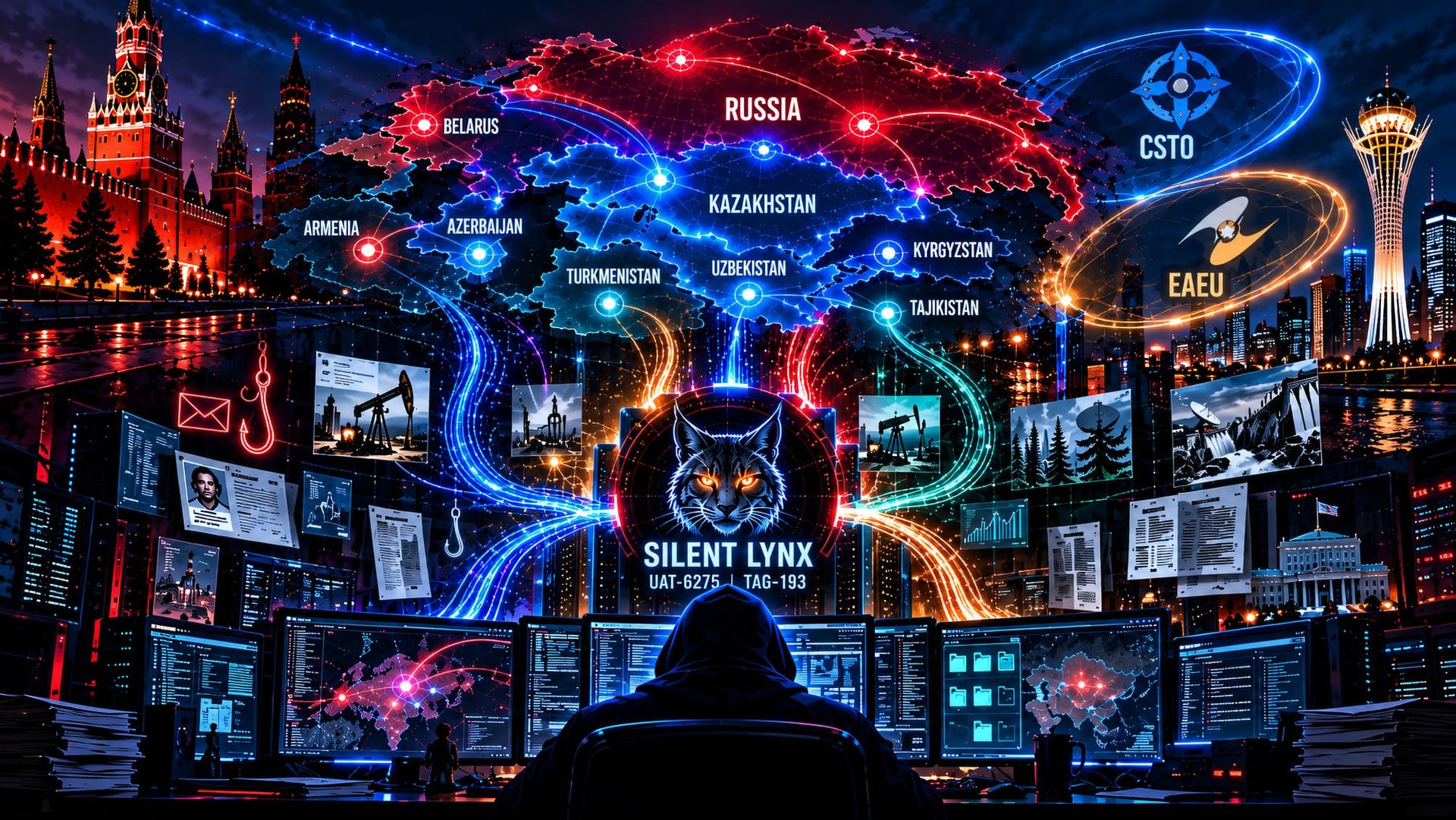
one of russia’s own partners appears to be reading its mail. on october 14 recorded future and cisco published joint findings on a cyber espionage threat actor named silent lynx, which cisco tracks as uat-6275 and recorded future as tag-193. the newest reporting ties it to kazakhstan with moderate confidence. kazakhstan belongs to russia’s own security and economic blocs, the collective security treaty organization, and the eurasian economic union. this is exactly what makes the target list worth a closer look.
silent lynx first surfaced publicly in january 2025, when seqrite documented activity from late 2024. cisco and recorded future have since mapped at least eight campaigns from june 2025 through may 2026, with observed victims and lure themes spanning nine countries. the target set is unusually coherent, covering diplomacy, economic development, agriculture, environmental management, water, forestry, and energy. the group relies heavily on spear-phishing and relatively lightweight remote access rather than an exotic arsenal. three exposed staging directories and a previously unreported github repository ultimately gave researchers a rare look behind the curtain at how the operation was being built and changed.
the russian story is already messier than most of the news reporting suggests. the orsk oil refinery, the headline victim in much of the coverage thus far, appears in the technical reporting only as a lure. it was a business proposal document built to bait a recipient, not evidence the refinery network was breached. reuters separately reported researchers found evidence of a break-in at the nizhny novgorod city government, although neither public technical report lays out that intrusion. the refinery’s months-long outage came from ukrainian drones, a separate kinetic event this campaign had nothing to do with.
the country attribution is where it gets both more honest and more interesting. no single forensic artifact makes a convincing case for kazakhstan. talos observed apparent malware-testing submissions from kazakhstan shortly after compilation, russian-language artifacts, and operator activity consistent with utc+5 working hours. its github analysis covered seventy seven commits viewed across utc+3 and utc+5. cisco rates the kazakhstan assessment at moderate confidence and says plainly it has not established whether the operators work for a government. individually, none of those signals places the actor anywhere with much certainty.
what points more strongly toward kazakhstan is the victimology. a tajik government agency communicated with silent lynx infrastructure shortly after treaty discussions involving kazakhstan. activity involving a belarusian government entity appeared ahead of a bilateral meeting in april. the wider target set maps onto questions a kazakh collector would reasonably want answered about regional diplomacy, water, energy, trade, and environmental policy. the victimology is doing more of the strategic attribution work than any single forensic artifact. a target list timed to one country’s diplomatic calendar is a stronger signal than a keyboard layout.
even the orsk lure makes more sense through that lens. the refinery sits near the kazakh border and supplies petroleum products into kazakhstan. russian refinery disruption has also made regional fuel security increasingly important to astana. its condition would therefore be a legitimate kazakh intelligence question even without a successful intrusion. the lure says something important about collection requirements without proving the organization named inside it was ever breached.
this is more than a regional footnote. kazakhstan is not an adversary of russia on paper. it remains a treaty partner inside moscow’s security and economic order. but it has spent the years since the invasion of ukraine protecting room to maneuver, refusing to recognize russia’s annexations while maintaining deep economic and political ties with moscow. a cyber threat actor aligned with kazakh interests collecting on russian energy, belarus, and fellow central asian states around specific diplomatic moments would be an interesting balancing act showing up in cyberspace. allies have always spied on allies. it is rare to see the intelligence requirements line up this neatly with the uncertainties inside an alliance.
however, there is a larger shift underneath taking place. intelligence collection is also a form of strategic autonomy. kazakhstan does not have to leave russian-led institutions to reduce its dependence on moscow. it can remain inside them while building its own picture of what russia, belarus, and its central asian neighbors intend. if the attribution holds, silent lynx would be evidence of a smaller regional state refusing to outsource its understanding of the region to the power that still claims to anchor it. spying on a partner does not prove the alliance is fake. it proves membership does not erase uncertainty.
the tradecraft shows how accessible that autonomy has become. in june 2025 one observed chain leaned on macro-enabled word documents. july brought ps2exe downloaders, and october brought malicious shortcuts pulling powershell from github. by april 2026 the group had weaponized the winrar flaw cve-2025-8088 to place pickleshell in the windows startup folder. this was the first exploit-assisted delivery researchers saw from silent lynx. exposed infrastructure also contained linux-compatible tooling and a public fortiweb exploit, suggesting the threat actor was widening its options without proving either capability had been used in the wild.
none of this looks like a showcase arsenal. it is a practical collection stack becoming more capable over time. if the kazakhstan nexus ultimately proves state-aligned, that may be the more important lesson. strategic cyber espionage no longer requires the industrial machinery associated with the largest intelligence services. compromised accounts, public hosting, commodity tooling, a few custom shells, and patient targeting can buy a smaller state access to information with disproportionate geopolitical value.
cisco places silent lynx within a suspected broader activity cluster around yorotrooper. other researchers document partly overlapping activity under names including tomiris, shadowsilk, cavalry werewolf, and hydra saiga. but cisco continues to track uat-6275 and yorotrooper separately because it has not observed direct indicators or toolset overlaps between them. this is a hypothesis about a wider lineage or ecosystem, not a confirmed identity.
there is another way to read the target list. intelligence requirements are revealed preference. treaties tell you where a government says it stands. diplomatic language tells you what it wants the relationship to look like. collection tells you which uncertainties it is unwilling to leave in someone else’s hands. if silent lynx is ultimately tied to kazakh-state interests, its targets are not evidence kazakhstan has abandoned its alliances. they are evidence of the distance between formal alignment and actual confidence.
the refinery headline gets it backwards. silent lynx matters not because a kazakh-linked actor may have poked at a russian oil refinery, which it was never shown to breach. rather it is because its target list reads like a kazakh intelligence requirements document. several of the names on it are supposed to be on the same side.
alliances are public posture. intelligence requirements are private doubt. if the attribution holds, silent lynx is the space between them. moscow is on kazakhstan’s list.