

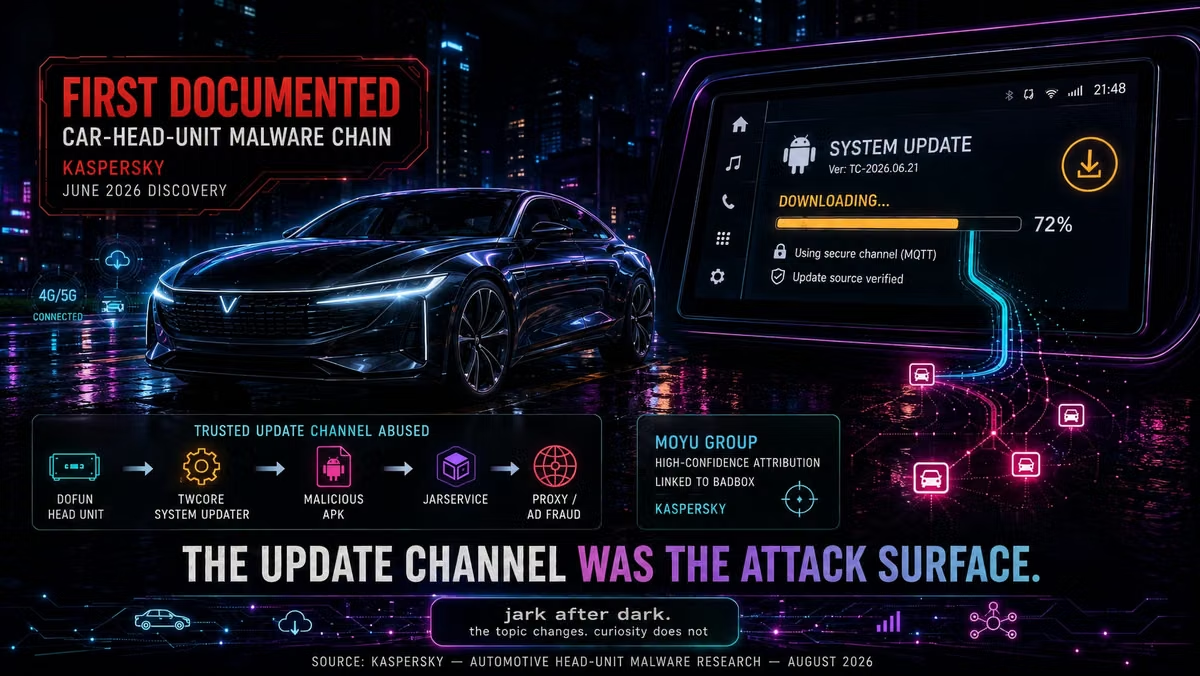
Malware is not something most people associate with cars, but believe it or not, it exists. In low quantity. Specifically in the screen on your dashboard. And it got there through the update feature.
Kaspersky found the first known malware built specifically for car head units. Those are the Android touchscreens running your navigation, music, lighting, settings, and more. The affected ones use firmware from a Chinese company called Dofun. The threat actor behind it is called MoYu, tied to the BADBOX botnet Google sued over last year.
Here is the clever part. MoYu did not hack the car. It hijacked the car’s updates. Every head unit has a system app silently checking for new software and installing it. The app is trusted by design. The threat actor simply told it to install malicious code instead. The car updated itself into being infected, and to the system it looked completely routine.
This malware did not touch your brakes or your steering. It was not after your safety. It wanted your car for something far more idiotic, your internet connection. It turned the dashboard into a node in a proxy botnet and used it to run ad fraud. Your car became a tiny anonymous relay for someone else’s clicks so they can make money.
Think about why a car is a good target for this. It is always online. It has a SIM card. Nobody ever checks it for malware, because nobody thinks of their dashboard as a computer. But it is one. It is an Android device with constant internet and zero supervision, exactly what a botnet wants. The same logic applies to the TV in your living room.
That is the real lesson. The attack surface is not just your phone, your tablet, and your laptop. It is everything with a chip and a connection, including the parts of your life you never think of as computers, and the update channel you trust most is exactly the one a threat actor wants to own.
The car did not get hacked because it is a car. It got hacked because it is a computer nobody was watching.