

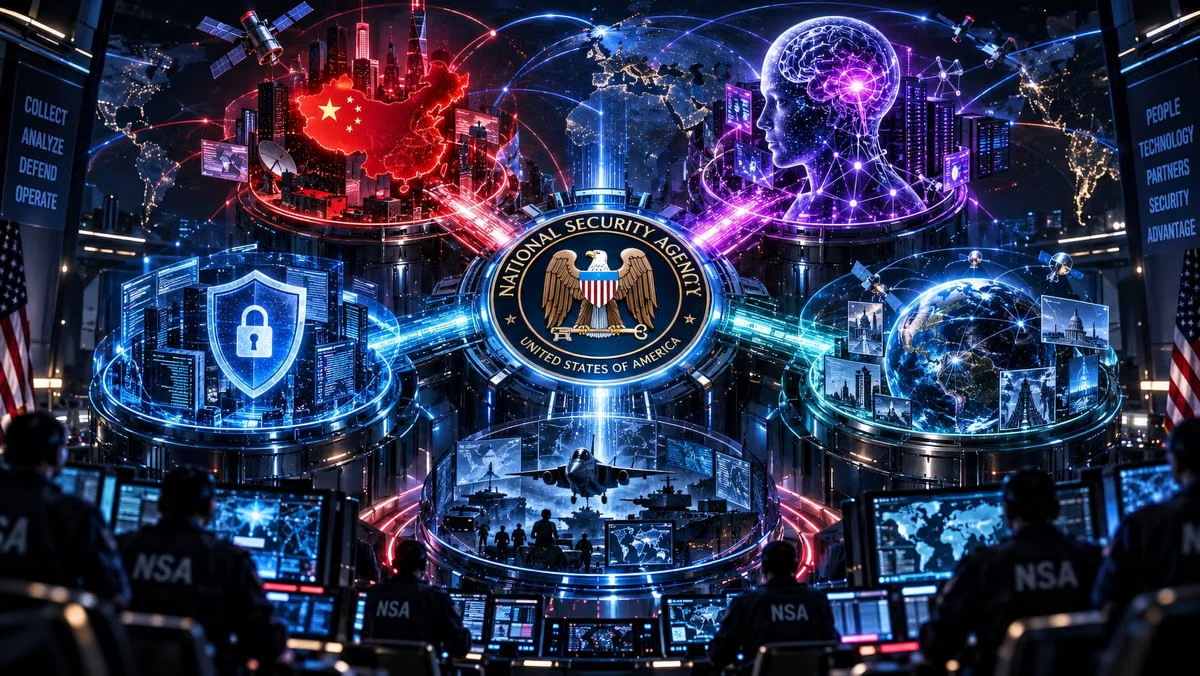
The NSA just rewrote its own org chart, and the new categories show exactly what the United States thinks it should fear. Of the five new divisions, two are China and AI. If that is not a new threat assessment, I do not know what is.
The largest signals intelligence agency on earth is scrapping its old directorate structure and rebuilding around five mission centers. China. Cyber security. Artificial intelligence. Combat support. Global intelligence. It is the biggest reorganization of the agency in about a decade, led by General Joshua Rudd, who is both NSA director and commander of USCYBERCOM.
Bureaucratic reshuffles are usually boring. This one is not, because of what the structure says. An intelligence agency does not build a permanent division around a problem it considers minor or ephemeral. It stands up a dedicated center when something has become central enough to organize the entire mission around it. The NSA just did so for China and for AI, at the same time, in the same overhaul. The org chart is the confession.
The focus on China with no equivalent focus on Russia stands out most to me. By some measures Russia is the more aggressive and technically sophisticated cyber adversary, the home of threat actors behind the most brazen operations on record. But China operates at a different scale entirely, and with a different objective.
Russia tends to disrupt and destroy. China acquires. Economic and technological advantage have long been central to the Chinese playbook, quietly absorbing decades of someone else’s research to skip the time and cost of building it. The Chinese aviation industry and its EV manufacturers, BYD chief among them, are shining examples of the strategy paying off in spades.
The absence of a dedicated Russia center to mirror China is therefore telling. Presumably much of the Russia mission now disappears into the global intelligence bucket. That makes the decision to pull China out of the same bucket and give it its own center even more revealing. The NSA is not necessarily saying Russia stopped mattering. It is apparently saying China is the adversary worth organizing the entire agency around.
The announcement came days after the NSA, FBI, and CISA jointly accused six Chinese AI firms of industrial-scale data theft from American models. The two new pillars, China and AI, may not be entirely separate priorities. Increasingly, they are parts of the same story. The agency is reorganizing around Chinese state power and artificial intelligence at precisely the moment the two are becoming harder to separate.
The speed reveals how urgent the agency thinks this is. A 30-day clock. Plans due by the end of September. Rollout in October. Full operational capability by January. Rudd and his deputy have openly acknowledged moving this fast will break things inside a famously slow bureaucracy, and they will fix it on the fly. An agency does not accept breaking its own machine unless it believes standing still is the bigger risk.
Tailored Access Operations, the elite offensive hacking unit of the NSA, deserves watching. It was quietly brought back under its old name in July after years on the shelf. TAO now sits inside the new global intelligence center, reportedly with a bigger budget coming. Reconstituting an elite offensive team while reorganizing around China and AI is not a coincidence. It is a posture. The United States is not just reorganizing to defend. It is reorganizing to operate. The move is fascinating and necessary, but it should have happened years ago.
For everyone else, the consequence is plain. The machine-speed, AI-accelerated, China-driven threat environment people in this field keep describing is no longer a forecast. The most secretive and best-resourced intelligence agency in the world just bet its entire structure on it. When the NSA reorganizes, it is not reacting to a headline. It is committing years and thousands of people to a view of where the danger is going.
Nobody needs the classified reporting to know what the NSA is worried about. The agency just published it, in the only language an intelligence agency ever speaks plainly, the shape of the organization itself. The threats worth naming got their own division. Everything else got folded into the background.
Speeches are messaging. Org charts are commitments. Anyone can spin a press release, but it is considerably harder to bullshit where an agency puts thousands of people, authorities, missions, and money.
The NSA just published a threat assessment with the classification markings removed.