
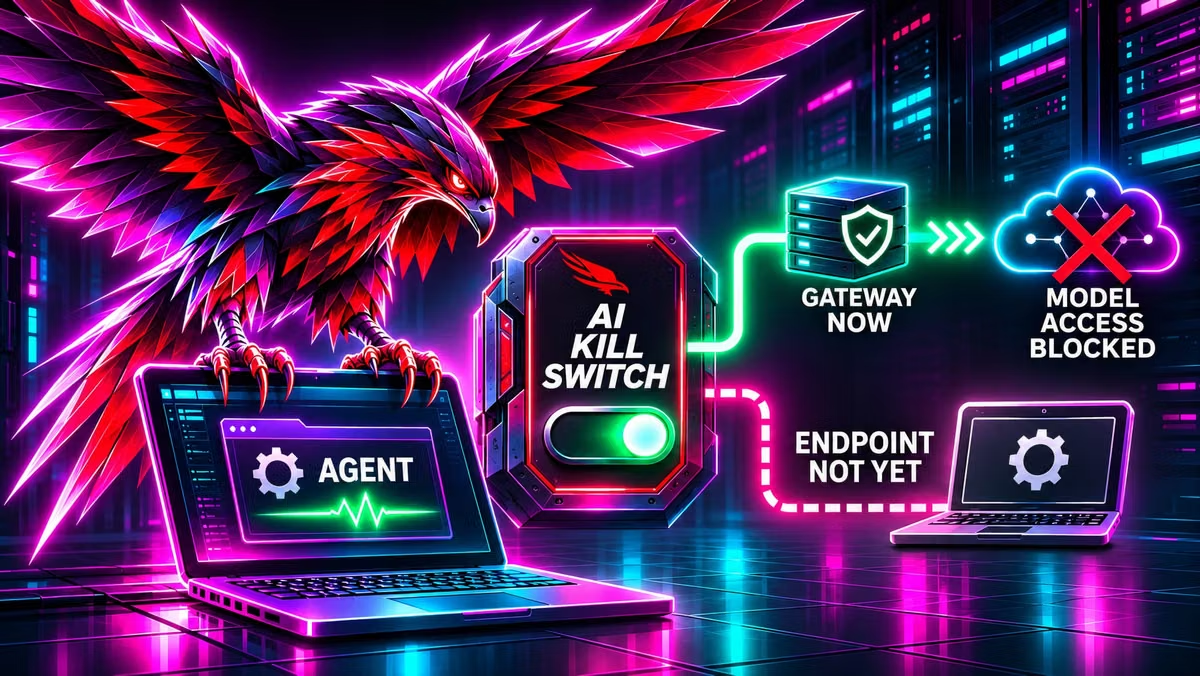
On November 3, George Kurtz sat across from Jim Cramer on Mad Money and made a clean promise. "Everyone is building AI agents, but they never had the off button, and now they do," the CrowdStrike chief executive said. Cramer pushed him further. If a company purchased CrowdStrike security products and one of its AI agents started doing something wrong, could it stop the agent cold? Kurtz said yes. He reached for an analogy anyone could feel, comparing the technology to the airbags in a car, a safeguard there for the moment something goes wrong. It carried a name built for maximum dramatic effect, the AI Kill Switch, and a promise to match. If an agent turned rogue, a defender could finally stop it.
The path to that promise looks very different when looking at the sequence of events leading up to the Cramer interview. On September 1, CrowdStrike launched Falcon Guardian around a clear architectural argument. AI agents should be secured "where they execute," on the endpoint at runtime. Kurtz called the endpoint the control point for AI agent security and said AI demanded the same approach CrowdStrike had pioneered with EDR.
September 3 brought a much less dramatic answer. Chief Product Officer AJ Shipley was asked directly whether Guardian could kill a rogue agent. He said CrowdStrike did not have that capability, at least not in the form customers might expect. The harder judgment still belonged partly to the customer because only the customer knew which assets were critical enough to protect. Three weeks later, on September 24, a published comparison of agent-security vendors still showed CrowdStrike with no public kill-switch claim.
On November 3, the language changed completely. CrowdStrike announced defenders could "terminate rogue agents at the root," terminate an agent "where it runs," and keep humans in ultimate control. The release said the Kill Switch "starts on the endpoint, where the Falcon sensor already operates." Hours later on Mad Money, Kurtz said CrowdStrike had engineered the missing off button. He told Cramer the company could stop agents in their tracks, on the endpoint and through network integrations.
Sixty-three days separated the first statement from the last. The engineering explanation published alongside the announcement shows something much less abrupt had actually happened.
Buried a few lines beneath the promise of termination at the root, CrowdStrike says the Falcon sensor stops the agent from executing "first at the Gateway, and soon on the endpoint." Its technical explanation is clearer still. The available Kill Switch directs connected AI gateways to block access to the models driving the agent's decisions and actions. CrowdStrike calls disrupting that access "only the beginning," and says comprehensive containment requires controlling the agent's actions and system access wherever it operates. Direct termination of rogue agents and their processes on affected endpoints sits in the section labeled coming soon.
The endpoint is the entire CrowdStrike thesis, not a distant control plane the company still needs to reach. The Falcon sensor already lives on the host, across hundreds of millions of devices, quietly doing much of the platform's heavy lifting. CrowdStrike spent September arguing this existing endpoint real estate gave it a structural advantage no one else could match. Securing an agent through the Falcon sensor where it executes is exactly what anyone who knows the company would expect. The strange part is the sequence. The AI Kill Switch reached the network gateway first and direct endpoint process termination second.
CrowdStrike made the contradiction sharper on the same day it announced the product. In a companion release explaining why its endpoint architecture matters, the company argued network-only tools can watch traffic but "can't stop the action, because the agent executes on the endpoint, not the network." It then went further. "The moment an agent runs a local or open-weight model that never touches the network, network-only tools go blind."
Set those words beside a "kill switch" whose available enforcement begins at the gateway and the problem no longer comes from a critic interpreting the architecture. CrowdStrike described the limitation itself. The company spent September explaining why the endpoint was the only place capable of seeing and controlling the full action. In November it launched the "kill switch" at the layer its own argument had already declared insufficient.
A gateway block is still useful. If an agent depends on a model reachable through a controlled gateway, cutting the connection can interrupt whatever it is doing. It can buy a defender time, prevent another model call, and break an active chain of reasoning. But interruption and termination are not the same control. One severs access to something the process needs. The other stops the process altogether.
That distinction becomes more important with agents than with much of the malware CrowdStrike built its name fighting. An AI agent is software designed to pursue a goal and work around obstacles it encounters along the way. Cut its preferred path to a model and, depending on how it was built and what access it holds, it may try to locate another route to achieve its goal. It could have another provider, another egress path, or a local model on the same host. CrowdStrike itself identifies the local-model case as a blind spot for network-only enforcement. A compliant agent follows the architecture its owner gave it. A compromised or misdirected one is precisely the case where assuming cooperation becomes dangerous.
The human stays in control throughout, and that part is sound. An authorized administrator flips the switch, and every action is logged. But Kurtz's airbag comparison exposes another problem when pushed beyond the television sound bite. An airbag does not wait for the driver to recognize a collision, assess what is happening, and decide whether deployment is justified. Sensors make the decision in milliseconds. CrowdStrike's Kill Switch waits for a human.
An off button therefore solves only the second half of the control problem. Someone still has to recognize an agent has crossed from useful improvisation into dangerous behavior, understand enough of what it is doing to justify intervention, and act before the agent completes whatever made the intervention necessary. AI agents operate at machine speed and often behave differently from one run to the next.
Kurtz was open about the urgency behind the launch. He called enabling agents to work safely a massive market opportunity, and CrowdStrike has primed that market with a memorable figure. One Fortune 500 customer turned on agent discovery and surfaced 18,000 agents against 300 approved. CrowdStrike would not say how many of the remaining 17,700 represented genuine shadow deployments rather than multiple instances of developer tools scattered across endpoints. The figure sizes the fear, and the Kill Switch sells the answer.
The legal language underneath the announcement draws a boundary the television appearance blurred. CrowdStrike says unreleased features remain in development, are subject to change, and should not drive customer purchase decisions. Gateway enforcement is available now. Direct endpoint termination, along with coordinated containment across cloud, identity, SaaS, and browser environments, is not. The marketing describes the completed control architecture in the present tense while the forward-looking statement tells customers to buy only what exists today.
The company usually earns that latitude. CrowdStrike reads the shape of the problem correctly, an off button for AI agents is a good idea, maybe a necessary one, and it is running a play it has run before. The company has a long record of announcing an ambitious capability, shipping a deliberately narrow first version, then building it into something formidable over the following months and years. EDR itself followed that path. Customers know the pattern, which is why many buy on the roadmap rather than the release notes, taking the early version to deploy estate-wide and learn its administration while the harder pieces land. On delivery, CrowdStrike has earned the benefit of the doubt.
What works today is real. Guardian already discovers agents, connects their behavior to endpoint telemetry, applies policy, and gives defenders visibility into activity traditional controls struggle to see. The available Kill Switch adds another genuine control. A defender can cut an agent off from the models reachable through a connected gateway and intervene while an investigation continues.
The gap sits between that capability and the language wrapped around it. The press release promises termination at the root, then concedes a few lines later that endpoint termination is still coming. The companion release explains why network controls cannot stop endpoint action, while the product available today begins by enforcing at the network. The technical blog calls gateway disruption only the beginning.
Even when the rest ships, the hardest part of the job was never going to be the switch. Catching the instant an agent turns from useful into dangerous, fast enough for a human to intervene, is a problem of judgment at machine speed, and no off button answers it. CrowdStrike has shipped the first layer of an AI containment architecture and named it after the finished one.