
Fear of a Breach Is How The Gentlemen Get Paid
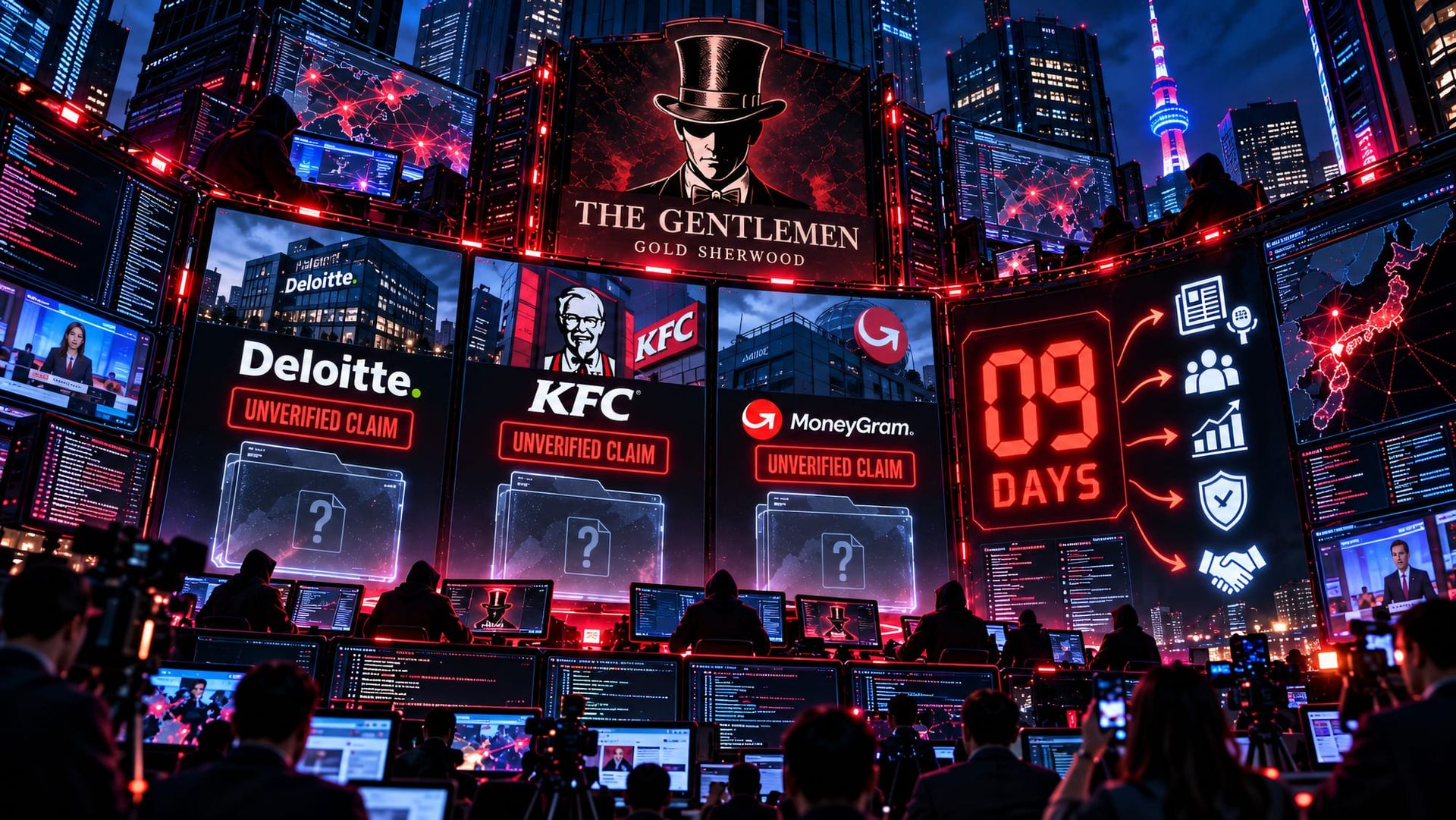
the ransomware-as-a-service operation known as the gentlemen added roughly ten names to its dedicated leak site this month. deloitte, kfc, and moneygram were the ones built for larger headlines. none of the three has publicly confirmed the gentlemen’s claim, no supporting files have been posted, and the listings still lack the evidence needed to move them from accusation to confirmed compromise. a dedicated leak site entry is almost a product of its own.
a name on a dedicated leak site is not proof of a breach. it is an adversary claim attached to a countdown clock. the gentlemen did not say what data it allegedly holds from these three organizations, how much it took, or how access supposedly happened. it posted recognizable names, gave them roughly nine days, and let everyone else amplify the pressure.
that mechanism works before anyone knows whether the underlying claim is true. the victim has to investigate. journalists have a famous company to write about. customers start asking questions. investors notice. search results begin connecting the brand with ransomware before a single stolen file has appeared.
the dedicated leak site is also talking to another audience. prospective affiliates see a service appearing busy, successful, and capable of landing names large enough to make international news. one post can pressure a victim, generate free media coverage, and advertise the ransomware-as-a-service operation to the criminals deciding which platform to rent next.
that is why the distinction between a listed victim and a verified victim matters so much. the dls tells us what the gentlemen wants the world to believe. it is not an audited incident database.
deloitte is the perfect name for burning an analyst who forgets the difference. there is currently not enough public evidence to assess the new claim with confidence. the same is true for kfc and moneygram. all three remain mere allegations at this juncture.
older incidents make the picture even easier to muddy. moneygram suffered a separate cyber attack in september 2024 in which an unauthorized third party accessed and acquired customer information. that was a real breach, but moneygram said there was no evidence it was caused by ransomware.
deloitte has its own unrelated 2024 history. the deloitte-operated ribridges system in rhode island was breached after unauthorized use of deloitte credentials. in that intrusion files were exfiltrated. the extortion group brain cipher later released data, but an independent crowdstrike investigation found no evidence ransomware actually executed inside the ribridges environment.
neither incident validates what the gentlemen posted this month. familiar company plus previous cyber incident does not equal corroboration. sometimes history adds context. sometimes it is just an attractive way to manufacture certainty from coincidence.
the operation behind the new claims is very real, though, which is where the story gets more interesting. sophos tracks the gentlemen as gold sherwood, and describes a double-extortion ransomware-as-a-service operation emerging in mid-2025. victim names began appearing on its dedicated leak site that september. the same month, the group advertised on the ramp cyber crime forum with a ninety-ten split letting affiliates keep ninety percent of ransom proceeds.
that is an aggressive offer in a market where the affiliate is the customer. the ransomware operator supplies the locker, infrastructure, negotiation framework, leak site, and brand. the affiliate brings access, runs much of the intrusion, and expects to be paid for the trouble.
the recruitment appears to have worked. fewer than twenty names were posted each month during the remainder of 2025. by early 2026, the average had climbed above seventy-five. sophos counted 683 names on the gentlemen’s dedicated leak site by the end of july, with 169 added in july alone.
but sophos did not use those 683 listings to tell us how the intrusions actually work. its technical picture came from fifteen incidents it investigated. that difference is almost the entire lesson. one dataset records what criminals published about themselves. the other records what defenders actually observed inside compromised networks. they answer different intelligence questions and deserve different assessments.
the gentlemen’s origin story is also a useful reminder that ransomware brands are businesses before they are identities. halcyon traces the operation back to armcorp, a prolific affiliate cluster that worked inside the qilin ransomware ecosystem. one of the central actors used the handle hastalamuerte and is tracked elsewhere as larva-368. before going independent, the actor had reportedly accumulated more than a dozen victims during roughly six weeks as a qilin affiliate.
then came the money problem. on july 22, 2025, hastalamuerte filed what amounts to a criminal underground arbitration complaint on the ramp forums. the allegation was that qilin’s operator, known as haise, had withheld roughly us$48,000 in bitcoin commissions owed to the affiliate.
there is something almost wonderfully mundane about organized ecrime eventually arriving at a payment dispute. the business steals from companies for a living, then needs a forum moderator when one criminal allegedly fails to pay another criminal their contractual share. ramp apparently closed the dispute without sanctioning qilin.
five days before it became public, on july 17, the first known gentlemen ransomware sample had already appeared on virustotal. the binary contained the address of the gentlemen’s new leak site. the divorce paperwork was filed after someone had already rented the apartment.
that means the new operation was not simply an emotional reaction to a bad day on ramp. the infrastructure and branding were already being prepared while armcorp was still publicly associated with qilin. by september, the gentlemen was recruiting its own affiliates and publishing victims under its own name.
halcyon assesses that lineage with more confidence than sophos does, so it is worth keeping the source distinction visible. the connection is compelling, but it comes primarily from halcyon’s reconstruction of the criminal ecosystem rather than from the fifteen intrusions sophos used for its technical findings.
the branding changed quickly. much of the underlying economics did not. sophos saw affiliates gain access through weakly protected remote services, including valid vpn credentials where multi-factor authentication was absent. once inside, they abused legitimate domain accounts and remote administration tools to move through the environment.
then they attacked the things that decide whether the victim still has choices. the affiliates used bring-your-own-vulnerable-driver techniques to interfere with endpoint security and aggressively targeted backup infrastructure before deploying ransomware. sophos observed more than two hundred variations of service-configuration commands used against backup and recovery products, including veeam and backup exec.
data theft has used tools such as rclone, restic, and the minio client. the tooling changes because the affiliate changes, and because a rented ransomware brand does not require everyone using it to run the same intrusion.
speed is part of the value proposition. across the incidents sophos could measure, the median time between first observed post-compromise activity and ransomware deployment was around two days. the fastest cases moved in less than twenty-four hours.
that does not mean every gentlemen intrusion begins or ends the same way. it means the affiliate model can turn available access into encryption quickly enough that the recovery architecture needs to work before the victim knows it is being tested.
the backup step matters because encryption loses much of its leverage when a victim can restore and walk away. take the recovery path away first and the economics change. the organization is no longer deciding whether restoring is inconvenient. it is deciding whether restoring is possible.
double extortion preserves the other half of the pressure. even a perfect restoration does not pull stolen data back across the network. an independent recovery copy can neutralize the encryption problem while leaving the confidentiality problem completely intact.
that distinction connects the gentlemen to some of the worst ransomware outcomes this year without pretending the incidents are the same. attackers keep reaching for backups, snapshots, hypervisors, and recovery services because a victim with an independent way back has negotiating power. a victim without one has a deadline.
the ransomware-as-a-service model also makes the logo on the ransom note increasingly poor shorthand for who actually broke into the network. the brand tells you who supplied the commercial ecosystem. it does not necessarily tell you who was sitting at the keyboard.
affiliates can move between programs when economics change, infrastructure disappears, operators cheat them, or a competitor offers a better split. the locker changes. the leak site changes. the affiliate may keep using the same stolen credentials, exposed vpn appliances, weak remote access, and familiar administrative tooling. following the brand can therefore tell you less about the intrusion than following the access method.
the gentlemen’s own origin proves the point. a qilin affiliate allegedly got tired of waiting for money, prepared another ransomware service, fought about the commission in public, and then competed against the program it had just left. the top hat is new. much of the market underneath it is recycled labor.
that also explains why the dedicated leak site matters beyond individual extortion. ransomware-as-a-service operations have to recruit affiliates just as affiliates have to select between them, and visible victim volume is part reputation, part intimidation, and part sales pitch.
by july, the gentlemen had placed 683 names on that stage. sophos needed only fifteen real investigations to show that behind the theater sits an operation capable of moving from access to ransomware in hours, killing defenses, attacking recovery, stealing data, and deploying encryption across enterprise environments. those are two different truths. one is what the criminal wants everyone to see. the other is what happened when defenders looked inside.
that distinction brings us back to deloitte, kfc, and moneygram. a dls listing deserves collection. it deserves monitoring. it may justify outreach and further investigation. it does not deserve automatic promotion to confirmed breach simply because the company name makes a better headline that way.
some of these claims may turn out to be real. some may not. the public evidence today does not answer the question. the gentlemen does not need the uncertainty resolved immediately. uncertainty is useful. every hour the target remains silent leaves customers wondering, reporters calling, and competitors watching the countdown.
that is the clever part of the product. the actual intrusion creates technical leverage. the dedicated leak site creates leverage from the possibility of the intrusion before the rest of us can establish what happened. the ransomware brand may be rented, the affiliates may change, and even the criminal enterprise itself was born from an argument over unpaid commissions. the pressure machine does not care. it only needs a recognizable name and enough ambiguity for the accusation to travel faster than the evidence.
the top hat is theater, but the theater has a business model. in ransomware, the breach creates leverage. on a dedicated leak site, the accusation can start working first.
the gentlemen do not need you to believe the breach. they need the victim to fear that everyone else will.