

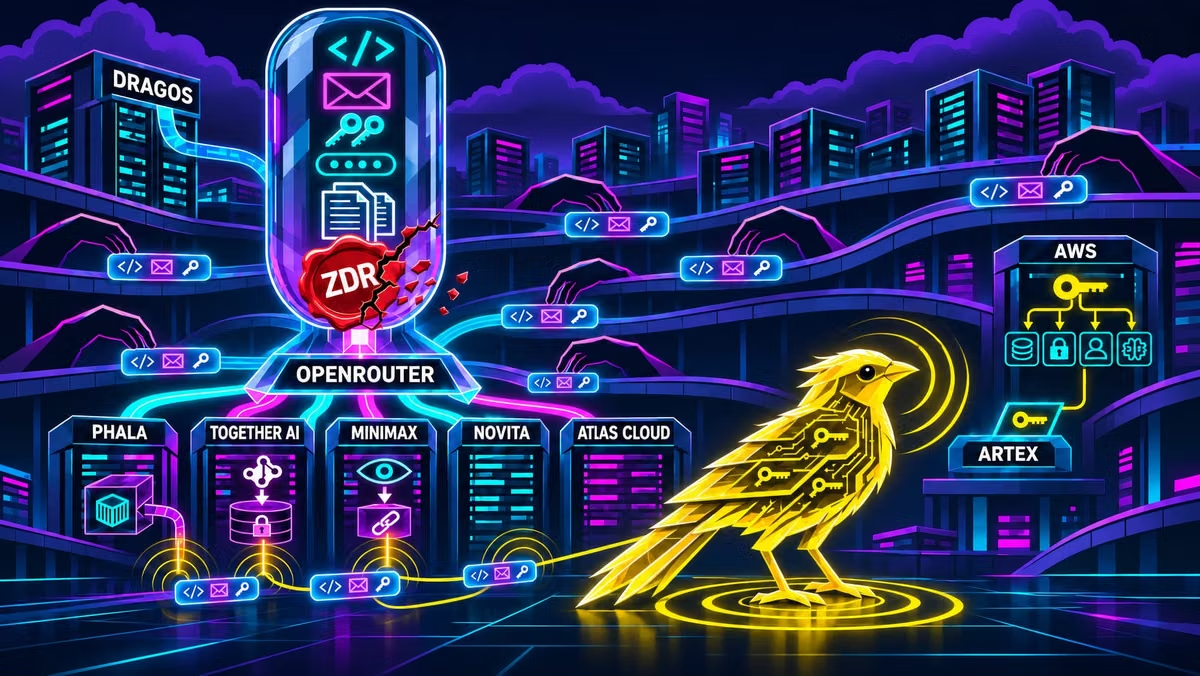
Companies hosting artificial intelligence (AI) models failed for months to detect intruders copying customer prompts from their servers. Dragos, a cyber security company focused on operational technology (OT), the systems running industrial equipment, sent bait prompts containing fake credentials and found intruders inside three providers. None detected the access before Dragos warned them. Some stolen requests were marked Zero Data Retention (ZDR), a setting specifying that the prompt and response should not be stored. Real customer requests passed through those systems and were almost certainly copied as well.
Prompts often contain source code, internal messages, business plans, and passwords. At Phala, a provider selling AI on hardware meant to keep customer data sealed, an intruder could read the 152,092 requests sent to one compromised server over just under 11 days, Phala reports. Dragos says the fake Amazon Web Services (AWS) keys hidden in its prompts were tried within a few hours in some cases.
Stolen AI keys are a known problem. Earlier analysis counted 16 AI developer platforms disclosing breaches in five weeks, the stolen keys feeding resellers of cheap model access. Chat transcripts from customers of the software company Notion were exposed through Fireworks AI, a platform for running open-source AI models, as an earlier brief recorded. Dragos located the leak inside the AI providers themselves. Intruders read requests customers had marked for no storage at all. Companies the providers quietly passed traffic to also read those requests.
OpenRouter, a service routing customers' AI requests to a pool of outside providers, dropped three of them on November 22. OpenRouter also stopped offering ZDR on 125 model listings and notified all potentially affected customers. The findings showed no breach of OpenRouter itself, the routing service says. Phala and Together AI, which run AI models for customers, have published notices. So have Novita and Atlas Cloud, which resell access to models from other developers.
Dragos has not named the three breached providers, and OpenRouter has not named the three it dropped, the security news site The Hacker News notes. Neither company has said whether the two lists match. Novita and Atlas Cloud both point to MiniMax, a Chinese AI developer, as the place where secret links planted in the bait prompts were opened after the requests left their systems. MiniMax has published no response to the findings.
Operation Timeline
Trace the events, turning points, and connections behind the analysis.
AI Provider Prompt Leak Timeline
Key events from the May 28, 2026 start of the Novita misrouting window to the Phala detailed report of November 23, 2026.
View Timeline Hide Timeline
-
May 28, 2026
-
July 1, 2026
-
Mid-July
-
July 14, 2026
-
October 20, 2026
-
October 21, 2026
-
October 22, 2026
-
November 1, 2026
-
November 1, 2026
-
November 5, 2026
-
November 8, 2026
-
November 10, 2026
-
November 19, 2026
-
November 21, 2026
-
November 22, 2026
-
November 22, 2026
-
November 23, 2026
-
November 23, 2026
Bait Prompts Turned Every Read Into Evidence
Dragos published its findings on November 19 after testing AI providers with bait no legitimate system would ever touch. From July through November 2026, Dragos sent approximately two million prompts to widely used AI services, each carrying unique web addresses and fake credentials known as canaries. A canary exists in exactly one place, so any use of one proves someone read the prompt carrying it. HD Moore, the Dragos chief research officer and creator of the Metasploit penetration testing framework, led the work.
The first canaries came from Thinkst Canarytokens, a free service alerting its owner when someone uses a planted key or link. Every July request carried an AWS key, a web domain name registered in the Domain Name System (DNS), and a web address never seen anywhere else. Dragos then built its own service, generating unique hostnames, addresses, and credentials for every prompt. Dragos reports running the services those credentials point to, among them web, git code repositories, Secure Shell (SSH), databases, and mail.
An AI router gives customers one application programming interface (API), a single connection point for their software, and forwards each request to one of many models, often at several hosting companies. Every hop can see the entire prompt and response, Moore writes. Some routers are open marketplaces where the seller with the lowest price gets the request. The route a prompt took therefore matters as much as the provider at its end.
Every touch on a canary ties back to the exact prompt, model, router, and privacy setting carrying it, Moore writes. The logs record which DNS server a reader used, how long it took to reply, and every piece of the inbound connection, down to the credentials typed. Five kinds of bait, each aimed at a different reader, caught the leaks in the sections below.
- AWS keys. Real keys tied to empty accounts with full logging, aimed at anyone testing stolen cloud credentials. These caught the threat actor described in the section on stolen keys.
- Secret web addresses. Links seen nowhere else, aimed at any system or person opening links in a prompt. These caught the scraper at a Chinese AI lab, described below, and a link posted into a chat on Feishu, a Chinese workplace app.
- Login pages. Secret links leading to a working login page, aimed at a human reader. One caught a reseller on an AI marketplace guessing usernames.
- SSH servers. A root password for an SSH server, aimed at hands-on intrusion. These caught a person in France typing logins by hand.
- Private git repositories. The address of a code repository, aimed at anyone collecting source code. These caught a git client trying to copy repositories.
Canaries show that a prompt leaked, not where along the route it leaked. A router typically reports a single upstream provider, and that provider is often another router, according to Moore. To see who actually handled each request, Dragos built a tracing method resembling traceroute, the network tool listing each hop a packet passes through.
Each Dragos request carries an image address pointing back to Dragos servers. Every system fetching that picture reveals its internet address, the web software it runs, and a timestamp. Dragos also sends small, slightly broken requests along each route.
Each router tends to wrap the error from the hop behind it in its own format, so a single response can hold three or four nested envelopes. Matching each envelope against a signature database, a catalog of known error formats, yields the list of hops, the software at each one, the network each uses, and often the business operating each hop.
Dragos has published neither the signature database nor the tracer. Of about two thousand routes traced, several hundred included a system Dragos could not identify. A handful of routes sent the tracking image to a company not on the advertised path at all. One marketplace seller quietly adds about a thousand hidden tokens, the units of text a model reads, to every prompt. Another fetches images through a shared consumer subscription account, and Dragos does not say whose.
One published trace ran from Surplus Intelligence, an open market routing AI requests to whichever seller offers the best price, to the AI developer Anthropic. The trace exposed an OpenRouter hop the marketplace never disclosed. Each Dragos report to a breached provider carried the list of stolen requests and unique strings the provider could search for in its own logs.
Canaries catch leaks only in the requests carrying them. The researcher's tests sampled requests and did not watch every one, the Phala preliminary report notes. A provider with no canary hits is not proven clean, and a hit shows only that the requests carrying canaries leaked.
Phala Let an Unsecured Test Server Handle Real Customer Requests
Phala published the most complete account of an AI provider breach in its detailed report on November 23. From October 21 to November 1, an intruder could read requests sent through OpenRouter to a model by Chinese developer DeepSeek. Phala runs each customer workload in a confidential virtual machine (CVM) on dstack, its open framework, behind trusted execution environment (TEE) hardware. The TEE hardware worked as designed, Phala says. The intruder came in through server management software and a key-release policy trusting the wrong callers.
On October 20, Phala started an experimental DeepSeek V4 Flash 0731 deployment on GPU3, a new graphics processor server, and the deployment took real OpenRouter traffic before getting production security controls. A CVM running Grafana monitoring software, set up beside the deployment, still had its default administrator password. At 20:15 on October 20, the Phala report says, the threat actor logged into Grafana with that password.
From Grafana the threat actor reached the virtual machine manager (VMM), the host software creating and configuring CVMs, at 02:12 on October 21. The VMM accepted any request coming from the server itself without asking for credentials, Phala says. The threat actor swapped the startup script of the DeepSeek CVM, which runs with full administrator (root) rights before the application starts. The new script added the threat actor's SSH key to /root/.ssh/authorized_keys, and by 02:34 the CVM was fully compromised.
At 04:55 the threat actor restored the original settings, leaving a rootkit, hidden malicious software, running in its own isolated software container. The rootkit read the contents of incoming requests. The first leaked canary key sat in a request sent at 03:27 on October 21. The DeepSeek experiment ended at 02:03 on November 1, Phala says, and Phala took the deployment down unaware of the intrusion. By then 152,092 requests had reached it, 0.45 percent of all Phala requests in that period.
Phala did not detect the intrusion. On November 8, an independent researcher Phala does not name showed Phala that canary credentials sent in October had been misused. The first recorded misuse came at 05:41:23 on October 22, and the last at 01:05:17 on November 7. Phala still does not know what the rootkit ran or where the stolen requests went. The first Phala report, on November 10, had warned of a longer exposure, from October 21 to November 8, before the investigation narrowed it.
On November 5, the threat actor came back and took the master key of the older Phala Cloud key management service (KMS). Every application key on that service is derived from the master key, which the KMS handed to callers seven times that day, the first time to the threat actor's own internet address. The provider warns the threat actor can recreate any key derived from the old master key, indefinitely. By November 21, 2,179 of 2,271 affected CVMs had moved to new keys.
A single SSH key ties the October and November intrusions to one threat actor, Phala says. The key, with fingerprint SHA256:mv3U4QYpcwhOUm+s2TBhtxecUdtmm0jFiOiq8A8jDUQ, was written on GPU3 and built into a container template on two other servers. The key belonged to a third party, not to Phala, and Phala does not say whose. The first recorded scan of the Phala Cloud servers came from 82.29.131[.]62 at 19:33 on November 4. The provider also concedes AI security scans of its code "did not find what the attacker found."
Together AI Lost Prompt Samples to an Agent's Commit
Together AI, an AI provider running models for customers on its own cloud, disclosed on November 21 that an outsider tried to use five Dragos canaries taken from its stored prompts. An unauthorized party downloaded saved prompt samples after a credential for a private repository surfaced in public code, the Together AI notice says. Together AI kept the samples in a private repository on Hugging Face, a site for hosting AI models and data, for routine software testing.
An AI coding agent working on xorl, a public Together AI repository on GitHub, committed that credential into the public code. Automated scanning at Together AI caught the credential, and the company reverted the commit. Before the revert, an unauthorized party obtained the credential and downloaded the samples.
The samples came from requests to the MiniMax M3, GLM-5.2, and Kimi K2.6 models. GLM-5.2 comes from the Chinese developer Z.ai, and Kimi K2.6 from the Chinese developer Moonshot AI. Most samples date to June 24, July 4, July 8, and July 14, 2026, Together AI says. The outsider searched the samples for credentials to other services and tried them, and five were Dragos canaries.
Together AI worked with an outside forensic firm and law enforcement. The provider made ZDR the default for new accounts and is changing its rules for AI coding agents. The notice names no threat actor and does not say when the credential was exposed or when the download happened. Together AI is still reviewing what information was exposed and which customers require direct notification.
Agent tooling has exposed Hugging Face credentials by another route. Versions 1.26.1 and 1.26.2 of the Microsoft agent-framework package, used to build AI agents, carried a credential stealer collecting those tokens among other secrets, as earlier analysis of that compromise recorded. AI agents will send whatever they can read, including credentials, Moore warns.
The earliest breach Dragos found dates to mid-July, at a provider Dragos does not name, and most Together AI samples come from July. The unnamed provider first blamed a misconfigured internal tool, then a partner's data handling, before finding its internal credentials compromised, according to Moore. As of November 19, the provider breached in mid-July had not disclosed the incident publicly. Neither Dragos nor Together AI links the two accounts.
Stolen AWS Keys Were Used to Hunt for Data and Run AI Models
Whoever stole prompts from the AI providers tried each fake AWS key in them to see whether it worked, in some cases within a few hours of the request. With a working key, the threat actor listed the storage buckets, the folders holding files, in Amazon Simple Storage Service (S3). The threat actor also searched AWS Secrets Manager and Parameter Store, the AWS services holding passwords and keys.
The threat actor then tried to switch on AI models in Amazon Bedrock, the AWS service offering AI models. The threat actor created Bedrock keys and added its own users through Identity and Access Management (IAM) to keep access. In total the bait keys drew tens of thousands of calls to AWS. One key seeded on October 21 was first used the next day and was still in use three weeks later.
One threat actor appears to have compromised two providers simultaneously, using secrets from both on one rented server. Dragos does not say which two providers, or whether the adversary also breached Phala. The tooling changed over three weeks, from a script posing as Chrome on Windows to the AWS command line on Kali Linux, a Linux version built for penetration testing, Dragos reports.
On November 1, the threat actor added ARTEX, an open-source tool using a large language model (LLM) to run penetration tests with little human input. ARTEX made only a handful of calls, checking whether the stolen keys still worked. The Federal Bureau of Investigation (FBI) warned in FLASH alert FLASH-20261113-001 on November 13 that various threat actors have used ARTEX since at least August 2026. A developer going by Autumn-27 first released ARTEX on GitHub in July 2026, the trade publication Industrial Cyber reports.
ARTEX labeled its requests with two user agents, the name tags software attaches to each web request, artex-agent and artex-judge-r121. Neither appears in any public indicator list Dragos could find. Dragos reports Kali and ARTEX both named themselves in user agents logged by AWS CloudTrail, the AWS activity log, but only in a small fraction of traffic.
Fast use of stolen cloud keys shows up in other measurements too. Lauren Proehl of the THOR Collective newsletter planted keys on a fake developer server from July 7 to November 7. Proehl measured a median of 37 minutes from theft to first use, and about half the keys stolen in September and October were checked for Bedrock.
Her keys sat in files on an exposed server anyone could scan. The Dragos keys went only to AI providers, so any use of one proves the leak came from a provider. Organized eCrime hunts cloud credentials too. SLIM SPIDER, a Brazil-based eCrime adversary tracked since March 2026, queries the cloud metadata service, the internal address handing temporary credentials to running servers, and enumerates the secrets behind them, as earlier analysis recorded.
ARTEX ties the provider thief to a tool used for both eCrime, financially motivated cyber crime, and espionage. Microsoft tied ARTEX use to Storm-0940, a China state-aligned adversary active since 2021, as earlier analysis of the framework records. A European Union official told Politico ARTEX was the tool in the intrusion at the European Commission, the European Union executive. In a separate intrusion, a forgotten vendor key let ARTEX cross about ten cloud accounts at the security vendor Barracuda in 44 hours.
The identity software company WorkOS also identified ARTEX through the user agents in the requests during an earlier intrusion against WorkOS. Other open-source attack frameworks run on Chinese models too. A China-nexus threat actor Unit 42 tracks as CL-STA-1238 ran Cairn, another open-source AI penetration testing framework, on GLM and DeepSeek models in 25 attacks against at least 19 organizations, breaching 10. ARTEX use alone identifies no one, because eCrime threat actors and espionage adversaries both run the framework.
Home Broadband Users Tried Passwords From Logged Prompts
Some resellers of AI providers' models on a marketplace Dragos does not name simply logged and kept the prompts sent to them, Moore reports. The resellers are separate from the three breached providers. The resellers exploited no vulnerability and bypassed no platform controls. The sellers only had to list a model at the lowest price, enable request logging, and wait.
The marketplace sellers looked like individuals, working from what looked like home internet connections and personal computers. In one case, two prompts went through a single seller. About a day and a half later, someone on home broadband opened both secret links in a desktop browser and started guessing usernames at the login page.
Prompts for that model sent through a different seller were never touched, so the leak followed the seller, not the marketplace. In another case, Dragos reports, someone on a Mac on a home broadband line in France took passwords from two prompts. The person then tried to log in as root over SSH, typing each attempt by hand, and used one password four times in two minutes.
One key reached the marketplace by another route, through a router other than the one Dragos chose, quietly passing some of its traffic to the marketplace sellers. The second router told Dragos the forwarding stopped. In the shadier marketplaces, sellers often pay for the AI usage with stolen AWS credentials or consumer API keys, Moore adds.
Zero Data Retention Stopped at the First Company
ZDR promised AI providers' customers their prompts would not be kept, and OpenRouter defines ZDR as no routine storage after processing. Providers often ignore privacy settings, intentionally or through bugs in their processing flow, Dragos reports. The clearest case involves a Chinese AI lab Dragos does not name.
The lab's systems fetched the secret links from more than half the prompts sent to its models between July and October. Of the requests marked "no data collection" or ZDR, roughly two-thirds had their links fetched. The scraper typically arrived two or three days after the request. Several American companies resell the lab's models, and prompts sent to those resellers triggered the lab's scraper too.
Later, a git client on a cloud network separate from the scraper tried to copy the private code repositories referenced in the prompts, but only for prompts using that lab's models. A customer picking an American provider to keep data in the United States did not get what the customer paid for, Moore writes.
Two resellers now point at MiniMax. A routing mistake sent some MiniMax requests to the official MiniMax API instead of Novita's own servers, the Novita notice confirms. Requests to MiniMax models through Novita between May 28 and November 11, 2026, may have been accessed or kept by a third party, including requests routed through OpenRouter. The independent researcher saw links and hostnames opened but no use of the AWS keys, and Novita thinks automated content review may explain the access.
Atlas Cloud reports links opened from MiniMax M3 and M2.7 prompts sent through its service in the third and early fourth quarters of 2026. The testing points to the access happening after requests reached MiniMax, not on the reseller's own systems. The reseller stopped sending requests to the official MiniMax API and pulled all its models from OpenRouter by its own decision. Moore now tests the Atlas Cloud models four times a day.
OpenRouter later emailed customers that the links were opened whether prompts went to MiniMax directly or through resellers such as Novita and StreamLake, The Next Web reports, citing Ars Technica. Links in direct requests were opened too, which places the reads at MiniMax rather than at any reseller.
Large American providers have issues of their own. One kept crawling a secret link more than two months after Dragos used the link once in a request to that provider's search service. Another runs a scraper returning for the planted links days after each request, whichever router carried it.
Twenty-four days after one prompt went out, Dragos reports, its secret link was posted into a channel on Feishu, known outside China as Lark. Within two minutes, three desktops and three phones in Beijing and Shanghai opened the link. When Dragos reported the leak to that provider, the report carried only the first eight characters of the link, so whoever shared the full link was reading a stored copy of the prompt.
The Dragos account of the Feishu prompt is inconsistent. One sentence says the prompt went to a Chinese provider, and the next says the request went to a provider based in the United States with the ZDR flag. Under either account, people read a stored ZDR prompt more than three weeks after the request.
ZDR is only as strong as each provider's own terms. OpenRouter shows the retention policies "as reflected in each provider’s terms" and leaves it to customers to avoid providers falling short. OpenRouter now requires assurances and validation before restoring ZDR to any listing it removed. Novita is improving its disclosures of the retention policies and terms of service behind its listings. Customers who sent personal or regulated data now have evidence it was kept or shared against a provider's stated policy.
Three Explanations for Who Opened the MiniMax Links
Atlas Cloud traced the opened links to requests reaching MiniMax, which also sells access to its own models as an AI provider. A joint advisory from the National Security Agency (NSA), the Cybersecurity and Infrastructure Security Agency (CISA), and the FBI named MiniMax among six Chinese AI developers. The agencies accused the six of distilling American models, training their own on the American models' answers. Earlier analysis covered the advisory, which concerned querying American models, not reading customer prompts.
Hypothesis 1, Automated Content Review
MiniMax or a contractor scanned incoming prompts and fetched embedded links as part of safety or abuse review. Novita leans toward this reading, saying the access patterns suggest automated content review. Dragos also lists safety and abuse monitoring among the common reasons providers store prompts. Fetches from crawler infrastructure alone, with no logins and no human follow-up, would support content review.
Hypothesis 2, Collection for Model Training
MiniMax kept prompts, including ZDR prompts, and fetched linked content to build training data. Training is among the purposes providers store prompts for, according to the Dragos report. Long retention and link fetches at scale, with no credential use, would support training collection. A scraper arriving two or three days later fits a batch job run after the fact better than a safety check made while answering the request.
Hypothesis 3, Human Collection of Customer Data
People read customer prompts for intelligence or commercial value. The git client trying to copy private repositories referenced only in prompts to the lab's models fits human collection. Logins with credentials taken from the prompts would separate human collection from the first two hypotheses. No login attempt tied to the lab appears in the Dragos report, and no source ties the Feishu case to MiniMax.
The evidence leans toward Hypothesis 2, with Hypothesis 3 unproven. No AWS canary sent through Novita to MiniMax was used, which argues against people hunting for credentials. The copy attempts came from a separate cloud network, and no source ties that network to MiniMax itself. I assess with low confidence the reads served model training rather than safety review or human collection. A MiniMax statement on retention, or logs showing human use of the fetched content, would change that judgment.
Phala Fits the Largest Breach and MiniMax Fits the Chinese Lab
The unnamed AI providers in the Dragos research can be matched to named companies with differing confidence. Intruders sat inside at least three AI providers, copying prompts including ZDR prompts, and no provider detected its own breach. Marketplace sellers read prompts with nothing more than request logging. Prompts sent to American resellers of a Chinese lab's models were opened after reaching the lab, against the privacy settings on the requests.
The largest breach Dragos describes, measured by stolen keys, involved a couple hundred AWS keys, each sent once in a few short windows in late October. Phala says only canary credentials sent on October 21 and 22 were misused. The research also mentions a preliminary security notice from one breached provider, which fits the Phala report of November 10. I assess with moderate confidence the largest breach happened at Phala. A statement from either company confirming the match would settle the question.
The Together AI samples date mostly to July, and a compromised credential exposed them, both fitting the mid-July breach. Against the match, Together AI blames a public commit, while Moore describes a provider first suspecting an internal tool and a partner. I assess with low confidence the mid-July breach happened at Together AI. A disclosure naming the mid-July provider would settle the match.
Novita confirmed requests went to the official MiniMax API, Atlas Cloud says access followed requests reaching the Chinese developer, and OpenRouter's email reports opened links on direct requests too. I assess with high confidence the Chinese AI lab Dragos describes is MiniMax. A MiniMax account of its own scraper would confirm or overturn that judgment.
Defending Prompts Past the First Hop
Customers of the AI providers who sent DeepSeek V4 Flash 0731 requests through OpenRouter between October 21 and November 1 should change every credential in those requests, as Phala directs. Customers who used MiniMax models directly or through Novita or Atlas Cloud should treat any secret sent as exposed. Any customer OpenRouter notified about the three dropped providers should change secrets sent through them.
The defenses Dragos recommends are concrete. Host sensitive work yourself where affordable, since self-hosting is the only option where no one else reads the prompt, though an eight-GPU NVIDIA B300 server lists for US$570,000 or more. Go directly to a first-tier provider, such as the model's developer, with one company, one contract, and one privacy policy. On any router, pick the providers yourself instead of the default pool, check that a privacy setting changes which providers receive the requests, and stay away from reseller marketplaces.
Put a fake credential into the material your AI agents and pipelines already send, and treat any use of it as an incident, as Phala now plans to do. Turn on settings stripping recognizable passwords and keys from prompts, knowing they miss sensitive data shaped unlike a key. Hunt CloudTrail for the artex-agent and artex-judge-r121 user agents.
Enterprises routing through OpenRouter can enforce the Dragos advice on every request. The provider routing settings accept a fixed list of providers to try in order and a switch turning off backup providers. A data collection setting of "deny" excludes providers that may store data, and a separate flag restricts routing to ZDR endpoints. An account-wide ZDR setting applies to every request, and a per-request setting can only tighten it. The routing settings choose who receives the request and bind only that first hop.
Article 28 of the General Data Protection Regulation (GDPR) reaches past the first hop when prompts carry personal data of people in the European Union. The enterprise is usually the controller, and the AI provider its processor. A processor "shall not engage another processor without prior specific or general written authorisation of the controller." Article 28 also requires the processor to allow and contribute to audits. Article 33 requires breach notice to the controller "without undue delay after becoming aware of a personal data breach."
The National Institute of Standards and Technology (NIST) Generative AI Profile tells organizations to draft contracts and service level agreements specifying security requirements for generative AI systems. The profile also tells them to review vendor contracts for terms contributing to unauthorized data collection by vendors or third parties, such as secondary data use. An AI provider contract built on both documents names every company a prompt may pass through, forbids unnamed resellers, and sets a breach notice deadline in hours.
One stolen canary key stayed in use for three weeks, which is why a credential in a prompt must expire. The Open Worldwide Application Security Project (OWASP) list of risks for LLM applications counts security credentials among the sensitive information an AI application can disclose. AWS Security Token Service (STS) credentials last from a few minutes to several hours, and AWS rejects them once they expire. IAM Roles Anywhere issues temporary credentials to servers and containers running outside AWS.
Together AI's credential went public through a commit by an AI coding agent. GitHub push protection blocks pushes containing secrets before they reach the repository, while the scanning at Together AI caught the credential only after the commit. Give each agent tokens reaching only the repositories and storage its task needs.
The canary key thief's moves in AWS left records in CloudTrail, the log where Dragos found the ARTEX user agents. CloudTrail captures all API calls for Amazon Bedrock and logs the model calls themselves, such as InvokeModel and Converse, as management events. Alert on Bedrock model access, new Bedrock keys, and new IAM users from unfamiliar networks, the three moves the thief made.
Running dstack yourself brings the Phala failure modes in-house. Phala tells anyone running dstack to upgrade to at least version 0.5.13 or 0.6.2, and says version alone was not the cause. Every VMM management endpoint must require credentials, because a request from the server itself, known as loopback access, is not authentication, Phala adds. Workloads handling real user data need a key provider enforcing the deployment policy, the approved system image and configuration, and any key request from an unregistered caller should raise an alert.
Pin the providers, turn off fallbacks, deny data collection, and write every onward hop into the contract. Issue agents only expiring credentials, block secrets at the push, plant canaries, and watch CloudTrail for Bedrock access, new IAM users, and the ARTEX user agents. Above all, keep live credentials out of prompts, because a privacy flag binds only the first hop and every later hop can see the whole request.
Analyst Annex
Evidence status as of November 24, 2026. The records cover the Dragos canary research of November 19, the separate Phala and Together AI intrusions, the OpenRouter response, and the MiniMax request handling Novita and Atlas Cloud disclosed. Dragos does not name the three breached providers, OpenRouter does not name the three providers it dropped, and no source confirms the two lists match. Matching the unnamed Dragos incidents to the Phala or Together AI disclosures is an assessment of the analysis above.
Phala publishes the only internet addresses tied to an intrusion, and Dragos publishes two user agents tied to use of stolen canary keys. No source attributes the opened links at the Chinese lab to a threat actor. The indicator table leaves out legitimate services and common file paths, which would block normal traffic, and marks the internal dstack detection pivots as context only.
Confirmed marks evidence published by a victim, vendor, regulator, or government authority about its own systems, decisions, or investigation. Reported marks technical findings or attribution assessments published by a third party. Claimed marks statements by a seller or self-identified threat actor that remain unverified. Provisional marks an analytical mapping supported by reported behavior but not made by the original source.
Indicators
| Indicator | Context | Status |
|---|---|---|
| IP Addresses | ||
82.29.131[.]62 |
First recorded scan against Phala hosts, November 4, 2026, at 19:33 UTC. Phala lists the address as a threat actor source in November Source: Phala | Confirmed |
159.223.110[.]159 |
Threat actor source address Phala lists for the November intrusion Source: Phala | Confirmed |
| Other Artifacts | ||
SHA256:mv3U4QYpcwhOUm+s2TBhtxecUdtmm0jFiOiq8A8jDUQ |
SSH key fingerprint written by the GPU3 prelaunch script and baked into a container image on GPU1 and GPU2. The key belonged to a third party, not to Phala Source: Phala | Confirmed |
artex-agent |
ARTEX user agent seen against stolen canary keys, in no public indicator list Dragos could find Source: Dragos | Reported |
artex-judge-r121 |
ARTEX user agent seen against stolen canary keys, in no public indicator list Dragos could find Source: Dragos | Reported |
| Behavioral Pivots | ||
10.0.2[.]2:9082, 10.0.2[.]2:9083, 10.0.2[.]2:9980, 10.0.2[.]2:18120 |
Context-only dstack detection pivot for confidential virtual machine traffic reaching host management services. This private address is not a blockable global indicator Source: Phala | Confirmed |
GetKmsKey |
A key request from an unregistered caller, which Phala lists as a root key handover detection. Rejections alert too Source: Phala | Confirmed |
restart policy without Compose project label |
Container behavior Phala associates with persistence outside the application lifecycle Source: Phala | Confirmed |
prelaunch script changes then reverts |
Behavior Phala associates with concealed modification of a confidential virtual machine Source: Phala | Confirmed |
MITRE ATT&CK Mapping
| Tactic | Technique | Procedure | Status |
|---|---|---|---|
| Phala DeepSeek V4 Flash 0731 Intrusion, October 20 to November 1, 2026 | |||
| Initial Access | T1078.001 Valid Accounts: Default Accounts | The threat actor logged into a Grafana monitoring CVM with its default administrator password Source: Phala | Provisional |
| Execution | T1610 Deploy Container | A rootkit container kept running and read request bodies Source: Phala | Provisional |
| Persistence | T1098.004 Account Manipulation: SSH Authorized Keys | A replaced prelaunch script wrote the threat actor SSH public key into the authorized keys file of the DeepSeek CVM Source: Phala | Provisional |
| Collection | T1005 Data from Local System | The rootkit container read request bodies reaching the compromised DeepSeek confidential virtual machine Source: Phala | Provisional |
| Phala Cloud Legacy KMS Intrusion, November 4 to 5, 2026 | |||
| Initial Access | T1190 Exploit Public-Facing Application | The threat actor used unauthenticated gateway and attestation paths to change state, expose application compose files, and reach management services Source: Phala | Provisional |
| Execution | T1610 Deploy Container | The threat actor created confidential virtual machines, including a backdoor CVM, on GPU1 and GPU2 Source: Phala | Provisional |
| Credential Access | T1555.006 Credentials from Password Stores: Cloud Secrets Management Stores | A CVM impersonating the Cloud gateway obtained its application key, and the legacy KMS handed the root key to callers the threat actor controlled seven times Source: Phala | Provisional |
| Use of Stolen AWS Canary Keys, October to November 2026 | |||
| Initial Access | T1078.004 Valid Accounts: Cloud Accounts | The threat actor tested each key to see if it was live, in some cases within a few hours of the request Source: Dragos | Provisional |
| Persistence | T1136.003 Create Account: Cloud Account | The threat actor added its own IAM users to keep access Source: Dragos | Provisional |
| Credential Access | T1555.006 Credentials from Password Stores: Cloud Secrets Management Stores | The threat actor searched Secrets Manager and Parameter Store Source: Dragos | Provisional |
| Discovery | T1619 Cloud Storage Object Discovery | The threat actor listed S3 buckets Source: Dragos | Provisional |
| Impact | T1496.004 Resource Hijacking: Cloud Service Hijacking | The threat actor tried enabling hosted models in AWS Bedrock and creating Bedrock API keys Source: Dragos | Provisional |
| Together AI Prompt Sample Theft, June to November 2026 | |||
| Initial Access | T1078 Valid Accounts | The unauthorized party used the exposed repository credential to access the private Hugging Face repository Source: Together AI | Provisional |
| Credential Access | T1552.001 Unsecured Credentials: Credentials In Files | An AI coding agent committed a credential to the public GitHub repository xorl, and an unauthorized party obtained it Source: Together AI | Provisional |
| Collection | T1530 Data from Cloud Storage | The unauthorized party downloaded stored prompt samples from a private Hugging Face repository Source: Together AI | Provisional |
| Marketplace Seller Logins, 2026 | |||
| Lateral Movement | T1021.004 Remote Services: SSH | A person in France took passwords from two prompts and tried to log in as root over SSH, typing each attempt by hand Source: Dragos | Provisional |
Entities
| Entity | Role | Status |
|---|---|---|
| Threat Actors | ||
| Unnamed Phala Threat ActorThreat actor | Compromised the DeepSeek deployment and obtained the root key of the Phala Cloud legacy KMS. Phala ties the October and November attacks to one threat actor through the same SSH key and shared methods Source: Phala | Confirmed |
| Unnamed Canary Key ThiefThreat actor | One threat actor appears to have compromised two providers at the same time, using secrets from both from a single rented server Source: Dragos | Reported |
| Unnamed Together AI Threat ActorThreat actor | Obtained a repository credential exposed in public code, downloaded stored prompt samples, searched them for credentials, and tested five Dragos canaries Source: Together AI | Confirmed |
| Unnamed Marketplace SellersMarketplace sellers | Logged and kept prompts through standard marketplace functions, then opened secret links and tried credentials without exploiting the marketplace Source: Dragos | Reported |
| Malware and Tools | ||
| ARTEXLLM-driven penetration testing framework | Added by the canary key thief on November 1 to confirm keys were still live Source: Dragos | Reported |
| Unnamed Phala RootkitContainerized malware | Persisted after the threat actor restored the original DeepSeek configuration and read incoming request bodies. Its code and exfiltration destination remain unknown Source: Phala | Confirmed |
| Thinkst CanarytokensCanary token service | Seeded the first Dragos prompts in July with an AWS key, a DNS name, and a URL Source: Dragos | Reported |
| Platforms and Services | ||
| OpenRouterAI router | Dropped three providers and removed 125 endpoints from Zero Data Retention (ZDR) eligibility. The findings did not show any breach of OpenRouter Source: OpenRouter | Confirmed |
| Surplus IntelligenceAI request marketplace | Routes AI calls to the best price. A Dragos trace from SurplusIntelligence to Anthropic exposed an OpenRouter hop the marketplace did not disclose Source: Surplus Intelligence, Dragos | Reported |
| Amazon Web ServicesCloud platform | Hosted the empty canary accounts used to record key abuse, including S3, Secrets Manager, Parameter Store, Bedrock, IAM, and CloudTrail activity Source: Dragos | Reported |
| Hugging FaceAI repository platform | Hosted the private repository containing Together AI prompt samples. No breach of Hugging Face is reported Source: Together AI | Confirmed |
| GitHubCode repository platform | Hosted the public xorl repository where an AI coding agent committed the credential. No breach of GitHub is reported Source: Together AI | Confirmed |
| dstackConfidential computing stack | Phala lists 0.5.13 and 0.6.2 as the minimum fixed versions for their respective branches and says self-hosters must also apply management and key-release hardening because version alone did not cause the incident Source: Phala | Confirmed |
| DeepSeek V4 Flash 0731AI model deployment | Experimental Phala deployment that handled 152,092 requests at risk from October 21 to November 1 Source: Phala | Confirmed |
| FeishuWorkplace chat app | A secret link from a stored ZDR prompt was posted into a Feishu chat channel and opened from three desktops and three phones in Beijing and Shanghai Source: Dragos | Reported |
| Organizations and Victims | ||
| DragosCyber security company focused on operational technology | Sent approximately two million canary-bearing prompts from July to November and traced their downstream use across providers, routers, and marketplace sellers Source: Dragos | Confirmed |
| PhalaAI provider | A threat actor could read requests sent to its DeepSeek V4 Flash 0731 backend from October 21 to November 1, placing 152,092 requests at risk, and later stole the legacy Phala Cloud KMS root key Source: Phala | Confirmed |
| Together AIAI provider | An unauthorized party downloaded stored prompt samples from MiniMax M3, GLM-5.2, and Kimi K2.6 requests Source: Together AI | Confirmed |
| NovitaAI model reseller | A routing configuration sent some MiniMax requests to the official MiniMax API from May 28 to November 11 instead of Novita-hosted infrastructure Source: Novita | Confirmed |
| Atlas CloudAI model reseller | Reported link access after requests reached the MiniMax official API, stopped sending requests there, and took every Atlas Cloud model off OpenRouter Source: Atlas Cloud | Confirmed |
| MiniMaxChinese AI developer | Novita and Atlas Cloud place the relevant request path at the official MiniMax API. MiniMax has not published a response Source: Atlas Cloud | Reported |
| Government Bodies | ||
| FBIUnited States law enforcement | FLASH-20261113-001 of November 13, 2026 says a variety of malicious cyber actors have used ARTEX since at least August 2026 Source: FBI | Confirmed |
Related Activity
The records below cover separate AI provider exposures, ARTEX intrusions, other AI attack frameworks, cloud credential theft, and Chinese model distillation claims. None of their victims or infrastructure was observed here, and ARTEX is the only shared tool.
| Item | Detail | Status |
|---|---|---|
| AI Developer Platform BreachesAI Provider Incidents, 2026 | Sixteen AI developer platforms disclosed breaches in five weeks, the stolen keys feeding resellers of cheap model access Source: jark.me | Reported |
| Fireworks AI Prompt ExposureAI Provider Incident, 2026 | Notion customer chat transcripts were exposed through Fireworks AI in a separate provider incident Source: jark.me | Reported |
| Microsoft Agent-Framework Credential StealerSoftware Supply Chain Compromise, 2026 | Versions 1.26.1 and 1.26.2 of the Microsoft agent-framework package carried a credential stealer collecting Hugging Face tokens among other secrets Source: jark.me | Reported |
| Storm-0940 ARTEX CampaignEspionage Campaign, 2026 | Microsoft attributed a ConnectWise-linked ARTEX campaign to Storm-0940, a China state-aligned adversary active since 2021 Source: jark.me | Reported |
| European Commission ARTEX IntrusionGovernment Intrusion, 2026 | A European Union official identified ARTEX as the tool used in a separate attack on the European Commission Source: jark.me | Reported |
| Barracuda ARTEX IntrusionCloud Intrusion, 2026 | A forgotten vendor key let ARTEX cross approximately ten Barracuda cloud accounts during a separate 44-hour intrusion Source: jark.me | Reported |
| WorkOS ARTEX IntrusionIdentity Provider Intrusion, 2026 | WorkOS identified ARTEX user agents during a separate intrusion against its environment Source: jark.me | Reported |
| CL-STA-1238 Cairn CampaignCampaign, 2026 | A China-nexus threat actor ran the Cairn framework on GLM and DeepSeek models in 25 attacks against at least 19 organizations, breaching 10 Source: jark.me | Reported |
| SLIM SPIDER Cloud Credential ThefteCrime Campaign, 2026 | A Brazil-based eCrime adversary queries the cloud metadata service for temporary credentials and enumerates the secrets behind them Source: jark.me | Reported |
| Chinese Model Distillation AdvisoryGovernment Advisory, 2026 | The NSA, CISA, and FBI advisory named DeepSeek, Moonshot AI, Alibaba, MiniMax, StepFun, and Z.ai in separate distillation activity Source: jark.me | Reported |
| Stolen Cloud Key HoneypotCredential Exposure Study, July to November 2026 | The THOR Collective measured a median 37 minutes from credential theft to first use in a separate experiment Source: THOR Collective | Reported |
Intelligence Gaps
| Gap | Why It Matters | What Would Close It |
|---|---|---|
| Identity and Correspondence of the Breached Providers | Dragos names none of its three breached providers, OpenRouter names none of the three it dropped, and the two lists may not match | A statement from Dragos, OpenRouter, or the providers naming each incident and removal |
| Phala as the Largest Breach | The Phala dates match the late October breach Dragos describes, but neither company confirms the match | Dragos or Phala confirming the match |
| Mid-July Provider | The mid-July provider had not disclosed the incident as of November 19, and Together AI is only a possible match | A disclosure naming the mid-July provider |
| Cross-Provider Threat Actor Relationships | Dragos links two unnamed providers through one rented server, but no evidence connects that threat actor to Together AI, Phala, the marketplace sellers, or the link access at the Chinese lab | Provider, cloud, or law enforcement records linking credentials, infrastructure, or threat actor activity across the incident sets |
| Purpose of the MiniMax Reads | Separates automated content review, training collection, and human collection of customer data | A MiniMax statement on retention, or logs showing human use of the fetched content |
| Destination of the Phala Rootkit Data | Phala does not know the rootkit code or where it sent data | Recovery of the rootkit or its network logs |
| Phala Legacy Key Blast Radius | The threat actor keeps the old root key and can derive historic application keys, while the owners of 509 applications had to act themselves | Completion records from affected application owners and confirmation that no old ciphertext or service still accepts derived keys |
| Together AI Exposure Window and Customer Scope | Together AI does not say when the public credential was obtained, when the repository was downloaded, or how many customers require notice | GitHub, Hugging Face, and forensic logs fixing the credential exposure and download times, plus final customer notifications |
| Real Customer Prompt Scope | Canaries prove sampled requests leaked but do not count every real prompt exposed across the three unnamed providers and the companies downstream of them | Complete provider and router logs covering every request in each exposure window |
| Undisclosed AI Request Routing | Several hundred of about two thousand traced routes held a system Dragos could not identify, and some prompts reached companies absent from the advertised route | Router and provider records naming every company handling each request, matched against the Dragos route traces |
| Unpublished Tracing Method | Dragos has published neither its signature database nor the tracer, so no AI customer, router, or provider can check which companies sat on each route | Dragos releasing the tracer or the signature database |
| Feishu Prompt Route | Dragos describes the prompt as sent both to a Chinese provider and to a provider based in the United States | Dragos clarifying which provider received the prompt |