

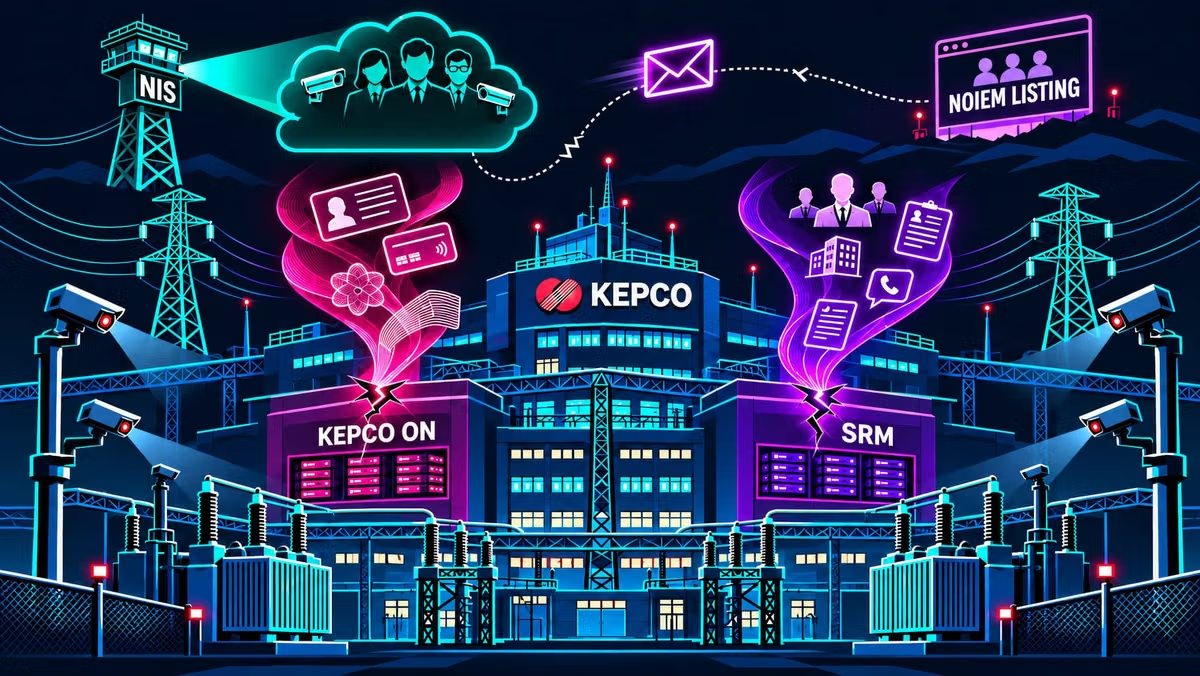
Korea Electric Power Corporation (KEPCO), South Korea's state-run power utility, says an external threat actor stole the personal data of 650,487 customers of KEPCO ON, the service customers use to check and pay electricity bills. Depending on the customer, the stolen data includes a resident registration number, the national identity number every Korean resident carries. For foreign residents, the stolen number is the registration number issued to them. The stolen payment data includes bank account numbers and payment card numbers with the card issuer and cardholder name, which the news agency Yonhap describes as credit card information.
The intruder also took data on 869,761 users of KEPCO's supplier relationship management (SRM) system, the electronic procurement platform where suppliers bid for KEPCO contracts. KEPCO disclosed both thefts on Sunday, November 22, Yonhap reports. A leaked registration number can change only after a government committee review, the Seoul Metropolitan Government explains. Long-term identity theft and fraud risk follow, the consumer advocacy group Green Consumers Network warned.
KEPCO's apology says some features offered for customer convenience became targets of external cyber attacks. KEPCO has not named the feature or said how the intruder used it. The utility has also not said how the intruder gained initial access or whether the theft links to an October exposure of employee data. The utility blamed attacks using artificial intelligence (AI) and published no evidence for the claim.
A threat actor no one has identified emailed KEPCO on November 19, claiming to have stolen the data, according to the Personal Information Protection Commission (PIPC), the national privacy regulator. The same day, an account called Noiem offered KEPCO data on DarkForums, a cyber crime forum, in a listing the Korean security news outlet DailySecu discovered. No one has identified who runs the Noiem account.
KEPCO confirmed the SRM theft from the threat actor's sample on November 20 and found the KEPCO ON theft hours later while examining service delays, according to Procurement Economy, a trade paper covering public procurement. Supplier relationship management is the standard term in Korean public procurement, a 2008 academic paper shows, though the KEPCO SRM site never spells the acronym out.
The November theft is the second KEPCO data exposure in two months, and the national intelligence service, not KEPCO's own monitoring, flagged the first one. The National Intelligence Service (NIS) told KEPCO on October 1 that employee data sat on a commercial cloud web page, the business daily Aju Business Daily reports. KEPCO first said no sensitive data was exposed. Records later showed facial authentication data for 408 staff and passwords for 14,957 closed-circuit television (CCTV) cameras, the broadcaster SBS Biz reported.
KEPCO Breach Timeline
Key events from the October 1, 2026 NIS notice to the November 22, 2026 KEPCO disclosure of data theft from KEPCO ON and SRM.
View Timeline Hide Timeline
-
July 19, 2026
-
October 1, 2026
-
October 2, 2026
-
October 4, 2026
-
October 6, 2026
-
October 19, 2026
-
October 29, 2026
-
November 2, 2026
-
November 19, 2026
-
November 19, 2026
-
November 20, 2026
-
November 20, 2026
-
November 22, 2026
-
November 22, 2026
-
November 23, 2026
KEPCO Began Investigating After the Threat Actor's Email
KEPCO's response to the November theft started with the threat actor's November 19 email, according to the PIPC account. On the morning of November 20, KEPCO sent the threat actor's sample to outside experts, and their analysis confirmed the SRM theft at about 2:57 p.m., Procurement Economy reports. KEPCO found the KEPCO ON theft at about 4:30 p.m. the same day while examining the cause of access delays.
The PIPC received KEPCO's report at about 6 p.m. on November 22, about 51 hours after the leak was confirmed and inside the 72-hour legal deadline, Procurement Economy adds. The deadline governs the report to the regulator and says nothing about whether KEPCO's notices to affected people were complete.
On November 20 the utility also confirmed what it calls illegal access attempts on the KEPCO ON system, blocked the IP addresses involved, and patched the related features, the security outlet Boannews reports. The apology adds that KEPCO suspended some external services and is checking the security of services still running.
DailySecu found the DarkForums post displayed a time of 2:44 p.m. on November 19, 2026, in a time zone the outlet could not confirm. Noiem put KEPCO and the domain kepco.co.kr in the title. Noiem labeled the data "560M CSV," a comma-separated values file, without saying what the "560M" measures. No source ties Noiem to the email, and no source ties Noiem or the emailer to the intrusion.
Noiem claimed 592,585 external user records with names, mobile numbers, and emails. The post also claimed 48,697 internal user records with employee numbers and departments, DailySecu reports. Whether those outside accounts belong to electricity customers, procurement users, or contractor staff needs confirmation. Noiem's count matches neither the 650,487 KEPCO ON customers nor the SRM figures the utility disclosed.
The procurement claims go further than anything KEPCO has disclosed. Noiem listed 950,054 basic supplier records, 401,951 bid price records, and 26,859 private contract records. The poster also claimed 3,124 military supplier records and 771 military facility bid reference prices. Noiem's list adds records on government suppliers, 12,036 of them, and 6,370 government facility bid prices, DailySecu reports.
A KEPCO official reportedly said no contract data leaked, Procurement Economy reports, and the KEPCO and PIPC notices list personal data only. If the denial holds, the forum poster may hold genuine personal data while overstating the scope of the theft.
Every one of Noiem's figures is the poster's own claim, with existence, authenticity, and duplication unverified, DailySecu stresses. The listing alone does not establish a breach of military or government systems. The post does not show the full data was released, sold, or downloaded, although the poster did list contact details for buyers. The PIPC and the Korea Internet and Security Agency (KISA) are monitoring for illegal online distribution of the data.
KEPCO ON Exposed Identifiers Customers Cannot Easily Change
The KEPCO ON breach exposed up to 12 data fields per customer, the business daily Financial News reports. The identity fields are the customer number, name, resident or foreigner registration number, phone number, and address. The payment fields are the bank name, account number, and account holder, plus the card issuer, card number, and cardholder name, alongside billing records. The published field list includes no card expiration date and no card security code.
Not every item leaked for every person, KEPCO's notice says, and a lookup menu on the KEPCO website lets each user check, Boannews adds. The 650,487 affected customers are about 7.1 percent of KEPCO ON's 9.2 million users, the broadcaster MTN reports. KEPCO's combined figure of 1,520,248 adds the KEPCO ON and SRM counts, the news site Better Future reports, so some victims may be counted twice.
A resident registration number has 13 digits. The first six give the date of birth and the seventh encodes the holder's gender, and a committee-approved change replaces only the last six, the Seoul government notes. Banks and card issuers, by contrast, can reissue account and payment card numbers. Green Consumers Network asked whether KEPCO properly collected and retained registration numbers and financial data, and whether the utility encrypted them. KEPCO has not said whether the stolen card and account numbers were encrypted.
The stolen billing records suit fraud built on the utility's own name. Green Consumers Network warned the data could fuel voice phishing posing as unpaid bill or refund notices. KEPCO told customers how to handle calls, texts, and emails impersonating the utility, Better Future reports. KEPCO says no secondary damage has been identified so far, the news site NewDaily reports, and the utility asked police to investigate.
The PIPC formed an initial response team and began an on-site inspection of KEPCO on November 23. The regulator will examine the utility's safeguards and whether KEPCO properly notified users and authorities, MTN reports. KEPCO has given neither the first intrusion time nor a deduplicated count.
The PIPC classifies leaks of 1 million or more people as major cases, with a 12-month target for resolving each one. The PIPC has not said whether it classed the KEPCO case as major. If it did, the 12-month target puts an expected deadline around late November 2027. The PIPC averaged 369 days per case in the first half of 2026, MTN reported in October, so a final result may still take about a year.
KEPCO ON customers lost more kinds of data than customers of the Japanese utility Shikoku Electric Power did in a breach this month. The Shikoku utility said names and addresses of about 600,000 members of its Yonden Concierge customer service leaked. The data leaked through KARTE, the marketing platform where Japanese companies keep copies of their customer data. KEPCO ON customers lost names and addresses too, plus registration numbers and payment details.
SRM Data Reaches Beyond KEPCO Suppliers
KEPCO runs purchasing, construction, and service contracts through SRM, the business daily Korea Economic Daily reports. Bid notices, bidding, evaluation, award, and contracts all pass through the procurement system, DailySecu adds. The SRM theft exposed the names, personal resident or foreigner registration numbers, emails, and company addresses of 426,827 corporate representatives, Financial News reports. Data on 442,934 KEPCO and contractor employees leaked too.
The KEPCO group's power companies share SRM, Procurement Economy reports. Korea Midland Power, one of those companies, tells its bidders to register on the KEPCO supplier portal. Korea Power Exchange bidders must register in SRM too. KEPCO's SRM notice lists current and former KEPCO staff, other organizations sharing the system, and external suppliers. The stolen records may map supplier relationships across Korea's public electricity sector.
Article 76 of the Enforcement Decree of the Act on Contracts to Which the State Is a Party requires heads of central agencies or contracting officials to check bidders' registration numbers. The check stops barred bidders from returning under changed trade names or representatives. Procurement Economy explains the SRM collection by that decree. The decree addresses central agencies, and KEPCO is a public enterprise, so applying the decree to KEPCO rests on Procurement Economy's reading.
The decree's registration number check concentrates hard-to-change identifiers for hundreds of thousands of business owners in one system. The SRM exposure covers about 220,000 more people than KEPCO ON and includes business owners' registration numbers, Procurement Economy notes. Supplier contacts and nonpublic bid and contract data together could support impersonation of procurement staff, DailySecu warns. A caller who knows a real contract and the real contact can make a fraudulent payment change sound routine.
KEPCO told SRM users only by homepage posting, so registered firms must check for themselves, Procurement Economy reports. KEPCO's apology addresses electricity customers and never mentions SRM or bidding firms. Whether the homepage notice meets notification law is for the PIPC to decide. KEPCO met the deadline for reporting to the regulator, but its most visible apology left out the larger SRM exposure.
National Intelligence Service Found the October Exposure
KEPCO learned of the October exposure from the NIS, not from its own monitoring. The NIS Gwangju branch notified the utility at about 3:59 p.m. on October 1 that employee data sat on a commercial cloud web page, Aju Business Daily reports. The NIS discovered the exposure first, the broadcaster YTN reported. KEPCO asked the company running the page to delete the data, and deletion came about 32 hours after KEPCO became aware, SBS Biz reported.
KEPCO's account of the October exposure kept growing. On October 4 the utility said about 24,000 employees lost names, positions, and phone numbers but no resident registration numbers, the newspaper Korea JoongAng Daily reported. The count later reached 35,528, adding about 10,000 retirees and 68 contractor staff to 24,769 employees, Boannews reports. On October 29 KEPCO posted that 65 retirees had also lost data, without saying whether they were already counted, DailySecu reported.
Facial authentication data for 408 employees, used for building entry, was exposed, according to records lawmaker Yoon Jae-ok of the People Power Party obtained from KEPCO. The IP addresses, log-in names, and passwords of 14,957 CCTV cameras leaked too, SBS Biz reported on October 19. KEPCO first said no unique identifiers or sensitive data were included, then confirmed the facial data in further analysis. The cloud page, hosted overseas, kept no access or download logs, so no one knows who took the data.
KEPCO began changing every CCTV log-in name and password, SBS Biz reported, but the staff whose facial data leaked cannot replace their faces. As earlier analysis of more than 153 million driver's license records allegedly for sale put it, "You cannot change your face or your date of birth." The utility's building entry systems need a second factor for anyone whose face is now in outside hands.
KEPCO's own audits over the past three years caught contractor staff logging in to internal systems with shared employee accounts, SBS Biz reported. The NIS, the PIPC, and the South Jeolla Provincial Police are investigating both a contractor leak and outside hacking, Aju Business Daily reports. KEPCO president and chief executive officer Kim Dong-cheol apologized at the October 19 National Assembly audit. Kim pledged to overhaul contractor management.
The October data sat on an external server in Hong Kong, industry sources told the daily Segye Ilbo. Data on a server outside KEPCO's network never passes KEPCO's own sensors. Spotting the data required watching outside infrastructure, and the NIS, not KEPCO, did that watching. Nothing in the public record shows KEPCO monitoring for its own data outside its network.
KEPCO's Own Audit Found Critical Flaws in Every Public Service It Tested
KEPCO's own security assessment, run from April 21 to July 19, 2026, found 218 critical vulnerabilities, 197 on servers and 21 in external services. The office of Democratic Party lawmaker Lee Yong-woo released the assessment report on October 19, Asia Times Korea reports. A penetration test of 10 public-facing services, the homepage among them, found critical flaws in every one. The main findings were weak user authentication, weak access-rights checks, and exposure of important information.
KEPCO planned to fix the critical flaws in public-facing services by August and on servers by September. No source says whether KEPCO met either date. The November apology blames convenience features in KEPCO's public-facing digital services. No source ties the November intrusion to any flaw the assessment found, but the assessment had already told KEPCO where to look.
KEPCO ran that assessment on an overall information protection budget of 36.29 billion won in 2026, more than double the 17.55 billion won of five years earlier, the trade paper Energy Daily reports. Lawmaker Kim So-hee's office puts the 2026 capital budget for security equipment at 17.62 billion won, a 14.7 percent cut with 34.8 percent spent by October, Segye Ilbo reported. Lawmaker Park Hae-cheol's office counts the security equipment budget at 21.91 billion won, Asia Times Korea reports.
KEPCO's information security specialists have held at 72 since 2022, Segye Ilbo adds. Drills KEPCO planned on its own fell from 8 in 2024 to 3 in 2025 to one tabletop exercise through September 2026, Energy Daily reports. KEPCO's drill record has no personal data breach response drill, and no AI attack readiness check of the kind other power companies ran. Park, whose office counted the overall budget, said that budget's growth beside shrinking drills leaves no explanation of where the money went.
Unverified KEPCO Files Sit With an Outside Firm
Separate from both incidents, a threat intelligence firm based in the United States, a company that tracks threat actors and stolen data, held files on KEPCO with far more than names and phone numbers, DailySecu reported on October 6 without naming the firm. Whether the threat intelligence files came from the October cloud page exposure is unconfirmed. The files included CCTV and video management system (VMS) account data, access control data, facial recognition data, and a human resources database.
One VMS account in the threat intelligence files carried a Chinese-language note meaning "VMS password-backdoor." The note alone does not prove a backdoor existed and may have been added during outside analysis, the outlet cautions. No evidence ties the note to Noiem, the November email, or the November intrusion.
DailySecu found the threat intelligence files also mapped substations and generation sites into coordinates and referenced about 22,700 CCTV cameras, more than the 14,957 cameras SBS Biz reported. File names included all_decrypted_credentials.csv, alongside saved sessions for remote server management. A file with that name may be an export the threat intelligence firm itself created. The files alone do not prove KEPCO servers were taken over.
Until KEPCO compares the threat intelligence files with its own systems, nobody outside the utility can say which credentials in them are real. Any KEPCO validates as authentic must be revoked or replaced. The substation coordinates and camera records matter more than the employee names if they prove genuine.
Of Course KEPCO Blames Artificial Intelligence
KEPCO framed the November theft as part of a wave of AI-enabled attacks, the most fashionable explanation in cyber security this year. The utility said it had expanded open digital services while reinforcing security, but AI-enabled cyber attacks are growing more intelligent, Financial News reports. The NIS, the Ministry of Climate, Energy and Environment Cyber Safety Center, and outside experts are still tracing the access path and attack method. KEPCO is blaming AI before its own investigators have found the way in.
KEPCO took the opposite line in October. A utility representative said the employee data leak appeared unrelated to the AI-related hacking attacks at financial firms, the Korea JoongAng Daily reported. Nothing KEPCO has published since shows AI in either incident. AI became the explanation in November, when KEPCO had to account for customers' bank account and payment card numbers.
KEPCO never ran the AI attack readiness check other power companies ran, Energy Daily reports, which undercuts its own excuse. The utility's own assessment found weak authentication and access-rights checks in every public service it tested. No intruder needs AI to exploit weak authentication. Blaming AI turns attention away from a remediation list KEPCO wrote itself.
The bank breaches KEPCO distanced itself from in October did reportedly leave AI traces. Shinhan Bank, one of Korea's largest commercial banks, said about 25,000 customers were affected after an intruder bypassed authentication on a loan agent service, The Korea Times reported. Traces of a Chinese-language AI penetration-testing tool were reportedly found on a server tied to the Shinhan attack. The Korea Times called the traces a possible link to ARTEX, an open-source framework developed in China in which AI agents run penetration tests.
The security company CrowdStrike reported on October 7 that an unnamed threat actor used ARTEX against South Korean financial organizations. Earlier analysis tied the ARTEX intrusions to breaches at seven South Korean financial institutions. More than 470,000 personal data records leaked across 40 reported incidents at 37 financial companies from September 30, Yonhap reported on November 5. The 37 companies cover every reported financial sector leak, not only ARTEX intrusions.
KEPCO has drawn no link between its breach and ARTEX, and an AI claim without an access path gives customers and suppliers nothing to act on. A web flaw, a stolen password, and a contractor account each call for a different fix. KEPCO's own assessment had already named the likeliest fixes, stronger authentication and access checks on public services.
Four Explanations for Two Incidents
Whether the two KEPCO incidents share an attack path or cause is not yet confirmed, MTN reports. Four explanations fit the published record so far. The intrusion, the email to KEPCO, and the forum listing are three separate acts, and no source ties them to one threat actor.
Hypothesis 1, One Intruder Kept Access From October Into November
Decrypted credentials and remote session files appear in the threat intelligence files, and KEPCO audits found contractors sharing employee accounts. An intruder holding valid credentials could return for the customer and procurement systems. Against this, the provenance of the threat intelligence files is unproven, and the October data came from employee and building security systems. A KEPCO official said in October that customer data sits apart in a dedicated system, SBS Biz reported.
Hypothesis 2, Two Separate Control Failures
The October exposure may have come from a contractor or third-party failure, and the November theft from a separate external intrusion into KEPCO services. Investigators are examining both a contractor leak and outside hacking for October, and KEPCO's own audits caught shared contractor accounts. KEPCO's apology points the November theft at public-facing convenience features. A finding on who uploaded the October data, and a November access path with no October overlap, would confirm this hypothesis.
Hypothesis 3, eCrime Threat Actors Are Monetizing the November Data
The email with a sample, and a same-day listing with buyer contact details, fit eCrime, the industry term for financially motivated cyber crime. Payment card details, bank accounts, and registration numbers sell for fraud. Against this hypothesis, no source reports a ransom demand, a price, or a sale. A utility official's reported denial that contract data leaked suggests the listing may overstate the haul. The email text, any sale terms, and a reconciliation of Noiem's files with KEPCO's denial would test the hypothesis.
Hypothesis 4, A State-Linked Threat Actor Is Collecting on South Korea's Grid
The threat intelligence files carry a Chinese-language note on a VMS account and coordinates for substations and generation sites. Separately, Noiem claims military supplier records and bid reference prices for military facilities. No evidence shows the two came from one threat actor or one collection effort. The origin of the note and any use of the stolen CCTV access would test the hypothesis.
Assessment
KEPCO sent the threat actor's sample for analysis the morning after the email and found the KEPCO ON theft hours after that analysis began. No source describes an earlier alert from KEPCO's own monitoring. I assess with moderate confidence the threat actor's email, not KEPCO monitoring, started KEPCO's November response.
The email, the sample, and the listing point to stolen data moving through eCrime channels. I assess with moderate confidence the November data is being monetized through eCrime channels. Nothing published ties Noiem to the intrusion or the email account, and I assess with low confidence that Noiem carried out either one. Nothing published ties the October and November incidents to one intruder, and I assess with low confidence the two share one intruder.
KEPCO and the NIS hold the evidence that would settle all four explanations. The evidence includes the threat actor's email, the access logs, the contractor account records, and a comparison of the threat intelligence files with KEPCO systems. The utility has released none of them.
What KEPCO Owes Customers and Suppliers Now
KEPCO audits caught contractors using shared employee accounts, so every contractor needs a named login of its own. Every credential KEPCO validates as authentic, including the camera passwords the utility began changing, must be revoked or replaced. Kim pledged an outside review of the utility's personal data protection in the November 22 apology, NewDaily reports. The outside reviewers should start with the contractor accounts KEPCO's own audits already found and the convenience features KEPCO says were targeted.
Registration numbers and payment card numbers stored together in a billing service are a standing target. Green Consumers Network asked whether KEPCO needed to keep the registration numbers and financial data at all, and whether the utility encrypted them. KEPCO owes customers an answer on both, and a deduplicated count of who lost what. SRM users deserve direct notice instead of a homepage posting.
KEPCO suppliers and power sector bidders should treat any request to change payment details as fraud until confirmed through a known phone number. KEPCO ON customers should expect calls and texts posing as the utility about unpaid bills or refunds. Victims whose registration numbers leaked can apply to change them.
The NIS found KEPCO's October exposure, and KEPCO began investigating the November theft only after the threat actor emailed. Shared contractor accounts, stored payment data, targeted convenience features, and unrotated credentials are where the next intrusion starts. Named contractor logins, revoked credentials, encrypted or deleted payment data, direct notice to suppliers, and a published account of how the intruder gained initial access are the defenses KEPCO has yet to put in place.
Analyst Annex
Evidence status as of November 23, 2026. The principal record is the November 22, 2026 disclosure by Korea Electric Power Corporation (KEPCO) of data theft from KEPCO ON and SRM, the November 23 Personal Information Protection Commission (PIPC) release, and KEPCO's apology. The public record supports collection of personal data from KEPCO ON and SRM. The record does not support mapping an initial access, exfiltration, or credential access technique, and no indicator of compromise is public.
Separate record sets cover the DarkForums listing first reported on November 19, 2026, the October 2026 employee data exposure the National Intelligence Service (NIS) reported to KEPCO, and files held by a threat intelligence firm DailySecu does not name. The intrusion, the November 19 email to KEPCO, and the listing are treated as separate acts. No public evidence ties them, or the October and November incidents, to one threat actor.
Confirmed marks evidence published by a victim, vendor, regulator, or government authority about its own systems, decisions, or investigation. Reported marks technical findings or attribution assessments published by a third party. Claimed marks statements by a seller or self-identified threat actor that remain unverified. Provisional marks an analytical mapping supported by reported behavior but not made by the original source.
Indicators
No public network indicator exists for the November theft, and none is derived here from KEPCO domains or forum infrastructure. The file names below are contextual artifact names from unverified holdings attributed to an unidentified threat intelligence firm, DailySecu reported. The file names are unsuitable for blocking or standalone detection.
| Indicator | Context | Status |
|---|---|---|
| Contextual Artifact Names | ||
busan_face_users.csv |
Busan region entry records with facial photo paths, from unverified holdings attributed to an unidentified threat intelligence firm Source: DailySecu | Reported |
naju_access_users.csv |
Naju headquarters access control records, from the same unverified holdings Source: DailySecu | Reported |
all_decrypted_credentials.csv |
File name suggesting decrypted credentials, possibly an export the threat intelligence firm created Source: DailySecu | Reported |
MITRE ATT&CK Mapping
| Tactic | Technique | Procedure | Status |
|---|---|---|---|
| KEPCO ON and SRM Theft, confirmed November 20, 2026 | |||
| Collection | T1213 Data from Information Repositories | Analyst mapping, not a procedure KEPCO reported. Personal data of KEPCO ON customers and SRM users came from those two structured repositories, which an external threat actor accessed Source: Yonhap, MITRE ATT&CK | Provisional |
Entities
| Entity | Role | Status |
|---|---|---|
| Threat Actors | ||
| Unidentified IntruderUnattributed Threat Actor | An external threat actor accessed KEPCO ON and SRM and stole the data, Yonhap reports. Initial access is undetermined Source: Yonhap | Reported |
| Unidentified EmailerUnattributed Threat Actor | Emailed KEPCO on November 19 claiming data theft and supplied sample data. No source names the sender or ties the sender to the intrusion Source: PIPC | Reported |
| NoiemForum Account | Posted the KEPCO listing on November 19 with kepco.co.kr in the title and buyer contact details. The listing is observed, and its data claims are unverified Source: DailySecu | Reported |
| Organizations and Victims | ||
| KEPCOState-Run Power Utility | Disclosed data theft on 650,487 KEPCO ON users and 869,761 SRM users on November 22 Source: Yonhap, KEPCO | Confirmed |
| KEPCO ON CustomersElectricity Customers | Up to 12 data fields each, including resident or foreigner registration number, account number, card number, and billing information. Not every item leaked for every person Source: Financial News | Confirmed |
| SRM Corporate RepresentativesSupplier Representatives | 426,827 people, with names, registration numbers, emails, and company addresses Source: Financial News | Confirmed |
| KEPCO and Contractor EmployeesSRM Users | 442,934 people, with names, affiliations, employee numbers, mobile numbers, emails, and company phone numbers Source: Financial News | Confirmed |
| Power Group Companies and Korea Power ExchangeJoint SRM Users | Power group companies share SRM, and Korea Power Exchange bidders must register in it. The SRM notice lists joint-use organizations among those affected Source: Procurement Economy | Reported |
| Platforms and Services | ||
| KEPCO ONElectricity Bill Service | Service customers use to check and pay electricity bills Source: Financial News | Confirmed |
| SRMElectronic Procurement System | Handles purchasing, construction, and service contracts for KEPCO and power group companies Source: Korea Economic Daily, Procurement Economy | Confirmed |
| DarkForumsUnderground Cyber Crime Forum | Hosted the Noiem listing claiming 401,951 bid price records and 3,124 military supplier records Source: DailySecu | Reported |
| Government Bodies | ||
| National Intelligence ServiceSouth Korean Intelligence Service | Investigating the November intrusion with government agencies and outside experts Source: Yonhap, NIS | Reported |
| Personal Information Protection CommissionPrivacy Regulator | Began an investigation and on-site inspection of KEPCO on November 23 Source: PIPC | Confirmed |
| Korea Internet and Security AgencyInternet Security Agency | Monitoring with the PIPC for illegal online distribution of the leaked data Source: PIPC | Confirmed |
| Ministry of Climate, Energy and Environment Cyber Safety CenterGovernment Cyber Body | Investigating the access path and attack method with the NIS Source: Financial News | Reported |
Related Activity
The records below cover the KEPCO security self-assessment and budget, the November report to the PIPC, the October KEPCO exposure, an unverified file corpus, a KEPCO affiliate, Korean financial sector breaches, and the Shikoku Electric Power breach. None is tied to the November KEPCO theft unless the record says so.
| Item | Detail | Status |
|---|---|---|
| KEPCO Security Self-AssessmentAssessment, April 21 to July 19, 2026 | Found 218 critical vulnerabilities, 197 on servers and 21 in external services. A penetration test of 10 public-facing services found critical flaws in every one, mainly weak user authentication and access-rights checks Source: Asia Times Korea | Reported |
| KEPCO Security Budget and DrillsBudget Records, 2026 | Information protection budget of 36.29 billion won in 2026, more than double five years earlier, while self-planned drills fell to one tabletop exercise through September and no personal data breach response drill was held Source: Energy Daily | Reported |
| October KEPCO Data ExposureData Exposure, October 1, 2026 | The NIS Gwangju branch notified KEPCO that employee data sat on a commercial cloud web page. Investigators are examining both a contractor leak and outside hacking Source: Aju Business Daily | Reported |
| KEPCO Report to the PIPCRegulator Report, November 22, 2026 | KEPCO reported at about 6 p.m., about 51 hours after confirming the leak and inside the 72-hour legal deadline Source: PIPC, Procurement Economy | Confirmed |
| KEPCO Facial and CCTV DataData Exposure, reported October 19, 2026 | Facial authentication data for 408 employees and the IP addresses, IDs, and passwords of 14,957 CCTV cameras leaked Source: SBS Biz | Reported |
| Unverified KEPCO File CorpusThreat Intelligence Holdings, October 2026 | Files held by an unnamed threat intelligence firm include a Chinese-language VMS note, substation coordinates, and about 22,700 CCTV camera records. A link to the confirmed October exposure is unconfirmed Source: DailySecu | Reported |
| KEPCO ES and Douzone Bizon ActivityData Exposure Notice, November 2, 2026 | KEPCO ES, an energy efficiency firm KEPCO invested in, said its data may have leaked in the Douzone Bizon hack. Actual leakage unconfirmed Source: DailySecu | Reported |
| ARTEX Financial Sector ActivityCampaign, analyzed November 9, 2026 | Contextual activity with no established KEPCO connection. Linked to breaches at seven South Korean financial institutions Source: jark.me | Reported |
| Shinhan Bank BreachData Breach, reported October 2, 2026 | About 25,000 customers were affected after an unauthorized party bypassed authentication on a loan agent service Source: The Korea Times | Reported |
| Korean Financial Sector LeaksData Breaches, reported November 5, 2026 | More than 470,000 personal data records across 40 reported incidents at 37 companies since September 30 Source: Yonhap | Reported |
| Shikoku Electric PowerData Breach, analyzed November 20, 2026 | Names and addresses of about 600,000 Yonden Concierge members leaked Source: jark.me | Reported |
Intelligence Gaps
| Gap | Why It Matters | What Would Close It |
|---|---|---|
| Remediation of Self-Assessment Findings | KEPCO planned to fix critical public-facing flaws by August and server flaws by September, and no source says whether it met either date | Remediation logs from KEPCO, or a PIPC or NIS finding on the flaws the intruder used |
| External Data Monitoring | The NIS, not KEPCO, found the October data on a server in Hong Kong | Evidence of KEPCO monitoring for its own data outside its network, or a contract for that service |
| November Initial Access and Exploited Feature | Convenience features are the only target in the utility apology, with no specific feature and no confirmed exploitation | The patched KEPCO ON feature list from November 20, access logs, or an NIS finding |
| Emailer and Noiem Relationship | No source ties the November 19 emailer to Noiem or either one to the intrusion | The email text and headers, forum account history, or a match between the emailed sample and the listed files |
| October Exposure Cause | Investigators are examining both a contractor leak and outside hacking | An NIS, PIPC, or police finding on who uploaded the data to the cloud page |
| October Data Provenance | The threat intelligence files may or may not come from the October cloud page exposure | A KEPCO comparison of the files with its own systems |
| Link Between Incidents | Determines whether KEPCO failed to remove existing access or suffered two separate control failures | Matching accounts, access paths, or infrastructure across both incidents |
| Military and Bid Data Authenticity | Noiem claims 401,951 bid price records and 26,859 private contract records. As material contrary evidence, one utility official reportedly said no contract data leaked, and the official releases list personal data only | A reconciliation of the emailed sample and the listed files with the reported denial and SRM records |
| Affected-Person Notification | The regulator report met the 72-hour deadline, but SRM users were told only by homepage posting and the apology does not name SRM. Compliance stays unresolved pending the PIPC investigation | A PIPC finding on notification and reporting duties |
| Incident Start and Dwell Time | KEPCO has not given the first intrusion time | Access logs showing first intruder activity on KEPCO ON and SRM |
| Data Distribution and Sale | The listing does not show the data was released, sold, or downloaded | Sale records, buyer reports, or PIPC and KISA monitoring results |
| Encryption of Payment Data | KEPCO has not said whether stolen card and account numbers were encrypted | A KEPCO statement or PIPC finding on safeguards |
| Deduplicated Victim Count | The 1,520,248 total is a simple sum across the two systems | A KEPCO count of unique people and items per person |
| AI Use | KEPCO blamed AI-enabled attacks without evidence, after denying an AI link in October | Attack logs, tool configurations, binaries, prompt transcripts, model records, or an investigator finding |