


Two lines of Russian sit in a configuration file on a server somebody forgot to lock. The first labels what follows as LLM API keys for auto-exploitation, part of an "exploit_agent pilot." The second gives an instruction to whoever opens the file next. "Enter the keys yourself," it reads in Google's translation, "right here, not in the chat." It adds, like a careful colleague, that both lines are required.
Google Threat Intelligence Group found that file on an exposed staging server and published it this week in its quarterly AI Threat Tracker. Around it sat a multi-agent framework, dubbed exploit_agent, built to compare web application code before and after patches, infer what each fix closed, write an exploit, and run it.
Google calls it the first time threat actors have used AI "to fully automate vulnerability discovery and exploitation without a human in the loop." CyberScoop carried the finding under a headline about Russian-speaking hackers running the first fully automated AI cyber attack.
That claim holds for one step of the attack, the conversion of a patch into an executed exploit. The report also documents a collapse in the cost and time of turning patches into exploits, and it leaves out nearly everything a defender would need. The second line of Russian, read closely, sounds like an AI coding assistant telling its user where to paste his secrets, which changes what the language can reveal about who built the tool.
Inside exploit_agent
Google describes exploit_agent as a vulnerability research and weaponization framework integrated with "multiple frontier and local LLMs." It runs continuous differential analysis against popular web application software, a technique known as patch diffing. When a vendor ships a fix, the framework compares the old and new code, reasons about what the change reveals, drafts an exploit, and executes it automatically.
The same server held data exfiltrated from victims. It also held scripts for internal reconnaissance, brute-forcing, and installing webshells, plus one for removing webshells planted by other attackers. Victim telemetry pointed to French websites in media, entertainment, and education.
The one code sample Google published shows the framework inspecting an access-control function in version 2.19.25 of Spectra, a WordPress block plugin also known as Ultimate Addons for Gutenberg. The function guards a REST route for the plugin's popups, the kind of authorization check where missing-permission bugs live. Small publishers and schools, the sectors in the victim telemetry, rarely employ anyone to read plugin changelogs.
Version 2.19.25 is also the last release vulnerable to CVE-2026-7465, a remote code execution flaw reachable by any user with contributor access. Spectra's developers fixed it on May 4 in a plugin with more than one million active installations. The function in Google's figure is not the code path where that flaw lives, and Google does not say whether exploit_agent found or used it.
Google publishes no indicators of compromise, no victim count, no exploited CVE identifiers, no dates for the activity, and no names for the LLM providers behind the keys. It does not say how it found the server, or state that exploit_agent itself carried out the compromises behind the stolen data. A French newsroom running WordPress has nothing to search its logs for, and the only party holding the evidence is the vendor publishing it.
What No Human in the Loop Means
A maturity chart in the same report places today's activity at stage five of seven, described as multiple attack stages run by LLM-driven tooling with "minimal human-in-the-loop." Stage six, multi-agent attacks with little to no human interaction, appears as a projection one to three months out. Stage seven, sophisticated fully autonomous attacks, sits three to six months away.

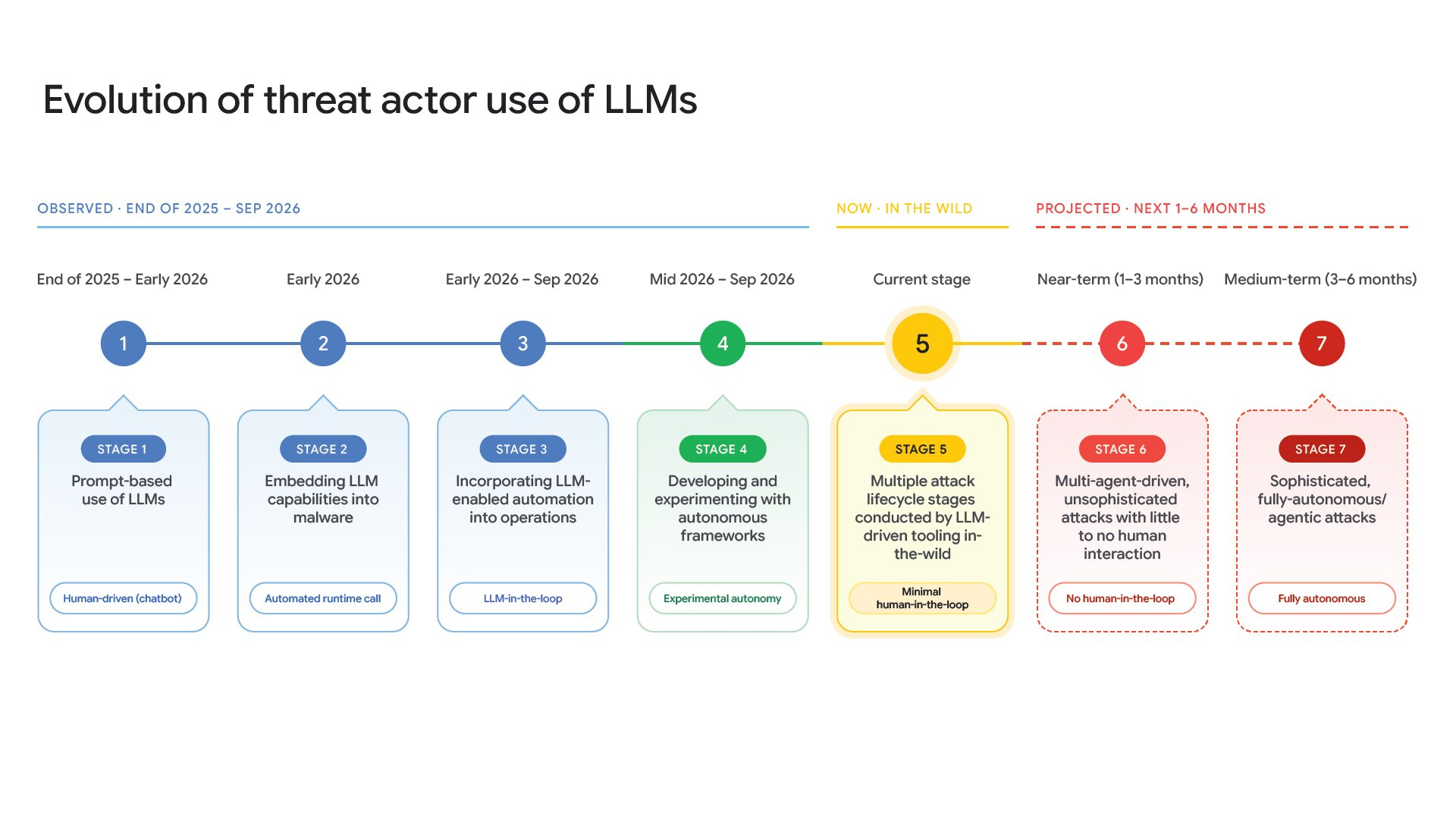
exploit_agent removes the human from one link in the attack chain, the step running from patch to working exploit to execution, so the chart and the claim describe different scopes. A human still chose the target sectors, supplied the API keys, and staged the server, and the stolen data landed on infrastructure under human control.
The word "pilot" in the configuration file suggests a trial, or possibly a demonstration for a customer or partner. The published evidence does not establish whether the framework's builder ran the activity, licensed the tooling, or supplied the access to someone else.
Google's previous tracker, published in September, said it had "not yet observed threat actors deploying fully autonomous pipelines against targets in the wild." Two months later, it has observed one link of such a pipeline running unattended.
Anthropic's account of Storm-2634 (aka GTG-1002), a Chinese state-sponsored threat actor it disrupted in 2025, found AI performing 80 to 90 percent of tactical work. Humans still approved the move from reconnaissance to exploitation, the use of stolen credentials, and the scope of exfiltration.
Humans also set the goals in the intrusion Unit 42 documented in September and in the China-nexus attacks run through the Cairn framework, a framework Google's report says it has also seen used against US aerospace targets.
In September, GreyNoise recorded a likely Russian-speaking threat actor whose AI agents compromised 440 PaperCut servers, a campaign I examined when it broke. Its timeline still shows the threat actor being "prompted for permission to continue." exploit_agent drops that approval step between patch and attack.
Google sees through its own platforms, Mandiant incident response, and infrastructure exposed by careless threat actors. An attacker running open-weight models on private hardware leaves no trace in any provider's abuse logs and no staging server for a researcher to find. The first fully automated pipeline anyone has published belongs to someone careless enough to expose it, and better-disciplined threat actors may already be further along, out of view.
Patch Day Becomes Exploit Day
Google's data shows disclosures and exploits nearly doubling between January and August 2026. Zero-day exploitation rose only from a 2025 average of eight a month to 11 a month in 2026, before spiking to 22 in August. Hunting zero-days requires casting a wide net, Google's analysts note, while a patched n-day gives a model a finite set of source material in the code before and after the fix, the release notes, and any public research.
PaperCut published its advisory for two flaws on August 27. Huntress and other researchers produced working exploits with LLMs within a day. The AI-driven campaign GreyNoise tracked launched at scale on September 1 and reached domain administrator at one US high school seven minutes after initial access.
The PHP flaws known as PHP2Shell, which went on to open Check Point gateways and Palo Alto Networks firewalls to attackers, were found with LLM-enabled analysis, according to Google. A proof-of-concept video and early patched code appeared before the official October 21 release, letting attackers diff the fix before defenders could install it.
After the PHP patch, Google counted hundreds of claimed but non-functional proofs of concept, likely generated with LLMs, each demanding verification. The flood echoes the cost I traced when Google paused its open-source bug bounty, where machine-generated reports consumed the human attention needed to find real bugs.
Google's September tracker called premium model access and compute a major obstacle for threat actors, and its November report documents the workaround. Underground "LLM Mixers" resell stolen access to frontier models at US$0.10 to US$25 per million tokens. LLMJacking intrusions feed them, with single-day fraudulent charges in some cases exceeding US$100,000. Leaked keys from the cleanup failures I examined last week feed a similar resale market, and a victim's billing account can fund a pipeline as well as the attacker's.
Reading the Russian
The Russian-language comments are the only clue Google offers to the builder's identity, and Google draws no conclusion from them. The second line uses the informal imperative to tell its reader to enter the keys "сюда, не в чат," here and not in the chat.
The line reads like a security reminder from an AI coding assistant after its user asked for help setting up the file, telling him to keep his keys out of the conversation. A colleague or a copied template could produce similar wording, but the reference to the chat fits an assistant best.
If an assistant wrote it, the language reflects the language of the prompts. The human behind exploit_agent most likely asked for the code in Russian, and the model answered in kind. That makes Russian speech a reasonable working inference and a weak attribution. Russian remains the common language of the eCrime ecosystem across the former Soviet Union and beyond, so it narrows nothing to a state.
An adversary wanting French victims to blame Moscow needs only to prompt in Russian, and the model writes the false flag for him at no cost. Language artifacts have always made weak ground for attribution, and nothing in the published evidence supports a link to the Russian government.
Whoever wrote the line understood the chat window as a place where secrets leak, because AI providers can review what passes through their hosted platforms. That visibility has turned AI companies into intelligence collectors. Anthropic reconstructed an entire espionage campaign from activity on its models, and OpenAI and Google publish similar findings. Local models escape that view, and exploit_agent used both kinds.
A threat actor expecting provider scrutiny can stage what the provider sees, from prompt language to target lists. Stolen keys and LLM Mixers separate the person writing a prompt from the account submitting it. A provider may hold a detailed record of an attack and still attribute it to a company whose credentials were stolen, sending investigators toward a victim instead of the threat actor.
Why France
French media, entertainment, and education websites hold little financial data and few trade secrets. Four explanations fit the targeting, and the evidence separates them only partly.
Hypothesis 1, Opportunistic eCrime at Scale
Brute-forcing, webshell installation, and the removal of rival attackers' webshells describe a threat actor competing for shared territory on vulnerable sites, a pattern long familiar from mass WordPress compromise campaigns. Compromised sites earn money through search-engine spam, malicious redirects, cryptocurrency mining, and resale of access.
Mining and spam tolerate shared access, but an access seller needs exclusivity, because a clean foothold sells for more and a rival's noise can get it burned. The script removing rival webshells therefore suggests protected inventory. The framework may automate the production of access as much as exploitation, leaving humans to decide which footholds become theft, extortion, influence, or inventory for sale.
Under this reading, France served as a test market for a pilot, chosen for its supply of unpatched French-language sites rather than for anything French. It explains every published artifact without assuming more.
Hypothesis 2, Access for Influence Campaigns
In May 2025, the French government condemned Russian actors behind the Neva Flood (aka Storm-1516) network, linking it to 77 information campaigns since 2023 against France, Ukraine, and other Western countries. In October 2025, NewsGuard rated 139 fake French news sites tied to the same ecosystem, built to imitate established outlets. France's presidential election runs on April 18 and May 2, 2027.
The Belarus-linked Ghostwriter campaign replaced genuine stories on Baltic and Polish news sites with fabricated ones, apparently through their content management systems, borrowing the credibility fake outlets lack. Write access to French media websites, produced at machine speed, would interest any influence service before an election, whether it ran the pipeline or bought the access. Nothing in Google's report shows such use, and this hypothesis rests on fit and timing alone.
A threat actor preparing for the election could hold webshells on legitimate sites for months, until a coordinated release carried the most political value. Dormant access would leave an influence objective invisible until activation, so the absence of fabricated articles today does not rule this hypothesis out.
Hypothesis 3, Hacktivist Defacement
Pro-Russian hacktivists hit French targets repeatedly, mostly with denial-of-service attacks. NoName057(16) claimed the December 2025 attack knocking La Poste's online services offline, and this month published personal data on European officials and journalists. Media and education sites make visible stages for messages. The exfiltrated victim data and the webshell scripts point toward durable access and data theft rather than quick defacement, which weakens this reading without excluding it.
Hypothesis 4, A Returning PaperCut Threat Actor
GreyNoise attributed the PaperCut campaign to a likely Russian-speaking threat actor who diffed software versions and generated exploits with AI agents. France counted 31 victims, tied for third among affected countries, so language, method, and geography all overlap.
The PaperCut threat actor ran hundreds of agents on a commercial coding harness, while exploit_agent is a self-built multi-agent framework, and neither GreyNoise nor Google draws a connection. Shared language and a shared method describe a growing population of threat actors as easily as a single one.
View From Google's Side
Google's report promotes Google AI Threat Defense, the new Gemini 4 Carbon model, and a Fairwind program granting vetted defenders access to dual-use cyber capabilities. AI companies now compete on threat disclosure much as they compete on benchmarks, and a "first" draws coverage. None of that makes the finding false, though it helps explain why the report emphasizes the milestone over the detail.
Google attributes the activity to no one, while coverage often collapses language into nationality. After the Expedia breach, Forbes described n0n as Russian without stating a basis. Google's restraint on this point deserves credit.
Google's analysts note these frameworks "trade stealth for velocity," generating forensic noise and recognizable code traces. A threat actor running a pipeline like exploit_agent against small French websites accepts that trade because detection costs him little. Each compromised plugin installation stands alone, and the pipeline replaces burned access faster than defenders clean it up. Noise would hurt an espionage threat actor needing to stay hidden, but this one needs volume.
Google found data stolen from French websites, and its report does not say whether the affected organizations, France's national cyber security agency ANSSI, or its incident response team CERT-FR received the evidence. Their investigations would also test Google's account, confirming the exploitation or exposing test data and rival leftovers. Google says it disabled assets tied to Gemini misuse elsewhere in the report, but says nothing about whose models powered exploit_agent or whether those providers acted.
What Changes for Defenders
When a model can turn a plugin changelog into a working exploit in hours, patch windows measured in weeks leave internet-facing sites exposed. Automatic updates for WordPress core and plugins stop being a convenience setting and become the only control fast enough. Sites unable to update immediately need virtual patching at the web application firewall for newly fixed flaws, and an inventory of plugins nobody remembers installing.
Autonomous tooling probes, fails, and retries at a pace no human matches, which makes it detectable. Bursts of requests against freshly patched routes, webshells appearing and disappearing, and file changes in plugin directories all deserve alerts. Compromise of one site invites competing intruders, so a cleanup removing one webshell while missing another has not finished.
Defenders also need to treat their own AI accounts as attack infrastructure. Every leaked model key can fund an attacker's pipeline, and the stolen-token market Google describes prices that funding cheaply. Rotating keys, setting spending caps, and alerting on usage spikes now protect other people's websites as well as the key owner's budget.
Hosting providers and web agencies managing dozens of client sites hold the most leverage. One managed update policy closes a patched flaw across every client at once, while each unmanaged site waits on an owner who may never log in. For small newsrooms and schools, that provider is often the only security team they have.
Assessment
A threat actor built and piloted a framework turning web application patches into executed exploits without a human approving each step, and victim data on its server points to French media, entertainment, and education websites. Google's evidence supports that narrow claim. The Russian-language comments most likely reflect the language its builder used with an AI coding assistant.
I assess with moderate confidence an AI coding assistant wrote the second comment while helping its user configure the file, and with low confidence a link to the threat actor behind the PaperCut campaign.
I assess with moderate confidence the threat actor behind exploit_agent is a Russian-speaking eCrime threat actor running opportunistic mass exploitation, and with low confidence the access serves Russian influence activity ahead of France's 2027 election. I assess with high confidence the time between a web application patch and its exploitation will keep shrinking for internet-facing software through 2027, driven by automated patch diffing and cheap stolen model access.
Fabricated articles appearing on genuine French media sites before April would strengthen the influence hypothesis sharply. Infrastructure or tooling shared with the PaperCut campaign would link the two threat actors. Disclosure of the exploited flaws and victim counts would let anyone outside Google measure how well the pipeline works.
A few lines in a configuration file now carry most of what the public knows about this threat actor. One of them was probably written by a machine, addressed to a human, in the language the human chose, on a server the human forgot to secure.
The attacker delegated the exploitation, the assistant wrote the security reminder, and the defenders learned about it from a quarterly report with nothing in it to search for. The pipeline from patch to exploit now runs without a person. Naming who built it, warning the newsrooms and schools it reached, and closing the next patch window all remain human work, and on the evidence published so far, nobody has finished any of it.
Analyst Annex
Evidence status as of November 17, 2026. The records cover Google Threat Intelligence Group’s discovery of an exposed staging server hosting exploit_agent, a multi-agent vulnerability research and weaponization framework, plus victim data and post-compromise scripts found on the same server. Google does not identify the threat actor, victims, exploited vulnerabilities, model providers, infrastructure, activity dates, or victim count.
The public record does not establish that exploit_agent produced the compromises behind the stolen data, so the ATT&CK mapping covers procedures Google describes on the server rather than a complete victim intrusion. The PaperCut campaign, Storm-2634 (aka GTG-1002), the Cairn framework, Neva Flood (aka Storm-1516), Ghostwriter, and the LLMJacking ecosystem appear under Related Activity as context only.
Confirmed marks evidence published by an organization about its own systems, products, or decisions. Reported marks findings published by a third party. Claimed marks unverified statements by a threat actor or seller. Provisional marks an analytical mapping or inference supported by the evidence but not made by the original source.
Indicators
Google publishes no IP addresses, domains, URLs, file hashes, file names, or victim identifiers for this activity. The artifacts below are research and hunting pivots taken from the exposed configuration and Google’s Spectra example, not blockable indicators. The Spectra route and function are legitimate plugin components, and routine administrative activity can produce matching traffic.
| Indicator | Context | Status |
|---|---|---|
| Configuration Artifacts | ||
exploit_agent |
Tool name in the Russian configuration comment describing an auto-exploitation pilot. The name is generic, so correlate it with the surrounding Russian text or framework behavior Source: Google Threat Intelligence Group | Reported |
# LLM API-ключи для авто-эксплуатации (пилот exploit_agent) |
Russian comment Google translates as LLM API keys for auto-exploitation, part of an exploit_agent pilot
Source: Google Threat Intelligence Group
|
Reported |
# Впиши ключи сам — сюда, не в чат. Обе строки обязательны. |
Russian comment Google translates as an instruction to enter the keys yourself, right here and not in the chat, adding that both lines are required. The wording supports Russian-language development without identifying its author Source: Google Threat Intelligence Group | Reported |
| Spectra Research Pivots | ||
restrict_popup_rest_access |
Legitimate Spectra function shown in Google’s example of the framework inspecting an access-control implementation in version 2.19.25. Its presence alone is not malicious Source: Google Threat Intelligence Group | Reported |
/wp/v2/spectra-popup |
Legitimate WordPress REST route checked by that function. Repeated unauthenticated requests or unusual write methods may justify review, though editors and authorized scanners can generate matching traffic Source: Google Threat Intelligence Group | Reported |
MITRE ATT&CK Mapping
Google publishes no ATT&CK mapping for exploit_agent. The mapping below is my own and limited to procedures Google describes on the exposed server.
| Tactic | Technique | Procedure | Status |
|---|---|---|---|
| exploit_agent Framework and Server Artifacts | |||
| Resource Development | T1588.007 Obtain Capabilities: Artificial Intelligence |
The threat actor integrated multiple frontier and local LLMs into exploit_agent and configured LLM API keys in a file labeled as an exploit_agent pilot
Source: Google Threat Intelligence Group
|
Reported |
| Resource Development | T1587.004 Develop Capabilities: Exploits |
exploit_agent compares web application code before and after patch announcements, infers potential vulnerabilities, and drafts exploits without human intervention
Source: Google Threat Intelligence Group
|
Reported |
| Initial Access | T1190 Exploit Public-Facing Application |
exploit_agent automatically executes its drafted exploits against web applications. Google does not identify the flaws or establish which executions produced access to a victim
Source: Google Threat Intelligence Group
|
Reported |
| Persistence | T1505.003 Server Software Component: Web Shell | Scripts on the server install webshells on compromised sites. A separate script removes webshells planted by competing threat actors Source: Google Threat Intelligence Group | Reported |
| Credential Access | T1110 Brute Force | Post-compromise scripts on the server support brute-forcing. Google does not distinguish password guessing, spraying, cracking, or credential stuffing Source: Google Threat Intelligence Group | Reported |
| Discovery | T1046 Network Service Discovery | Google found scripts for internal reconnaissance. Network service discovery fits that description, but Google publishes no commands, protocols, or enumerated systems Source: Google Threat Intelligence Group | Provisional |
Entities
| Entity | Role | Status |
|---|---|---|
| Threat Actors and Infrastructure | ||
Unidentified exploit_agent Threat ActorThreat actor, suspected eCrime |
Maintained the exposed staging server and framework. Russian comments support Russian-language development without establishing nationality. The eCrime motive, AI authorship of the comment, and access-sale hypothesis are my assessments, not Google’s Source: Google Threat Intelligence Group | Provisional |
| Exposed Staging ServerThreat actor infrastructure |
Hosted exploit_agent, exfiltrated victim data, post-compromise scripts, and the Russian configuration comments. Google publishes no address, provider, jurisdiction, or access chronology
Source: Google Threat Intelligence Group
|
Reported |
| Tools | ||
exploit_agentMulti-agent vulnerability research and weaponization framework |
Compares patched and unpatched web application code, identifies potential vulnerabilities, drafts exploits, and executes them without a human approving each attempt, using multiple frontier and local LLMs. Google calls it the first observed fully automated vulnerability discovery and exploitation without a human in the loop Source: Google Threat Intelligence Group | Reported |
| Victims and Targets | ||
| French Media and Entertainment WebsitesTarget set, unnamed |
Victim telemetry on the server suggested specific interest in these sites. Google does not identify the organizations or state which exploit_agent compromised
Source: Google Threat Intelligence Group
|
Reported |
| French Education WebsitesTarget set, unnamed | Victim telemetry on the server suggested specific interest in the education sector. Google does not identify the organizations, affected data, or outcome Source: Google Threat Intelligence Group | Reported |
| Software and Vendors | ||
| Spectra (Ultimate Addons for Gutenberg)WordPress block plugin |
Version 2.19.25 appears in Google’s example of exploit_agent inspecting an access-control implementation. Google does not state the framework found or exploited a Spectra vulnerability
Source: Google Threat Intelligence Group, WordPress.org
|
Reported |
| Brainstorm ForceSoftware vendor | Publishes Spectra, whose WordPress.org page reports more than one million active installations Source: WordPress.org | Confirmed |
| Google Threat Intelligence GroupThreat intelligence organization | Discovered the exposed server, analyzed the framework and artifacts, and published the activity. Its report does not state how it found the server or what victim notifications followed Source: Google Threat Intelligence Group | Confirmed |
Related Activity
The records below provide technical and geopolitical context. None was observed in the exploit_agent activity, and shared language, target geography, AI use, or patch-diffing tradecraft does not establish common control.
| Item | Detail | Status |
|---|---|---|
| PaperCut AI-Orchestrated CampaignCampaign, August 31 to September 2, 2026 |
A likely Russian-speaking threat actor used hundreds of AI agents on a commercial coding harness with a DeepSeek model to exploit CVE-2026-81578 and CVE-2026-82078, compromising at least 440 PaperCut instances at 395 organizations in 48 countries, including 31 victims in France. Its timeline shows a permission prompt to the threat actor, and its published infrastructure includes 45.142.193[.]132. Different tooling and no shared artifacts leave common control unsupported
Source: GreyNoise
|
Reported |
| Storm-2634 (aka GTG-1002)Nation state campaign, 2025 | A Chinese state-sponsored threat actor used Claude Code for 80 to 90 percent of tactical work against about 30 entities, with humans approving exploitation, credential use, and exfiltration scope. It offers a comparison for high-autonomy intrusion, not a shared actor Source: Anthropic | Reported |
| Cairn Framework in the WildFramework use, 2026 | Google observed the open-source Cairn multi-agent framework used against targets including the US aerospace sector, without saying whether it overlaps the China-nexus Cairn activity documented by Unit 42 Source: Google Threat Intelligence Group | Reported |
| PHP2Shell Proof-of-Concept FloodVulnerability disclosure, October 2026 | LLM-enabled analysis found the PHP2Shell flaws, and early patched code appeared before the October 21 patch. Hundreds of non-functional, likely LLM-generated proofs of concept followed Source: Google Threat Intelligence Group | Reported |
| LLMJacking and LLM MixerseCrime ecosystem, 2026 |
Stolen credentials and cloud resources fund unauthorized model use. LLM Mixers route buyer traffic through pools of stolen credentials at US$0.10 to US$25 per million tokens, separating the person writing prompts from the account a provider sees. Google does not say exploit_agent used a mixer or stolen account
Source: Google Threat Intelligence Group
|
Reported |
| Neva Flood (aka Storm-1516)Nation state influence activity, 2023 to 2025 | VIGINUM documented 77 Russian information campaigns against Western audiences, including French ones, from late 2023 to March 5, 2025, often timed to elections. NewsGuard rated 139 fake French news sites tied to the network in October 2025. Relevant only to the influence hypothesis Source: VIGINUM, NewsGuard | Reported |
| Ghostwriter Media Site CompromisesInfluence campaign, 2017 onward | The Belarus-linked Ghostwriter campaign used website compromises and spoofed accounts to publish fabricated content, in some cases replacing genuine stories on Baltic and Polish news sites. It sets a precedent for using authentic publishing infrastructure, not a link to the French targeting Source: Google Threat Intelligence Group, SC Media | Reported |
| 2027 French Presidential ElectionScheduled election | The first round falls on April 18, 2027, and the second on May 2. The timing gives dormant access to French media sites potential influence value, but no published evidence connects the targeting to the election Source: Reuters via Internazionale | Reported |
| Spectra CVE-2026-7465Vulnerability, May 2026 |
Contributor-level users could reach remote code execution through attacker-controlled block attributes in Spectra through version 2.19.25, fixed in 2.19.26 on May 4, 2026. The vulnerable render path differs from restrict_popup_rest_access, the function Google shows, and Google does not connect the CVE to exploit_agent
Source: NVD, WordPress.org changelog
|
Confirmed |
Intelligence Gaps
| Gap | Why It Matters | What Would Close It |
|---|---|---|
| Threat actor identity, location, and role | Russian-language comments support a working-language assessment without identifying nationality, location, criminal affiliation, or state tasking. The builder, server administrator, and customer may be different parties | Infrastructure registration, payment records, authenticated accounts, recovered communications, or law enforcement findings |
| Authorship of the Russian comments | The instruction to place keys in the file rather than the chat fits an AI coding assistant, but a teammate, copied template, or deliberate deception could produce it. The answer sets how much attribution weight the language carries | Prompt history, file metadata, model output logs, repository history, or a matching generated template |
| LLM providers and access route | Hosted models may retain prompts, outputs, and account data, while local models leave no provider telemetry. Stolen keys or a mixer could make the visible account unrelated to the user | Recovered configuration, API endpoints, billing records, provider statements, or evidence of local inference infrastructure |
Relationship between exploit_agent and the victim data |
The framework, stolen data, and scripts shared a server, but Google does not state the framework caused the compromises. The server may combine testing, separate campaigns, or material from more than one threat actor | Execution logs tying exploit attempts to victim systems, victim-side telemetry, or forensic timelines |
| Exploited vulnerabilities and success rate | No CVE, exploit, victim count, or success rate is public, so defenders cannot tell a working pipeline from a noisy one producing failed attempts | Exploit source, execution results, task logs, or victim forensics |
| Spectra outcome | Google shows analysis of Spectra 2.19.25, the last version affected by CVE-2026-7465, but the displayed function is a different code path. Treating version overlap as exploitation would misstate the evidence | The framework’s Spectra task record, generated exploit, execution log, or confirmation from Google or Brainstorm Force |
| Identity, number, and notification of the French victims | Unnamed organizations cannot check their logs, and the public cannot tell whether Google, a hosting provider, ANSSI, or CERT-FR delivered evidence to them | Victim disclosures, notification records, ANSSI or CERT-FR statements, or a Google account of its response |
| Reason for the French sector focus | Opportunistic exploitation, a customer-supplied target list, regional exposure density, influence prepositioning, and hacktivist targeting all fit parts of the record | Recovered tasking, target lists, customer communications, victim selection rules, or later use of compromised sites |
| Whether the pilot was internal or customer-facing | The word pilot may describe an internal trial, a commercial demonstration, or a limited deployment for a buyer, each implying a different path to proliferation | Sales material, customer accounts, payment evidence, licensing artifacts, or threat actor communications |
| Access retention, resale, and handoff | Removing rival webshells can protect exclusive access and raise its resale value. The record does not show whether the threat actor monetized sites directly, sold access, or handed victims to another threat actor | Marketplace listings, affiliate communications, access-sale records, cryptocurrency payments, or downstream activity by another threat actor |
| Influence prepositioning before the French election | Access to legitimate media websites could be held for later publication, redirects, credential theft, or malware staging. No fabricated content or election-related tasking is reported | Content management audit logs, dormant webshell activation, fabricated content, or infrastructure overlap with a known influence actor |
| Relationship to the PaperCut threat actor | Russian-language use, AI-assisted patch analysis, mass exploitation, and French victims overlap, but different frameworks and no shared infrastructure or code leave common control unsupported | Shared infrastructure, credentials, code, model accounts, target lists, or payment records |
| Activity after Google found the server | Google does not say whether the server was secured, seized, or abandoned, whether related accounts were disabled, or whether the framework moved | Hosting provider action, provider enforcement records, fresh infrastructure, or follow-on reporting from Google |