

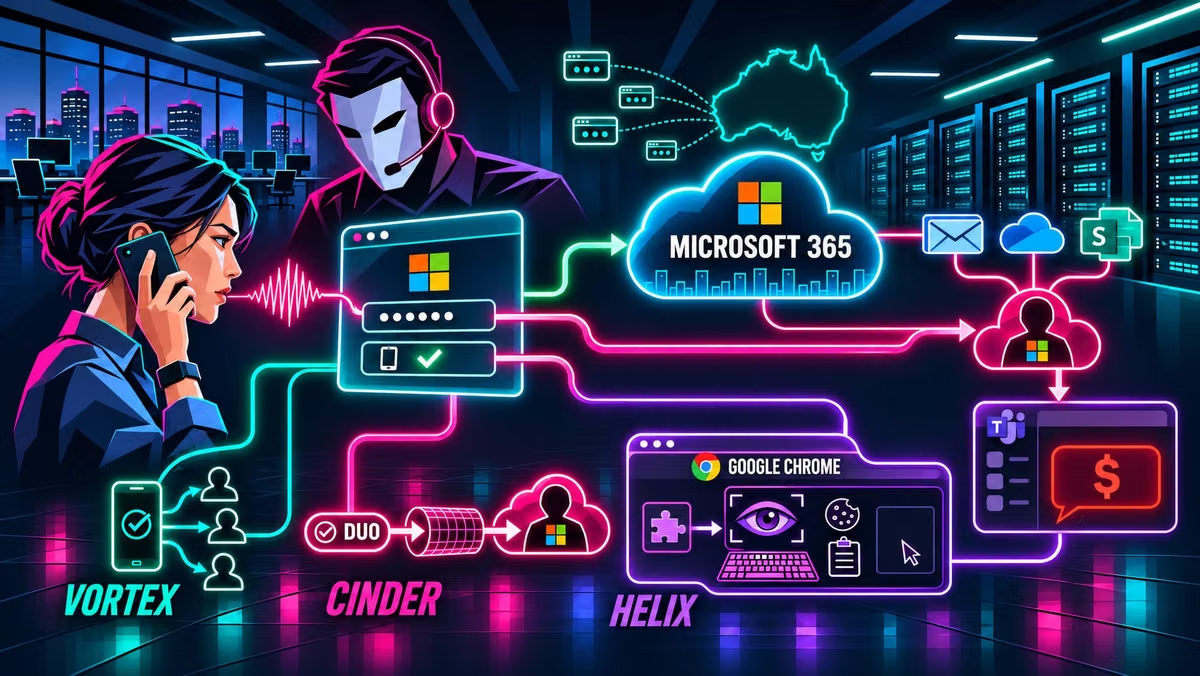
The Com keeps breaking into hospitals, law firms, and banks with one phone call. The Federal Bureau of Investigation (FBI) describes the Com as a primarily English-speaking online ecosystem whose members, many of them minors, commit crimes. The scam is vishing, short for voice phishing. A caller rings an employee's personal phone, posing as the employer's information technology (IT) help desk with a sign-in problem to fix. The link the caller sends opens a fake copy of the employer's log-in page.
The fake page forwards everything the employee enters to the caller in real time, the password and then the code or tap approving the sign-in. The caller uses them at once to log in to the real account as the employee. From inside that account, the caller copies the mailbox and shared files with scripts, then sends coworkers a demand for payment on Microsoft Teams.
Unit 42, the threat intelligence team of Palo Alto Networks, named two new sets of these attacks on November 20, 2026. Unit 42 calls each one an activity cluster, a label for related attacks not yet tied to a named threat actor. Unit 42 names no victim and gives no count of breaches or ransom payments for either.
Unit 42 tracks the first under the internal code CL-CRI-1264 and calls it Vortex. Vortex mostly calls staff at hospitals, drug makers, and other medical organizations, then adds a phone of its own to each stolen account. The second, CL-CRI-1274 or Cinder, replays a stolen "keep me signed in" token from Duo, a Cisco sign-in approval service, so Duo never asks the employee to approve the threat actor's sign-in.
The Cybersecurity and Infrastructure Security Agency (CISA) and the FBI described SCATTERED SPIDER (aka Octo Tempest), a threat actor from the Com ecosystem, posing as IT staff in November 2023. Help desk impersonation has been a public warning for three years. What is new is where the calls now land. Unit 42 found healthcare targets overtook financial services in September 2026 among the fake log-in addresses it tracked. Addresses naming Australian organizations rose to about 13 percent in October.
Operation Timeline
Trace the events, turning points, and connections behind the analysis.
Com Vishing Activity Timeline
Key events from the November 16, 2023 help desk impersonation advisory to the Unit 42 report of November 20, 2026.
View Timeline Hide Timeline
-
November 16, 2023
-
July 23, 2025
-
October 2025
-
May 2026
-
July 10, 2026
-
August 7, 2026
-
August 28, 2026
-
September 2026
-
September 9, 2026
-
September 10, 2026
-
October 3, 2026
-
October 2026
-
November 20, 2026
Vortex Reuses One Phone Across Its Victims
Vortex is the Unit 42 name for vishing attacks aimed primarily at healthcare, pharmaceutical, and other medical organizations, first identified in September 2026. Unit 42 says the tradecraft largely follows the wider Com playbook of help desk calls and fake log-in pages and names no person or threat actor behind it.
Vortex callers pose as internal IT support and send each employee to a web address carrying that employer's name. The servers behind those addresses are adversary-in-the-middle (AiTM) proxies, sitting between the employee and the real log-in page. The proxies pass each password and multi-factor authentication (MFA) response to the threat actor as the employee enters it. Vortex targets employees on corporate workstations and on personal mobile devices.
The personal phone keeps the first stage of the attack out of corporate evidence. Microsoft found the employee's recollection of a phone call or text message can be the earliest, and sometimes the only, evidence explaining how a compromise began. A victim organization may hold every cloud event after the sign-in and no record of the call, the text, or the lure page. Responders need the call time, the calling number, the text messages, and the browser history from the employee's phone.
Within minutes of the first sign-in, Vortex enrolls an unauthorized MFA device, a phone of its own added to the account as an extra sign-in factor. In multiple intrusions the threat actor reused a single device named Pixel 10a across compromised accounts. Unit 42 also lists a Pixel 9 Pro XL from its investigations and calls both ordinary phone models, not standalone indicators of compromise, so a device name alone proves nothing.
CrowdStrike has seen one MFA device enrolled across multiple compromised accounts in intrusions by adversaries CrowdStrike tracks, and the CrowdStrike detection guidance flags that pattern. One registered phone appearing on several accounts is a signal any identity team can alert on. CrowdStrike also found adversary devices registered as the first MFA factor on long-standing accounts where MFA had never been enabled.
Unit 42 found that once the new device is in place, Vortex runs Python scripts, identified by the python-httpx user agent, the software label each request carries, against Microsoft 365 mailboxes, OneDrive, and SharePoint. The threat actor then sends Microsoft Teams messages directly to employees, claiming data theft and pointing them to a negotiation site on the Tor anonymity network. In healthcare, Com threat actors broadcast extortion notices across internal chat channels and threaten to report the breach to regulators themselves.
The security company ReliaQuest found Helix, a Com extortion brand first named in July 2026, compromising a second user days or weeks after the first, apparently solely to deliver the demand over Teams and email. The account sending the threat may not be the one stealing the files. Disabling the user posting the demand can leave the account draining SharePoint untouched. Microsoft tells help desks to verify identity before any credential or MFA reset and to alert on each one.
Cinder Replayed an Existing Duo Session
Cinder is the Unit 42 name for a second set of Com vishing attacks, also first identified in September 2026. Unit 42 names no person or threat actor behind Cinder and publishes no target sector for it.
Unit 42 says Cinder used vishing for initial access, as Vortex does. Instead of capturing a fresh MFA approval, Cinder took a persistent Duo "keep me signed in" session token and replayed it from proxy servers, so Duo never prompted again. Unit 42 does not say how Cinder obtained the token. Duo issues such a token after an employee approves a sign-in and chooses to stay signed in, so the stolen token stood in for that approval.
Duo lets a user tick "Remember me" or remember a browser so later sign-ins skip the Duo prompt. Administrators can let a remembered browser session last up to 365 days, and Duo's separate risk-based option defaults to 30 days. Unit 42 reports no lifetime for the token Cinder stole and names no Duo policy governing it.
Google Threat Intelligence Group (GTIG) recommends forcing re-authentication at least once per work day. GTIG also recommends binding each session to its device or Internet Protocol (IP) address, so a stolen token fails anywhere else.
Cinder collected data through python-requests/2.34.2 and the Microsoft Graph software development kit (SDK), pulling SharePoint and OneDrive content. Unit 42 also lists the kiota-dotnet/1.17.1 and Microsoft.Graph.Client/6.2.0 user agents from its investigations. A compromised account then sent the extortion demand internally by email and Teams, pointing recipients to a negotiation site on Tor.
Phishing-resistant MFA built on Fast IDentity Online 2 (FIDO2) keys and passkeys breaks the relay route. GTIG notes FIDO2 security keys and passkeys resist social engineering in ways push-based or text message codes do not, because each key signs in only to the real web address. Without such a key, a relay page can capture the signed-in session, as earlier jark.me analysis of the NovaCookies phishing kit showed with Microsoft 365.
ReliaQuest found a Helix caller walking a target through entering a device code into Chrome, so Microsoft adds a second control. Administrators should shut off the device code flow, which lets a victim approve a sign-in for a threat actor's machine. Microsoft Learn, the company's documentation, urges organizations to get as close as possible to blocking the device code flow outright.
Healthcare and Australia Took the Calls
Unit 42 tracks where Com threat actors aim their fake log-in pages and what they take once inside. Each page sits on a web address carrying a target organization's name. In August 2026, financial services drew about twice as many lures as healthcare. Healthcare took the lead in September, around when Vortex first appeared. In October healthcare and financial services were the two most targeted industries. Construction, high technology, and transportation and logistics organizations also drew frequent lures.
The Health Information Sharing and Analysis Center (Health-ISAC) warned members on August 28, 2026 that vishing by ShinyHunters, a Com extortion brand, was actively targeting the global medical sector. The alert flagged domains in the form company-claims[.]com and company[.]claims. Unit 42 lists .claims and .report endings too, along with {company}-okta.com and claims-{company}.com. Hunt teams can search newly registered domains for each of these strings.
Australian organizations made up less than 1 percent of those addresses in August and September. The share rose to about 13 percent in October, and Australia is now the second most targeted country after the United States (US). The increase began in late September, and Unit 42 does not tie the Australian lures to Vortex, Cinder, or any other activity cluster. Unit 42 names no Australian victim and gives no count of organizations, so the figure measures lures prepared, not breaches confirmed.
Unit 42 says Com threat actors took partner communications, firm strategy, executive compensation, and pending contracts from legal targets, then threatened to publish client agreements. In some financial intrusions they took tens of millions of customer relationship management (CRM) and recruiting records. Earlier jark.me analysis of the McKesson breach covered a vishing intrusion at McKesson, which distributes about a third of North America's prescription medicines. ShinyHunters claimed 284 million records from McKesson and demanded US$55.2 million. Nothing public ties McKesson to Vortex or Cinder.
Unit 42 also found Com threat actors prioritizing private investment portfolios and deal pipelines, and targeting patient records and proprietary research. Pending contracts, legal strategy, executive compensation, and portfolios hold value to an intelligence service as well, because they reveal negotiating positions and people open to pressure. No public evidence shows Vortex, Cinder, or another Com threat actor selling access or data to a government. The access creates that option without establishing a buyer.
A Fake Chrome Streams the Webcam
The Com also works from inside an employee's browser. During an investigation into Helix, Unit 42 found a malicious browser extension named Google Chrome, version 1.6.111, never listed on the Chrome Web Store. Victims downloaded the extension package from oskeysetup[.]com and had to enable Developer Mode and install the extension by hand. The fake name makes Chrome's own warning, "Google Chrome started debugging this browser," look like ordinary activity. Unit 42 does not say how victims were persuaded to install it.
The extension installs global keyloggers and steals data websites store in the browser. The code harvests Microsoft and Google authentication cookies, scans pages for Quick Response (QR) codes carrying log-in or MFA tokens, and streams the webcam. A remote control module built on the Chrome DevTools Protocol, the browser's debugging interface, lets the threat actor take hidden screenshots, type, read the clipboard, and navigate. A second build, 1.6.112, reports to the command-and-control (C2) server controlling version 1.6.111 with an identical hard-coded API key.
Kevin Pham, a researcher writing on his Deoxy blog, published a source analysis of both builds on September 10, 2026, 71 days before Unit 42's report, and Unit 42 credits his write-up. Pham found the camera module sends a frame every 400 milliseconds. He also found a cursorless blackout page able to cover the screen while the threat actor works. Pham calls authenticator QR secrets, the codes that set up an authenticator app, an obvious target but marks that as an inference.
Unit 42's addition is a confirmed intrusion, the Helix investigation. The Palo Alto Networks team assesses with moderate confidence the threat actor behind Helix built the extension to steal credentials from Chromium-based browsers. Unit 42 says other Com threat actors might share the extension but has no evidence of that. Palo Alto Networks sells Prisma Browser to block attacks of this kind. Google's Chrome admin settings block the extension without Prisma Browser, preventing users from installing any extension outside an approved list.
An AiTM page captures the authenticated session from outside the browser, and FIDO2 keys break that relay. The fake Chrome extension takes control from inside a browser already signed in. Pham found the extension reads the complete cookie store and acts inside tabs already signed in. The store includes HttpOnly cookies, which websites shield from page scripts but not from extensions. A passkey cannot stop code an employee installed after signing in. The extension therefore gives the Com a second route around the sign-in.
Vendors Document the Infrastructure but Disagree on Control
Who controls Vortex and Cinder depends on how vendors group the Com's names, and Unit 42 tracks seven names for this Com activity. One is ShinyHunters. The others are activity clusters behind four extortion brands, Redact, Pink, Falcon, and Helix, plus Vortex and Cinder. GTIG says extortion messages from these intrusions carried different brands, and stolen data appeared on separate dedicated leak sites (DLS).
BlackFile, the extortion brand Unit 42 dates to January 2026, became Redact after announcing its retirement in May 2026. The identity company Okta found Pink targeting Microsoft 365 passkey enrollment since April 2026. In July, Unit 42's public threat notes on GitHub already assessed with moderate confidence that Falcon is related to Redact. An IP address from one Falcon intrusion had turned up in a Redact case.
CrowdStrike tracks Helix activity and BlackFile as one adversary, CORDIAL SPIDER (aka BlackFile), stealing and extorting data since at least October 2025. CrowdStrike lists CL-CRI-1116, Unit 42's label for Redact, and UNC6671, the label GTIG gives the threat actor, among its identifiers. The public profile maps none of Pink, Falcon, Vortex, or Cinder to CORDIAL SPIDER. Unit 42 itself told the Retail and Hospitality Information Sharing and Analysis Center (RH-ISAC) that its Redact activity cluster overlaps with BlackFile, UNC6671, and CORDIAL SPIDER.
GTIG, tracking the threat actor as UNC6671, reaches the BlackFile grouping through infrastructure. GTIG found BlackFile diversified across Redact, Pink, Helix, and Falcon instead of disbanding after its announced retirement in May 2026. One root domain, passkeyhelpdesk[.]com, targeted two separate victims, one later claimed by Falcon and the other by Helix. GTIG judges a coordinated threat actor running several public brands the most likely explanation and names splintering, shared phishing kit panels, and outsourced extortion as alternatives.
Microsoft dissents on Helix alone. The September 9 Microsoft report describes the Helix actors as a set who splintered from BlackFile. The Microsoft list of threat actor names still treats Redact and UNC6671 as one threat actor, so Microsoft differs from the other vendors only on Helix. ReliaQuest left that question open, calling Helix either a direct successor or an adjacent actor borrowing the BlackFile playbook.
Unit 42 reports that GTIG tracks CL-CRI-1192, the Helix activity cluster, under UNC6671. GTIG describes that grouping in its August 7 analysis. For Vortex and Cinder, Unit 42 says only that they overlap with activity GTIG tracks as UNC6671. Unit 42 publishes no shared domain, IP address, tool, wallet, or communication identifier explaining that overlap. The public record therefore provides a stronger association for Helix than for either new activity cluster.
Law enforcement pressure supplies context rather than attribution. Dutch authorities arrested Pepijn van der Stap, known as Umbreon, a convicted hacker and ShinyHunters suspect, on September 15. Unit 42 first observed Vortex and Cinder that month but gives no day for either activity cluster. Reuters reported on October 3 that Rey, the teenager from Amman who took control of the ShinyHunters brand as earlier members were arrested or jailed, was detained in Jordan and cooperating with the FBI, as KrebsOnSecurity recounted.
KrebsOnSecurity reports US authorities also charged Edward Dubrovsky, a 54-year-old Canadian cyber security executive, in the ShinyHunters investigation, with threatening to disclose stolen or hacked data. A Rotterdam court ordered van der Stap held for 90 days on September 29, and earlier jark.me analysis judged Rey's cooperation likely at moderate confidence.
Rey's reported cooperation and the later arrests show disruption across the Com ecosystem. Nothing public connects any of those developments to Vortex or Cinder, so the timing cannot establish whether the new names reflect fragmentation, replacement, or unrelated activity.
Across the reports, the vendors document passkey-themed lure domains, matching phishing templates, shared panel infrastructure, and the help desk pretext. The vendors disagree on who controls those resources. GTIG considers one coordinated threat actor the most likely explanation. Microsoft describes the Helix actors as a splinter. Unit 42 reports only an unexplained overlap linking Vortex and Cinder to UNC6671 activity. The three hypotheses below test that question for Vortex and Cinder.
Three Explanations for Two New Names
Three hypotheses fit the evidence on Vortex and Cinder, the two newest Com activity clusters. Each one predicts different traces in wallets, panels, and registrars, and the evidence below names what would separate them.
Hypothesis 1, One Threat Actor Opening New Fronts
The people behind BlackFile may have launched Vortex and Cinder in the way they opened Redact, Pink, Helix, and Falcon. Unit 42's reported overlap with UNC6671 activity supports this. ReliaQuest counted at least three successor brands within three months of BlackFile's shutdown. GTIG traced about US$10.69 million in Bitcoin flowing into 18 BlackFile wallets from January 7 to May 12, 2026. A shared account on Tox, the messenger used for negotiation, or a Vortex payment landing in one of those wallets would confirm Hypothesis 1.
Hypothesis 2, Many Buyers of One Kit
Separate threat actors may buy identical phishing kits and hire from one pool of callers. Okta found a vishing kit called Work Panel sold to multiple buyers, each bringing their own registrar account and callers. The browser security company Push Security traced Doko's Panel, an AiTM kit whose author recruited "experienced callers" with fluent English and no accent. Some copies renamed the panel's back-end file to api_FyekIDWY.php, and Unit 42 found that file name on multiple Com domains, a fingerprint of one kit.
Unit 42 lists NiceNIC as the registrar for every older activity cluster, with Cloudflare in front of the domains. Vortex uses another registrar, Cnobin, and Cinder uses Internet Domain Service BS Corp behind the hosting protection service DDoS-Guard. The new registrars point toward Hypothesis 2 without proving it, since one threat actor can also switch registrars.
GTIG's BlackFile analysis also found the threat actor hires callers rather than dialing itself. Shared administrator accounts on the phishing kits behind the two new activity clusters and Redact would point to one set of people. Separate accounts on identical kits would point to separate buyers.
Hypothesis 3, One Intrusion Team With Outsourced Extortion
One team may supply the callers, phishing infrastructure, and cloud collection, with other threat actors running the brands, negotiations, and extortion sites. GTIG raises this as an alternative, saying the intrusion team could remain one core team while extortion and negotiation pass to different actors. Hypothesis 3 explains why the technical sequence holds steady while Tox identities and public names change. Distinct negotiation accounts paired with shared panel administration and exfiltration infrastructure would support Hypothesis 3.
Defenses Built for the Phone Call
Unit 42's report establishes two new Com activity clusters, Vortex aimed primarily at medical organizations and Cinder with no published targets, while Com lures shifted toward healthcare and, since late September, Australia. Both run on the help desk pretext CISA described in 2023. Vortex shows the threat actor reusing one registered phone across victims. Cinder shows a remembered Duo session standing in for a new MFA prompt. The fake Chrome extension, published by Pham in September, now has a confirmed place in a Helix intrusion.
Unit 42 ties Vortex and Cinder to UNC6671 activity by an unexplained overlap, while the registrars show new infrastructure behind them. I assess with moderate confidence that Vortex and Cinder draw on BlackFile kits, callers, and lure infrastructure. I assess with low confidence that BlackFile members control them. A shared wallet or Tox ID would raise the second judgment, and new registrars paired with new negotiation channels would lower it.
Whichever hypothesis holds, staff at the targeted hospital or bank see an IT caller, a page branded with that hospital or bank, and an extortion message on Teams. A defender waiting to learn whether the caller works for Vortex, Cinder, or Helix has already lost the account.
Help desks that verify identity before any reset and alert on each one answer the first step. Call details from the employee's phone recover the step cloud logs never see. Phishing-resistant MFA breaks the AiTM page, and a device code block closes the code-approval route. Daily re-authentication shortens the life of a stolen Duo token. An alert on one phone enrolled across several accounts catches Vortex as it adds its phone. An extension allowlist stops the fake Chrome before the webcam turns on.
Analyst Annex
Evidence status as of November 23, 2026. The records cover the Com vishing activity Unit 42 described on November 20, 2026, centered on the new activity clusters CL-CRI-1264 (Vortex) and CL-CRI-1274 (Cinder), and the malicious browser extension Unit 42 found in an intrusion attributed to Helix. Each activity cluster stays a separate record set. Unit 42 tracks Helix as CL-CRI-1192 and reports GTIG attributes Helix to UNC6671.
For Vortex and Cinder, Unit 42 reports only an unspecified overlap with UNC6671 activity, not shared control or attribution. Earlier extortion brands, vendor naming, and arrests appear as context only.
Unit 42 publishes no victim names, messaging identifiers, or negotiation site addresses for Vortex or Cinder. The lure domain shares for healthcare and Australia measure subdomains Unit 42 monitors, not confirmed breaches. The vendor indicator set is in the Unit 42 report. Kevin Pham's Deoxy analysis publishes additional extension hashes, command-and-control paths, and the embedded API key.
Indicators are capped to artifacts Unit 42 and Kevin Pham tie to the activity described here. Broader Com infrastructure is labeled as ecosystem context. Microsoft 365, Duo, and Cloudflare Pages are excluded as standalone indicators. Ordinary phone model names appear only as contextual pivots, because blocking them without account and session context would create unsafe detections.
Confirmed marks evidence published by a victim, vendor, regulator, or government authority about its own systems, decisions, or investigation. Reported marks technical findings or attribution assessments published by a third party. Claimed marks statements by a seller or self-identified threat actor that remain unverified. Provisional marks an analytical mapping supported by reported behavior but not made by the original source.
Indicators
| Indicator | Context | Status |
|---|---|---|
| IP Addresses | ||
31.42.184[.]213 |
Hosted oskeysetup[.]com, the download and command-and-control server for the fake Google Chrome extension Source: Unit 42 | Reported |
193.149.176[.]62 |
Accessed compromised accounts Source: Unit 42 | Reported |
| Domains and URLs | ||
oskeysetup[.]com |
Threat actor server hosting the extension files and its command-and-control Source: Unit 42 | Reported |
itkeyenroll[.]com |
Further command-and-control domain Kevin Pham lists for the extension Source: Deoxy | Reported |
hxxps[:]//oskeysetup[.]com/files/folderextension.crx |
Extension package download Source: Unit 42 | Reported |
hxxps[:]//oskeysetup[.]com/files/folderextension.zip |
Extension package download Source: Unit 42 | Reported |
mfaregister[.]com |
Root domain example carrying per-target subdomains such as {company}.mfaregister[.]com
Source: Unit 42
|
Reported |
oskeyregister[.]com |
Root domain receiving redirects from connect-pages-{company}.pages[.]dev lures
Source: Unit 42
|
Reported |
connect-pages-{company}.pages[.]dev |
Cloudflare Pages naming pattern redirecting to company-specific subdomains under oskeyregister[.]com. The pattern requires the targeted organization name and should not be used to block Cloudflare Pages generally
Source: Unit 42
|
Reported |
| SHA-256 Hashes | ||
930898e8b65e9cf4e2595ac4092042a707cca8922751e723ad8b86260655154a |
folderextension.crx, the fake Google Chrome extension Source: Unit 42 | Reported |
ea8d30c42e758559e78bd1fe97f8849011beb7f24c7f092a066a5a62fa7fbe6f |
folderextension.zip, the fake Google Chrome extension Source: Unit 42 | Reported |
| Other Artifacts | ||
lbakgdabeflabhecgpegbcncjhpbdhgc |
Chrome extension ID Kevin Pham derived from the embedded signing key Source: Deoxy | Reported |
41f9c6be712288e359fce518e3d7df02efb9506b7718886d |
API key Kevin Pham found hard-coded in both extension builds Source: Deoxy | Reported |
Pixel 10a |
MFA device name Vortex reused across compromised accounts. A standard phone model, not a standalone indicator Source: Unit 42 | Reported |
python-httpx |
User agent of the Vortex exfiltration scripts against Microsoft 365 mailboxes, OneDrive, and SharePoint Source: Unit 42 | Reported |
python-requests/2.34.2 |
User agent of the Cinder scripted access to SharePoint and OneDrive Source: Unit 42 | Reported |
kiota-dotnet/1.17.1 |
User agent Unit 42 published for the broader Com activity. Correlate it with compromised identities, abnormal Microsoft Graph access, and unusual data volume Source: Unit 42 | Reported |
Microsoft.Graph.Client/6.2.0 |
Microsoft Graph client user agent Unit 42 published for the broader Com activity. Contextual rather than malicious on its own Source: Unit 42 | Reported |
api_FyekIDWY.php |
Renamed Doko's Panel endpoint Unit 42 observed on multiple Com domains Source: Unit 42 | Reported |
MITRE ATT&CK Mapping
| Tactic | Technique | Procedure | Status |
|---|---|---|---|
| CL-CRI-1264 (Vortex), September to November 2026 | |||
| Initial Access | T1566.004 Phishing: Spearphishing Voice | Callers pose as internal IT support and direct employees to subdomains tailored to each targeted organization Source: Unit 42 | Provisional |
| Credential Access | T1557 Adversary-in-the-Middle | Lure servers pass user credentials and MFA approvals to the threat actor in real time Source: Unit 42 | Provisional |
| Persistence | T1098.005 Account Manipulation: Device Registration | An unauthorized MFA device is enrolled within minutes, with one device named Pixel 10a reused across compromised accounts Source: Unit 42 | Provisional |
| Collection | T1114.002 Email Collection: Remote Email Collection | Python scripts with the python-httpx user agent collect Microsoft 365 mailbox content Source: Unit 42 | Provisional |
| Collection | T1530 Data from Cloud Storage | The python-httpx scripts collect OneDrive content Source: Unit 42 | Provisional |
| Collection | T1213.002 Data from Information Repositories: Sharepoint | The python-httpx scripts collect SharePoint content Source: Unit 42 | Provisional |
| Exfiltration | T1020 Automated Exfiltration | Vortex automates exfiltration from Microsoft 365 with Python scripts Source: Unit 42 | Provisional |
| CL-CRI-1274 (Cinder), September to November 2026 | |||
| Initial Access | T1566.004 Phishing: Spearphishing Voice | The threat actor used vishing for initial access Source: Unit 42 | Provisional |
| Lateral Movement | T1550.004 Use Alternate Authentication Material: Web Session Cookie | A persistent Duo "keep me signed in" session token is replayed from proxy infrastructure, avoiding a new Duo MFA prompt Source: Unit 42 | Provisional |
| Collection | T1530 Data from Cloud Storage | Scripted access through python-requests/2.34.2 and the Microsoft Graph SDK collects OneDrive data Source: Unit 42 | Provisional |
| Collection | T1213.002 Data from Information Repositories: Sharepoint | The python-requests/2.34.2 scripts collect SharePoint data Source: Unit 42 | Provisional |
| Exfiltration | T1020 Automated Exfiltration | Cinder uses Python and the Microsoft Graph SDK to collect and exfiltrate SharePoint and OneDrive data Source: Unit 42 | Provisional |
| Fake Google Chrome Extension in a Helix Intrusion, reported November 2026 | |||
| Execution | T1204.002 User Execution: Malicious File | The victim manually sideloads the extension package in Chrome Developer Mode Source: Unit 42 | Provisional |
| Persistence | T1176.001 Software Extensions: Browser Extensions | Victims sideload an extension named Google Chrome in Developer Mode Source: Unit 42 | Provisional |
| Credential Access | T1539 Steal Web Session Cookie | The extension harvests authentication cookies for Microsoft and Google accounts Source: Unit 42 | Provisional |
| Collection | T1056.001 Input Capture: Keylogging | The extension installs global keyloggers Source: Unit 42 | Provisional |
| Collection | T1113 Screen Capture | Chrome DevTools Protocol control lets the threat actor capture hidden screenshots Source: Unit 42 | Provisional |
| Collection | T1115 Clipboard Data | The extension steals clipboard contents through its remote control module Source: Unit 42 | Provisional |
| Collection | T1125 Video Capture | The extension streams webcam feeds, a JPEG frame every 400 ms in Kevin Pham's analysis Source: Deoxy | Provisional |
Entities
| Entity | Role | Status |
|---|---|---|
| Threat Actors | ||
| CL-CRI-1264 (Vortex)Activity cluster | First identified in September 2026, primarily targeting healthcare, pharmaceutical, and other medical organizations. Unit 42 reports an unexplained overlap with activity GTIG attributes to UNC6671 Source: Unit 42, GTIG | Reported |
| CL-CRI-1274 (Cinder)Activity cluster | First identified in September 2026, replaying Duo "keep me signed in" session tokens. Unit 42 reports an unexplained overlap with activity GTIG attributes to UNC6671 Source: Unit 42, GTIG | Reported |
| CORDIAL SPIDER (aka BlackFile)eCrime adversary | Data theft and extortion since at least October 2025. CrowdStrike lists Helix, UNC6671, BlackFile, and CL-CRI-1116 among its identifiers Source: CrowdStrike | Reported |
| HelixExtortion brand | CrowdStrike lists Helix under CORDIAL SPIDER, and Unit 42 tracks Helix as CL-CRI-1192. Microsoft instead describes the Helix actors as a splinter from BlackFile Source: CrowdStrike, Unit 42, Microsoft | Reported |
| ShinyHunters (aka Bling Libra)eCrime adversary | Com-affiliated extortion brand Unit 42 tracks as Bling Libra since 2019, with report- and claims-themed lure domains Source: Unit 42 | Reported |
| Malware and Tools | ||
| Fake Google Chrome ExtensionBrowser implant | Versions 1.6.111 and 1.6.112 with keylogging, cookie and storage theft, QR scanning, webcam streaming, and Chrome DevTools Protocol remote control Source: Unit 42 | Reported |
| Doko's PanelAiTM phishing kit | Panel-controlled kit some Com threat actors share, named for its developer's Telegram alias Source: Push Security | Reported |
| Work PanelVishing kit | Sold to multiple buyers, each bringing their own registrar account and callers Source: Okta | Reported |
| Platforms and Services | ||
| DuoMFA service | "Keep me signed in" session token replayed by Cinder Source: Unit 42 | Reported |
| Microsoft TeamsCollaboration platform | Used by Vortex and Cinder to deliver extortion messages inside victim organizations Source: Unit 42 | Reported |
| Microsoft 365Cloud productivity platform | Vortex collected mailbox, OneDrive, and SharePoint content, while Cinder collected and exfiltrated SharePoint and OneDrive data Source: Unit 42 | Reported |
| Organizations and Victims | ||
| Healthcare OrganizationsTargeted sector | Most targeted industry in Com lure domains in September and October 2026, per Unit 42 monitoring Source: Unit 42 | Reported |
| Australian OrganizationsTargeted country set | About 13 percent of observed lure subdomains in October 2026, up from less than 1 percent in August and September Source: Unit 42 | Reported |
| Government Bodies | ||
| FBIUnited States law enforcement | Describes the Com as a primarily English speaking, international online ecosystem whose members, many of them minors, commit crimes Source: FBI | Confirmed |
| CISAUnited States cyber defense agency | With the FBI, described SCATTERED SPIDER posing as IT and help desk staff in November 2023 Source: CISA | Confirmed |
Related Activity
The records below cover separate Com extortion brands, vendor analysis of related lure themes, and law enforcement action against ShinyHunters. They are not attributed to Vortex or Cinder unless stated.
| Item | Detail | Status |
|---|---|---|
| UNC6671 Extortion BrandsGTIG Analysis, August 7, 2026 | GTIG connects Redact, Pink, Helix, and Falcon to UNC6671 after the BlackFile brand announced its retirement Source: GTIG | Reported |
| Helix Second-Account ExtortionReliaQuest Analysis, July 10, 2026 | A second compromised user, often days or weeks later, delivers the extortion message over Teams and email Source: ReliaQuest | Reported |
| ShinyHunters Health Sector VishingHealth-ISAC Alert, August 28, 2026 |
Impersonation domains in the form company-claims[.]com and company[.]claims aimed at the global health sector
Source: Health-ISAC
|
Reported |
| Passkey-Themed LuresMicrosoft Analysis, September 9, 2026 | Passkey narratives used as a pretext for AiTM phishing or device code flows since May 2026 Source: Microsoft | Reported |
| McKesson Claimjark.me Analysis, September 7, 2026 | ShinyHunters claimed 284 million records and demanded US$55.2 million after a vishing intrusion Source: jark.me | Claimed |
| ShinyHunters ArrestsKrebsOnSecurity, October 19, 2026 | Rey detained by Jordanian authorities and cooperating with the FBI per Reuters, and a Canadian cyber security executive charged Source: KrebsOnSecurity | Reported |
| Umbreon Detentionjark.me Analysis, October 1, 2026 | A Rotterdam court ordered Pepijn van der Stap held for 90 days on September 29 Source: jark.me | Reported |
Intelligence Gaps
| Gap | Why It Matters | What Would Close It |
|---|---|---|
| Vortex and Cinder Overlap With UNC6671 Activity | Unit 42 reports an overlap with activity GTIG attributes to UNC6671 but publishes no shared domain, IP address, tool, or identity connecting them | Publication of the overlapping indicators, infrastructure, accounts, or tradecraft |
| Lifetime of the Stolen Duo Session | Duo supports remembered browser sessions up to 365 days, while its risk-based option defaults to 30 days. Unit 42 names neither the policy nor how long the Cinder token stayed valid | The victim Duo policy settings and session logs |
| First-Stage Evidence on Personal Phones | Microsoft says the employee recollection of a call or text can be the earliest, and sometimes the only, evidence of how a compromise began | Call times, calling numbers, text messages, and browser history preserved from employee phones |
| Intelligence Use of Stolen Data | Legal strategy, pending contracts, and investment portfolios hold value to a government, and no public evidence shows a Com threat actor selling to one | Evidence of access or data sales to a state customer |
| Helix Organizational Relationship | GTIG ties Helix to BlackFile activity and CrowdStrike lists Helix under CORDIAL SPIDER, while Microsoft calls the Helix actors a splinter | Negotiation channels, wallets, or panel admin accounts shared, or not shared, between Helix and Redact |
| Control of Vortex and Cinder | Separates one threat actor opening new fronts from independent kit buyers or outsourced callers, data thieves, and extortion specialists | Tox identifiers, Bitcoin wallets, negotiation sites, caller identities, or panel accounts shared with Redact, Helix, or Falcon |
| Victims of Vortex and Cinder | Unit 42 names no organization, so sector and country shares cannot be tied to breaches | Victim disclosures, regulator filings, or public extortion listings |
| Australian Breach Count | The 13 percent figure counts lure subdomains, not confirmed intrusions | Australian incident reports or Unit 42 case counts |
| Extension Reach Beyond Helix | Unit 42 has no evidence other Com threat actors use the extension | The extension ID or hashes appearing in intrusions attributed to other activity clusters |
| Panel Deployments Behind the New Lures | Shared admin accounts would show common people, not only common tooling | Panel backend and admin account analysis across Vortex, Cinder, and older domains |
| Ransom Demands and Payments | No figure is published for Vortex or Cinder | Negotiation records or blockchain tracing of their wallets |