
Metadata Unmasked the Undercover Agents
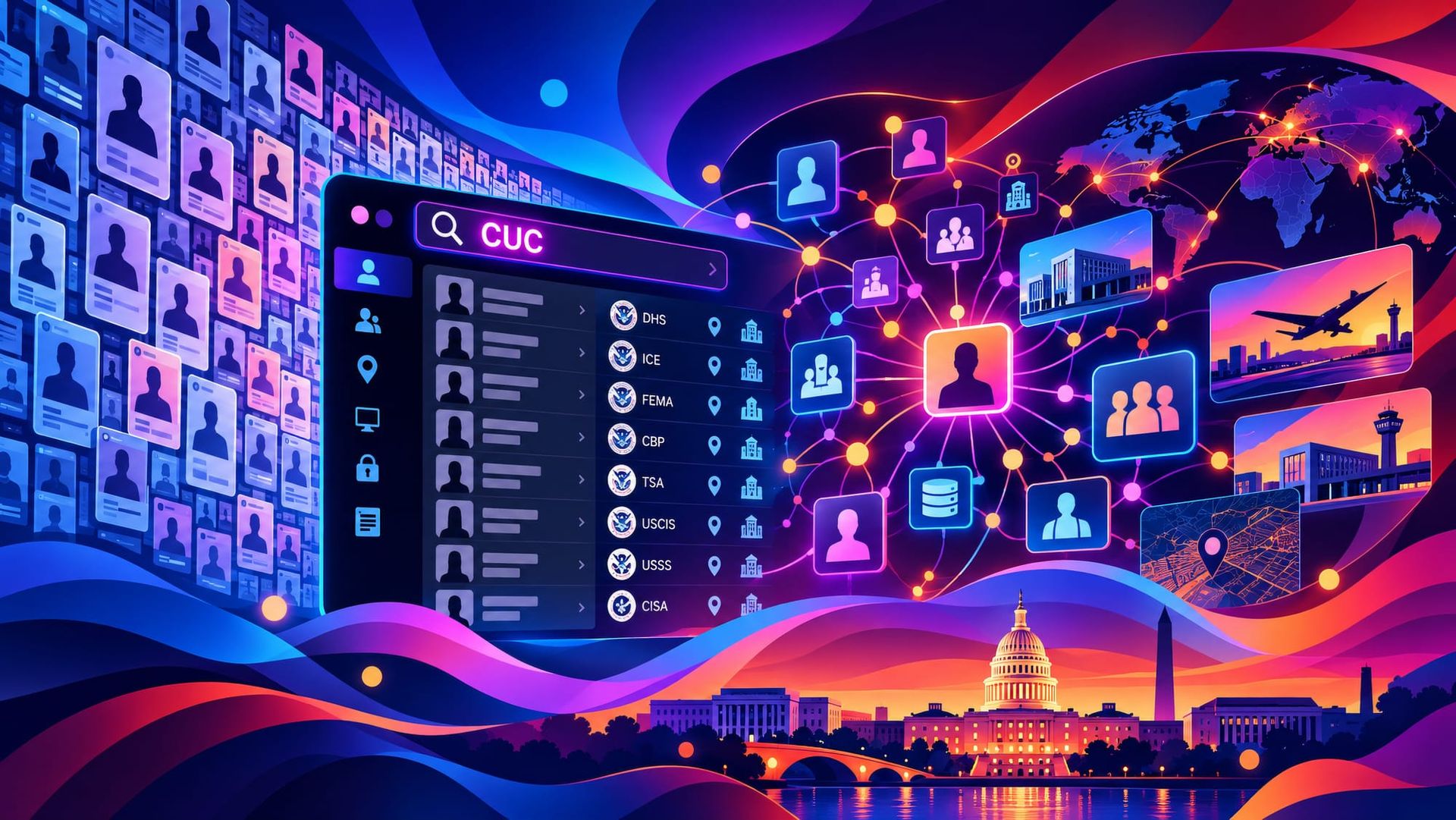
At first, it looks almost boring. A search box. Rows of names. Job titles, phone numbers, office locations, managers, access groups. The kind of administrative debris every large organization accumulates and almost nobody thinks twice about. Then three letters go into the search field.
CUC.
The results begin to populate, and the directory suddenly stops looking like an employee database. Homeland Security Investigations personnel appear across more than a dozen field offices. Names attach themselves to groups carrying the same acronym. Managers sit above them. Direct reports branch below. Phone numbers, email addresses, and locations fill in the spaces around them. Nothing on the screen says undercover agent. Nothing flashes red. There is no secret roster marked classified. There is only metadata, sitting there quietly, waiting for somebody to understand what it means.
Federal court filings provide the translation. CUC means certified undercover operation.
Now the whole thing changes.
A permission group that looked administrative a few seconds earlier becomes a clue. Follow one employee into a manager field and another relationship appears. Follow the group into a field office and geography snaps into place. Another access group in the St. Paul area references Keyhole, a program court records also describe as a certified undercover operation. Suddenly the banal machinery of identity management is reconstructing the contours of covert work in front of you. Thirty-nine HSI employees appear inside CUC-labeled groups. The records do not prove every one of them was personally operating under cover, but they do something dangerously close to it. They attach real names, real locations, real contact information, and real reporting relationships to infrastructure associated with certified undercover operations.
Nobody had to steal a file called "Undercover Personnel." Nobody had to crack some cinematic vault buried deep inside Homeland Security. The organization had already scattered the answer across the mundane systems used to run itself every day. Group memberships. Reporting lines. Office assignments. Permissions. Individually, they look harmless. Put them together and the metadata starts talking.
That is the moment Icepick stops being a personnel leak and becomes a counter-intelligence problem. Passwords are not the point. Credit cards are not the point. The exposure is the connective tissue of the organization, who works there, where they sit, what they can reach, which groups they belong to, and who they answer to. For most employers, losing that directory would be an ugly privacy breach. For an agency conducting covert operations, surveillance, wiretaps, and criminal investigations, it can become a fucking targeting package.
Distributed Denial of Secrets published Icepick on October 28. The archive contains more than 41,000 records covering employees and contractors across the Department of Homeland Security and seven component agencies. Directory timestamps place the capture around mid-August, with the collection last updated on August 19.
The composition skews heavily toward enforcement. Roughly 21,000 records belong to Customs and Border Protection, more than half the archive. About 10,000 cover Immigration and Customs Enforcement, with close to a third of those tied to Homeland Security Investigations. Another 6,200 belong to Citizenship and Immigration Services. Nearly 1,000 cover the Cybersecurity and Infrastructure Security Agency, more than half of them contractors. Headquarters and other components add thousands more. WIRED reports the archive covers roughly one-seventh of the department's workforce.
A name alone would be an ordinary personnel leak. These records go considerably further. They can include job titles, email addresses, cellphone numbers, office locations, internal systems, permission groups, supervisors, and direct reports.
The permissions data is enormous. WIRED reports more than 55,000 group names in the archive. Their names reference systems and capabilities ranging from immigration records and seized-phone data to wiretap programs, surveillance tooling, Palantir software, and AI services. These labels were created to administer access, not to communicate intelligence. Once exported with the people attached to them, they start doing both.
The chain behind the release has three parts. A group calling itself the Department of Peace says it obtained the data and passed copies to DDoSecrets and researcher maia arson crimew. Crimew cleaned and enriched the files and built the searchable front end. The motivation is openly hacktivist, with the group framing the release as a response to expanded immigration enforcement.
The trove has not been independently authenticated record by record, but meaningful portions have been corroborated. Nextgov/FCW matched one listed work phone number to a number its reporter had independently obtained before the leak. Several other listed numbers were tied to AT&T, and LinkedIn profiles for multiple people matched the titles and positions in the records. CyberScoop separately matched former CISA personnel appearing in the dataset.
DHS has now acknowledged the incident. The department says it is "aware of a potential breach and is actively working to address the situation swiftly and effectively." It has not publicly explained the intrusion path or said whether the underlying access has been closed.
Threat analysis has to account for the environment, and the environment around ICE has changed. A federal agency's personnel directory is not a typical hacktivist prize. These groups usually aim at corporations, surveillance vendors, or police departments at moments of specific outrage, not at the HR records of career civil servants.
What moved ICE into the crosshairs is temperature. Immigration enforcement is the most politically charged mission in the US government right now, and the administration has turned the heat up deliberately. Agree with the enforcement or not, the effect on the threat model is the same.
It is not only the deportations. The anger also comes from how ICE has conducted itself, and how little has reined in the agency or its public-facing agents. During the Minnesota deployment that ran into early 2026, an ICE agent shot and killed Renee Good, a US citizen, in Minneapolis. Investigative reporting has counted more than 500 US citizens swept into immigration enforcement, and oversight groups have tracked a string of deaths in ICE custody. Citizens and noncitizens are both inside the blast radius.
The expansion compounds it. ICE grew from roughly 10,000 officers to more than 22,000 in about four months, a 120 percent jump built on more than 220,000 applications and a stated target of a million deportations a year. Senator Gary Peters, the ranking member of the Senate Homeland Security Committee, has said ICE cut training requirements to hit those numbers and has not explained how it judged who was fit to carry a badge and a gun. Hire that fast and train that light, and routine encounters escalate where training would have calmed them.
Put it together and you have an agency many Americans now see as operating with impunity, with a documented record of harm to citizens and noncitizens alike. An agency carrying that reputation becomes a target a hacktivist will spend real effort to crack, where a year or two ago it would have been left alone.
None of this created the security hole. The misconfiguration was a technical failure like any other. What the climate changed is who went looking for that failure and what they did with the data once they had it. A quieter agency with the same weakness might have had its directory sold off privately or never taken at all. DHS got its directory exposed, enriched, and published with a search tool attached, because exposure was the entire point.
The pressure is not going to ease. The more aggressive and visible the campaign gets, the stronger the incentive to expose the people carrying it out, and the larger the pool of insiders, contractors, and sympathizers willing to help. Hacktivist interest tracks political salience. For as long as ICE stays the sharp edge of the administration's agenda, every identity system, vendor integration, and directory connected to the agency should be treated as a standing target. Icepick reads as the first clear data point in a trend.
The CUC discovery exposes the larger problem. This is deanonymization through metadata, and it is nastier than leaking a secret roster in one important way. Everyone knows a document labeled "Undercover Personnel" needs extraordinary protection. Almost nobody looks at a boring access-control group and sees the same counter-intelligence sensitivity. Yet the group can reveal the secret indirectly while sitting inside infrastructure administrators touch every day.
Identity systems do not merely contain users. They contain relationships between users, systems, privileges, managers, locations, and missions. Put enough of those relationships together and seemingly harmless administrative data begins reconstructing how the organization actually functions. The permissions graph becomes a mission graph. CUC is simply the most visceral example because three ordinary letters acquire operational meaning once an outsider knows where to look.
The last time officials waved something off as "just metadata," the reassurance was a lie by omission. When the NSA's bulk telephone program came to light in 2013, built on years of quiet cooperation from carriers like AT&T, the public defense was narrow and soothing. The agency collected only metadata, not the content of anyone's calls. Numbers, times, durations. Nothing anyone actually said.
The people who ran the system knew better. Former NSA general counsel Stewart Baker said metadata "absolutely tells you everything about somebody's life," adding that with enough of it "you don't really need content." Michael Hayden, former director of the NSA and the CIA, put the consequence on the record at a 2014 debate at Johns Hopkins University. "We kill people based on metadata." Who you call, when, from where, and how often rebuilds a life without a single transcript.
Icepick is that lesson pointed at an identity directory instead of a phone network. The records hold no undercover roster and no classified case files. They hold the structure around those things, and the structure is enough.
There is a harder edge to it here. The NSA built its case on other people's metadata. ICE and the wider immigration enforcement apparatus do the same thing for a living. They run on link analysis, phone extraction, Palantir case files, and the correlation of identity across databases, the exact tradecraft turning a name into a network. Icepick took that tradecraft and aimed it at the people who wield it. The group names in the leak include the agency's own surveillance tooling. A machine built to deanonymize everyone else was deanonymized by the same method, out of its own directory.
The stakes are physical, not reputational. An association with covert work is not a data-privacy inconvenience for the person behind it. A public search tool gives anyone with an internet connection a starting point consisting of names, locations, contact information, reporting relationships, and sensitive group memberships. Whether anyone converts those fragments into real-world harm depends on who downloads the data and what they combine it with. DHS no longer controls that variable.
The archive does not need to contain the whole targeting package. Start with a name, a cellphone number, an office, a manager, and a sensitive permission group. Correlate those against commercial data, property records, social media, previous breaches, or another intelligence collection and the missing pieces start filling themselves in.
Metadata compounds. One dataset tells you who the person is. Another tells you where the person lives. Another can expose family, travel, finances, social relationships, or previous credentials. The dangerous intelligence product is not always sitting intact inside one stolen database. Sometimes it emerges only after several ordinary datasets are laid on top of one another.
The entry point remains the weakest-sourced part of the disclosure. The Department of Peace says the records came from the single sign-on environment Homeland Security runs using Okta. Single sign-on lets employees authenticate once and reach multiple internal applications. The identity environment around it contains exactly the kind of users, groups, roles, and organizational relationships exposed here.
Okta disputes any compromise of its own systems. A company spokesperson said, "Okta is secure, and we have no evidence our data or systems were compromised." The public record does not independently establish how the records left DHS.
Okta denying compromise of Okta is not the same thing as disproving theft from a DHS identity environment built on Okta. The data could have been taken from the department's tenant, a connected application, an administrative interface, or through valid credentials. Those remain possibilities, not established facts. Until someone with visibility into the relevant logs explains the path, attribution to an Okta compromise stays low confidence.
The distinction matters enormously. A vulnerability inside Okta itself could implicate thousands of other customers. Theft from one customer's identity environment is a contained event with a radically different blast radius, even if the downstream consequences for the people inside that tenant look identical. Those are different security problems and should not be blurred because the same vendor name appears in both.
For a decade, security teams have been told identity is the new perimeter. Move access behind a centralized identity provider, enforce strong authentication there, and stop treating the network boundary as the primary security control. The advice is sound. Icepick exposes the part of the equation we talk about far less.
Centralizing identity also centralizes the description of the organization. The crown jewels inside a modern identity platform are not merely passwords, tokens, and keys. The directory itself is an asset. It tells you who exists, what they can reach, who they report to, and which systems or sensitive programs touch their identity. Tens of thousands of permission groups begin to resemble organizational reconnaissance rather than administrative exhaust.
Access can be remediated. Knowledge is harder. Once an adversary learns who runs a sensitive program, where a team operates, or which people touch covert infrastructure, changing the authentication material does not erase what has already been learned.
The answer is not to abandon centralized identity. It is to admit something uncomfortable about it. Least privilege, done well, builds the map. Granular roles and descriptively named groups are exactly what good access control looks like, and they are exactly what turned this directory into an org chart of covert operations. The discipline protecting access manufactures the intelligence. Tightening permissions does not close that gap. It sharpens the picture.
So sensitive programs have to design against their own hygiene. Groups tied to covert work should carry opaque identifiers, not labels like CUC or Keyhole broadcasting the mission to anyone who reads them. The most sensitive operations should live outside the enterprise identity provider entirely, rather than share a directory with the help desk and the motor pool. Bulk enumeration of users, groups, and reporting lines should be flagged as the collection activity it is, rather than logged and ignored. Least privilege protects access. Almost nothing in the standard identity playbook protects secrecy.
To a threat actor, the value of an identity provider is changing shape. The objective does not always have to be getting through the door. Sometimes the objective is reading the floor plan.
A clean copy of an adversary's directory is a counter-intelligence windfall. A nation state intelligence service would prize exactly this kind of material, names attached to capabilities, capabilities attached to groups, groups attached to managers, and managers attached to offices. A hacktivist publishes it because exposure is the point. A foreign intelligence service might never tell anyone it had the same data. It would enrich it, correlate it, task collection against it, and quietly exploit the relationships for years. One outcome produces headlines. The other is the one defenders should fear more.
Strip away the politics of this particular target and the pattern underneath is universal. Every large organization has a directory. Every directory accumulates relationships. People belong to groups, groups touch systems, managers connect teams, and administrative labels quietly encode what those teams actually do. An intruder does not always need the crown jewels if the metadata around them explains where the crown jewels are and who holds the keys.
Icepick changes the identity-security question because it demonstrates another failure mode. We have spent years asking what happens when someone steals a credential and gets through the perimeter. Sometimes the directory itself is the intelligence objective. Once you can see who exists, what they touch, where they sit, who they answer to, and which sensitive programs connect them, you are no longer looking at an employee database. You are looking at the organization from the inside.
Homeland Security can reset every password in the department. It can revoke every session, rotate every key, rebuild every account, and harden whatever system ultimately failed. None of those controls can make more than 41,000 exposed identities, tens of thousands of permission groups, and the operational associations between them unknown again.
Incident response cannot clean up this part. Credentials expire. Organizational knowledge does not.
An agency built on turning other people's metadata into targets just learned what it is to be the target. And when metadata has already connected a real human being to covert work, there is no password reset for a burned identity.