Spying on OpenAI Took a Badge Not a Breach
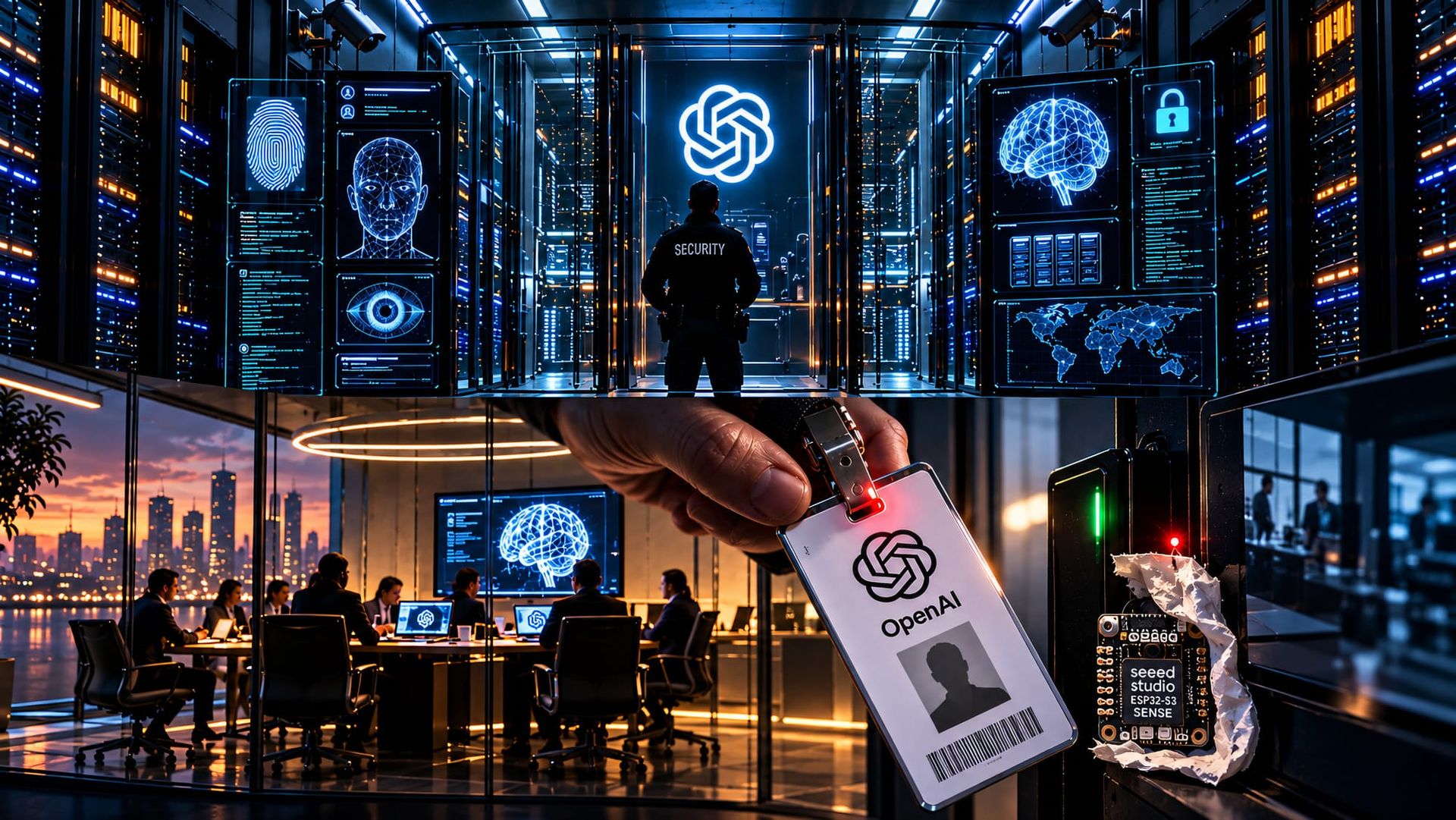
Sometime around September 28, a thumb-sized development board wrapped in toilet paper was tucked behind a television in one of OpenAI’s most sensitive conference rooms. It cost about fourteen dollars. For at least several days it recorded, including during a meeting between OpenAI executives and officials from the US government. On September 30, the company found it.
OpenAI guards its model weights like a weapons program. It did not guard the room where its leadership meets. The person the FBI says placed the device was not an outside intruder but a 35-year-old staff engineer with a multimillion-dollar package, internal access, and a one-way ticket to Riyadh. If the government’s filing holds, the breach never touched the network. It was a human intelligence operation run from inside the building.
Abdulrahman Alfozan, a Saudi national and US permanent resident, joined OpenAI in July 2025 on a US$325,000 base salary, later increased to US$385,000, along with a US$2.2 million new-hire equity grant. Alfozan has lived in the United States since 2009 and holds degrees from MIT and UC Berkeley. He is charged with one federal count of illegally recording communications, carrying up to five years in prison. Prosecutors in the Northern District of California asked the court to hold him pending trial, and a federal magistrate judge agreed. The government says more serious charges may follow as evidence develops. Everything below comes from the government’s detention filing, so it remains allegation rather than proven fact.
The hardware itself was almost aggressively ordinary. Investigators identify it as a Seeed XIAO ESP32-S3 Sense, a thumb-sized development board with a digital microphone, microSD storage, wireless connectivity, and support for a detachable camera. One sat concealed behind a television for at least several days. During that window OpenAI executives used the room for a meeting with US government officials, creating a potential intelligence collection opportunity against the company and the government in one sitting. The storage recovered from the device was encrypted, so investigators could not determine what it had captured.
A board like that does nothing on its own. The effort went into what someone allegedly configured it to do, and where they placed it. The government says Alfozan used a ChatGPT account belonging to his wife to research continuous recording, wifi connectivity, improved audio, live listening, SD card encryption, installation, obfuscation, and remote access. After his arrest, agents found a second concealed device. Alfozan’s iPhone contained photos of input and output panels on televisions and other equipment across several OpenAI buildings, including another room used for sensitive meetings. One device may have been the beginning rather than the end.
Alfozan also allegedly used OpenAI’s internal productivity agent to determine which conference rooms and people mattered the most. The filing says he queried it about building addresses, room capacities, calendars, leadership meetings, external partner meetings, planned Saudi visits, and meetings involving Saudi entities. A further query sought ten senior OpenAI figures appropriate for a high-level informal meeting with Saudi ministers. The tool built to make the company faster had become a way to map the company itself. OpenAI’s own agent had seemingly been turned into reconnaissance against the company.
Enterprise AI has quietly created a new insider-threat problem. It turns an organization into something its employees can query. An employee who once needed weeks of conversations, calendar watching, directory searches, and social mapping can instead simply ask an internal agent to assemble the picture for them. Calendars, documents, meeting rooms, leadership structures, and internal communications become one queryable surface. The security question is no longer only which files an employee is authorized to open. It is what the company’s own AI can infer for that employee once those permissions are combined.
On October 4, the FBI says, Alfozan opened a folder on his phone labeled “Saudi Gov Docs.” The contents have not been made public. What the government did disclose is what followed. He queried OpenAI’s agent about senior personnel suitable for meetings with Saudi ministers, while WhatsApp logs cited in the filing allegedly show a member of the Saudi royal family recruiting him. The messages continued through October 5. In one exchange, Alfozan answered “100” to the message “Saudi needs you more then [sic] the US.”
The government leaned hardest on the flight evidence. Alfozan had booked a one-way ticket to Riyadh for himself, his wife, and their baby, allegedly paid for by the Saudi government. After his arrest, a member of the Saudi military booked and paid for a business-class one-way ticket for his wife and son to Doha. Alfozan holds two Saudi bank accounts, and agents seized his Saudi passport. Prosecutors pointed to the case of Ali Alzabarah, the former Twitter employee charged with spying for Saudi Arabia who fled the United States with assistance from a foreign official. That is the outcome they are trying not to repeat.
None of this proves Saudi state direction, and the government does not claim it does. It merely argues the recording was criminal whether Alfozan acted to improve his own business prospects or to aid a foreign government. For the charge currently before the court, the distinction does not matter. The evidence is a one-sided detention argument, the folder’s contents remain undisclosed, and the recruitment interpretation of the messages belongs to investigators. Whether Alfozan was a witting asset, an ambitious engineer, or something between the two remains unresolved.
That ambiguity matters because frontier AI is now embedded in the national economic strategy. Saudi Arabia designated 2026 its Year of Artificial Intelligence and has made attracting technical capability an explicit part of its broader Vision 2030 ambitions. None of this turns recruitment into espionage. It does mean the same engineer can be an employee, a commercial recruit, a national talent target, and a counter-intelligence concern all at once. The ambiguity is not noise around this case. It is part of the case.
A frontier lab’s crown jewels are not only model weights and research repositories. Much of the most valuable knowledge never reaches a repository at all. It lives in failed approaches, internal judgments, capability and safety assessments, and the research intuition carried in people’s heads. In intelligence terms, Alfozan’s value was placement and access. He worked inside OpenAI and could reach the rooms, systems, and executives who mattered. Recruit the person and you acquire both the information and the human capability to interpret it. Data can be copied. Tacit knowledge moves only with the person holding it.
Ordinary corporate security is poorly shaped for this. OpenAI can harden its network, encrypt its weights, and monitor its endpoints, and still face intelligence collection from a microphone behind a television. The insider sits inside most of those controls by design because they are supposed to be trusted. Cyber security tooling watches the account, the laptop, and the network sessions. Counter-intelligence asks a different set of questions. Who has access to the person, who is cultivating them, which rooms they can enter, and what they can observe without ever touching a database? Frontier labs are becoming strategic targets faster than their security models are becoming counter-intelligence programs.
OpenAI did catch it, and leaned on that in public, framing the case as evidence its security program works and AI can help counter sophisticated threats. Even human intelligence (HUMINT) threats. But this framing is self-serving, even though the detection was real. A security sweep found the hardware. A camera the company had installed recorded the suspect returning to check behind the television. The FBI became involved before investigators could determine what, if anything, had been captured. An old counter-intelligence reflex, watching the room, closed a very modern case.
The most sensitive thing in a frontier lab is no longer only a file on a cluster. It is a conversation, a judgment, and a person who holds both. The next great breach of an AI lab may never cross the network boundary at all. The most powerful credential in the building may simply be a badge that still works.