
Fancy Bear is Mapping How Fast NATO Can Rebuild
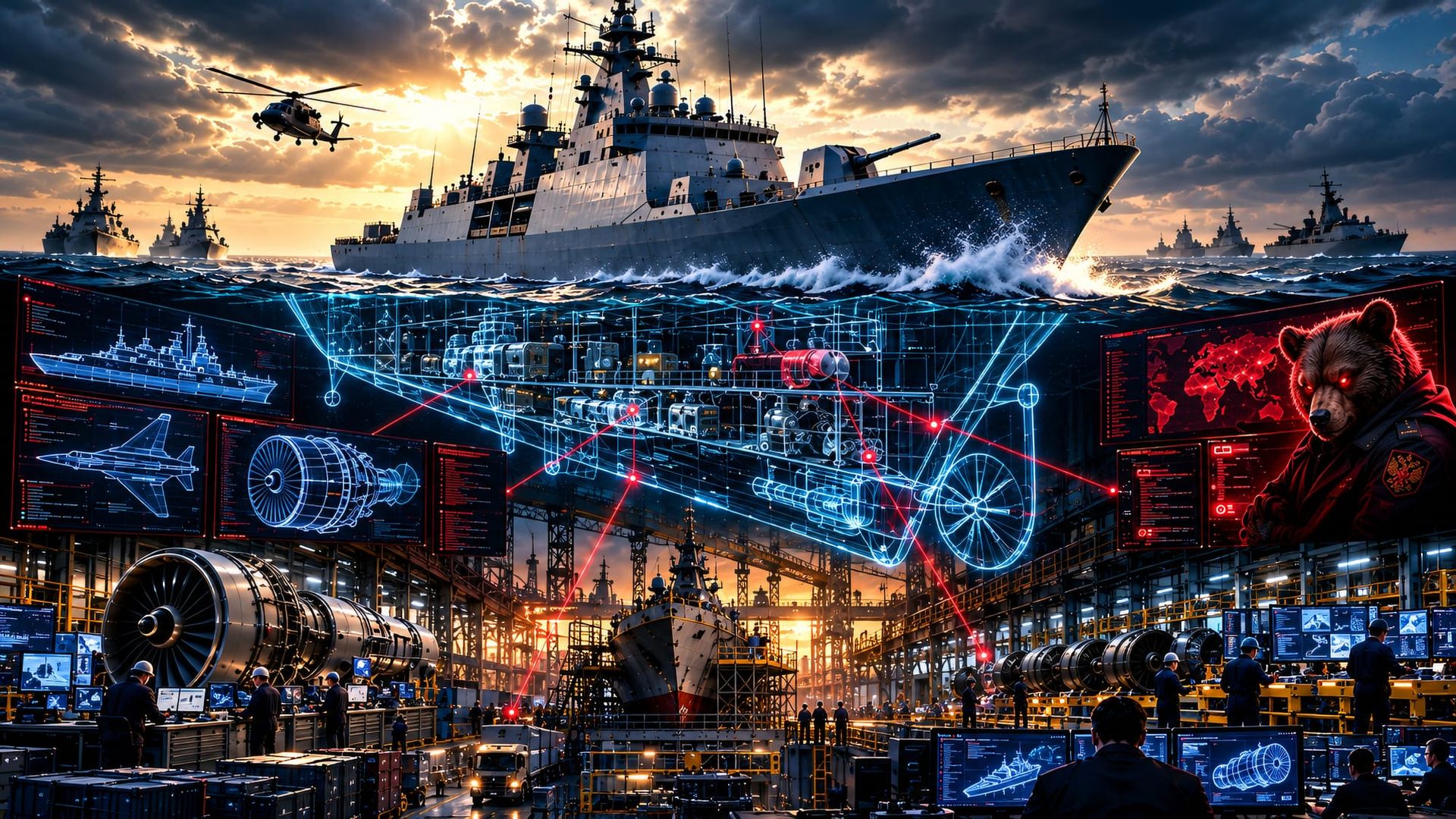
a navy keeps very few of its secrets inside the navy. the ships are designed, welded, wired, and tested by contractors. the engines powering them come from a separate set of firms with their own networks. and much more. in late july a gru actor was sitting inside one of those shipyards. symantec, which tracks the activity cluster as swallowtail, ties the adversary responsible to fancy bear.
the shipbuilder was not alone. symantec found the same operators inside a law enforcement agency, and a military aircraft engine manufacturer, spread across two nato member states. it has not named the countries or the companies.
none of the three victims is a defense ministry or an operational command. they are the industrial base the alliance’s hard power actually rests on. warship blueprints, build schedules, propulsion specifications, supplier relationships, and test results can all sit on contractor networks. those networks are routinely easier to reach than the military organizations they serve. an adversary that cannot easily breach a navy can still learn an extraordinary amount by breaching the yard building for it.
symantec does know how the shipbuilder intrusion began. on july 24 a malicious macro-enabled word document was opened directly from the outlook attachment cache, confirming it arrived as an email attachment. its obfuscated macro dropped hookedge and started the infection chain. there is no vulnerability tied to the initial compromise. the victim opened the door the old-fashioned way.
the first stage was deliberately ordinary. hookedge used a hidden microsoft edge window as its http client, pulling commands from webhook.site and sending results back through the same legitimate service. the operators checked outbound access to services including dropbox, google, microsoft, and mega. then they inventoried the machine, its network configuration, running processes, logged-on sessions, and local directories. this looks less like immediate exploitation than reconnaissance to decide what kind of host they had landed on.
then the operation changed. after a gap of roughly three days, the next stage abandoned webhook.site and began taking instructions from a hard-coded address at 185.82.218[.]119. symantec saw seven tasks arrive within about thirty seconds, each executing and returning output within seconds of the last. from there the operators repeatedly returned to the same host over the following week, hands-on-keyboard rather than firing an automated chain.
recorded future has independently described hookedge as part of a tiered model, where lightweight initial access identifies victims worth more intensive collection. the shipyard sequence has the same shape. cheap infrastructure gets the first look. once the target proves interesting, the operation turns deliberate. the move from a public webhook service to dedicated, hands-on tasking is itself an intelligence judgment about the value of the machine on the other end.
the operators took credential data two different ways. first they pushed an ssh private key onto the host. then they used windows openssh to create a persistent backgrounded tunnel to infrastructure they controlled. the tunnel gave them a route back through the compromised system and into the internal network. they immediately began resolving and probing internal hostnames.
the second method leaned even harder on built-in tools. a short powershell script stood up a listening port on the machine’s own loopback address. it then used net use to force the host to authenticate to itself, capturing the resulting ntlmv2 challenge and response. that data could be cracked offline or relayed elsewhere. no specialized credential-stealing binary was required. the operating system supplied almost everything they needed.
the malware was similarly restrained. ld.exe, a previously undocumented reflective loader, was already staged on the host on july 30. the next afternoon a curl command delivered an encrypted file named events.dat. the operators ran ld.exe with the path to that file and a decryption key as its arguments. it decrypted the payload directly in memory and called its exported loader function. symantec recovered ld.exe and the key but not events.dat. the final capability stays unknown.
the concentrated operator activity lasted days. the access lasted much longer. symantec still found the same loader and generic vbs launcher on the host roughly four weeks later. the launcher appeared again on september 24. whether that reflected continued automated persistence or renewed operator interest cannot be determined from the available telemetry. either way, a july phishing attachment had become at least a two-month presence inside a naval shipbuilder.
hookedge itself was not new. recorded future’s insikt group first documented the backdoor in august 2026 after tracing fancy bear campaigns against european diplomatic and defense targets. it shares substantial code and tradecraft with headlace, a fancy bear implant observed since 2023. both lean on batch scripting, legitimate internet services, and hidden browser sessions rather than elaborate bespoke infrastructure.
every piece of this is the furniture of ordinary system administration. microsoft edge, curl, powershell, ssh, ntlm, batch files, and scheduled tasks. the capability on display is not primarily in exotic tooling. it is in knowing which organizations matter, and in returning by hand until the network gives up what the operator came for. the distance between unremarkable technique and deliberate targeting is where this kind of espionage actually lives.
it also explains why the industrial base is the smart place to spend that patience. a warship program runs for years, so the intelligence compounds. a propulsion specification taken today can describe a hull still in service decades from now. a foothold in one supplier can also expose the relationships and dependencies surrounding the next. yards, engine makers, and subcontractors do not operate as isolated networks. they are severely intertwined.
the base is also where military capacity becomes measurable. production rates, repair cycles, delayed components, test failures, supplier dependencies, and spare capacity tell an intelligence service how quickly an alliance can replace what it loses. they also show where that replacement turns fragile. a blueprint describes a weapon. the industrial system around it describes how many can exist, how quickly, and for how long.
none of those facts has to look like a crown-jewel secret on its own. a late component, an engine test report, a maintenance backlog, or a subcontractor list can appear almost mundane. assembled together, they become a map of regeneration capacity. they tell an adversary not only what nato can field, but what it can rebuild after the first inventory is gone. this is important when considering the context from a kinetic lens.
that fragility is exactly what nato has been racing to address. it is pushing to scale defense production, protect defense-critical supply chains, and open new manufacturing capacity across the alliance. deterrence is no longer measured only by what sits in depots and harbors today. it depends increasingly on whether the industrial system behind those assets can keep producing under pressure. the networks inside that system therefore hold intelligence about military endurance, not only procurement.
there are real limits on what can be said here. the final payload is unknown, the victims are unnamed, and symantec does not publish a confidence level for the attribution. it ties swallowtail to fancy bear, a group the us government attributes to the gru. the tooling and tradecraft in this intrusion overlap with activity independently associated with the same activity cluster. what the operators ultimately took is the larger open question, and the recovered evidence cannot answer it.
the shape of the target, though, is not in question. the alliance counts its strength in hulls, airframes, and engines. the adversary counted its opportunity in the contractors building them, then worked through the network using tools a junior administrator would recognize on sight.
the fleet is the visible expression of military power. the industrial base is where an adversary learns what can be built, what can be replaced, and what breaks first. you can protect the navy and still lose the secrets determining whether it can keep being one.