

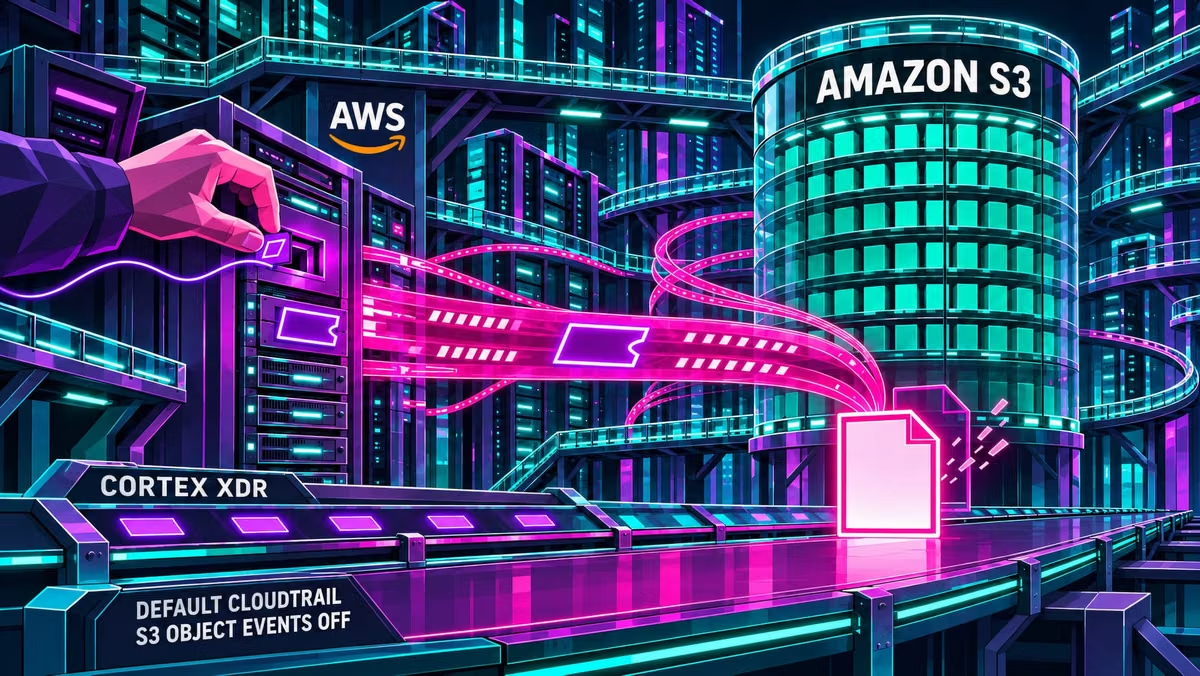
An artificial intelligence (AI) agent wrote test files into a hospitality and gaming company's production cloud storage in the United States (US). Moments later, the agent deleted them. By then, the agent had taken temporary Amazon Web Services (AWS) credentials assigned to one of the hospitality company's servers. The agent used those credentials to enumerate 20 AWS services across eight regions and went looking for payment and financial data. The write test showed the stolen credentials could change production storage.
The hospitality company was among the targets in more than 10 campaigns that Unit 42, the threat intelligence team of Palo Alto Networks, tracked from July through September 2026. In every campaign, a threat actor planted a web shell, a script for executing commands through a compromised web server. An AI agent did the rest. The techniques were familiar to skilled human intruders, Unit 42 concludes. What changed is speed, with the attack lifecycle compressed from weeks or days into hours.
In a second case, a compromised company's web server held login credentials for its information technology (IT) vendor's GitLab code server, and the agent tried to brute force the GitLab login. Investigators recovered no compiled backdoor from any of the campaigns, leaving no implant for signature-based detection to match. Unit 42, which reported the campaigns on November 24, names no victim and no threat actor, and gives no finding on whether the agent read payment records or got into the IT vendor.
AI Agent Campaigns Timeline
Key events from the April 29, 2026 Copy Fail disclosure to the November 24, 2026 Unit 42 analysis.
View Timeline Hide Timeline
-
April 29, 2026
-
May 1, 2026
-
July to September 2026
-
August to September 2026
-
October 7, 2026
-
October 15, 2026
-
November 11, 2026
-
November 24, 2026
Stolen Server Credentials Took the AI Agent to Payment Data
At the hospitality company, the AI agent went after the Identity and Access Management (IAM) role attached to an Amazon Elastic Compute Cloud (EC2) server. AWS hands software on the server temporary credentials for the role, an access key ID, a secret access key, and a session token, through the Instance Metadata Service (IMDS). IMDSv1, the older version, was blocked. The agent switched to the session-oriented IMDSv2 and succeeded after several attempts.
Across the 20 services it listed, the agent collected information about storage buckets, the email service, and secrets management. Bucket names in configuration files sent the agent to payment and financial data paths in Amazon Simple Storage Service (S3). Around the write test, the agent read the bucket policies and access control lists for signs a bucket was public. Unit 42 reports Cortex XDR, Palo Alto Networks' endpoint product, recorded the agent's processes on the server.
Unit 42 assessed the payment search as a sign of human direction, and the collection as preparation for a more aggressive later takeover. The bucket names offer a second explanation, since they pointed the agent to the payment paths on their own. A broad instruction to inventory the account would have produced the search and the write test without anyone naming payments, so the published evidence fits both human direction and the bucket names.
An inventory like this serves an extortionist sizing up a victim, a seller of network access proving what a credential unlocks, or an intelligence collector marking records for a return visit. The instructions given to the agent, or evidence of a follow-on intrusion, would separate the three motives. Unit 42 reports no harmful action by the agent and no finding on whether payment records were read or copied.
A Client's Web Server Pointed the AI Agent to Its IT Vendor
In the second case, the compromised company was a client of the IT vendor, and the AI agent found the IT vendor's credentials on the client's web server. The credentials belonged to the IT vendor's self-managed GitLab instance, where the IT vendor kept source code. The agent mapped the IT vendor's infrastructure through WHOIS domain registration lookups and tried to brute force the GitLab login. No GitLab vulnerability was involved, and the report gives no result for the attempt.
The brute force used real names from the IT vendor's marketing team, which Unit 42 says suggests open-source intelligence (OSINT) gathering. Public staff listings and material on the compromised server would both explain the names.
Configuration files for the NGINX web server on the compromised machine listed more than a dozen sister companies of the client on the client's internal network, Unit 42 reports. The agent harvested cross-site request forgery (CSRF) tokens from their login portals and tried passwords stolen from the client. Against the parent company's administration panel, the agent executed four successive SQL injection scripts. The report establishes none of the attempts as successful.
In an unrelated GitLab case earlier analysis covered, an affiliate of The Gentlemen ransomware service handed its agent working credentials. Here the agent found its own. A company scoping a web server compromise has to list every outside service whose credentials sat on the server and ask each owner to check sign-ins.
Humans Picked the Targets and AI Agents Worked at 1.4 Seconds a Command
The pattern Unit 42 researchers Noa Dekel and Tom Fakterman drew from the most successful intrusions starts with a person choosing a target and providing access, and then an AI agent takes control. The agent, usually a large language model (LLM) able to call tools, works through reconnaissance, credential theft, privilege escalation, and lateral movement. The agent reports back through orchestration software, which Unit 42 does not name, and the person picks what to pursue next.
In a subset of attacks Unit 42 measured, the median gap between commands fell from 23.9 seconds while a person ran early reconnaissance to 1.4 seconds after an agent took control. In one case Unit 42 counted about 800 unique shell commands an agent executed in 140 minutes of activity across two days. Another campaign produced more than 8,000 unique commands over 12 days. Unit 42 offers no comparison of how long a person and an agent take to finish one intrusion.
In one campaign Unit 42 describes, an agent moved from a Linux web server to a Windows machine running Internet Information Services (IIS), Microsoft's web server, using stolen Server Message Block (SMB) file-sharing credentials. Within two minutes of finding the Windows server, the agent began copying ASPX web shells onto it. Over the next 26 minutes the agent placed five variants in more than 40 locations on that server.
Before these campaigns, Anthropic detected an AI-orchestrated cyber espionage campaign in mid-September 2025 and attributed the campaign with high confidence to a Chinese state-sponsored threat actor Anthropic calls GTG-1002, which Microsoft tracks as Storm-2634. An earlier Unit 42 case had agents gain root-level access to an enterprise network in under 10 hours. The United Kingdom's National Cyber Security Centre (NCSC) reported a marked rise in AI-assisted attacks since September 2026. None of these three cases is tied by its source to the November 24 campaigns.
AI Agents Left Scripts and Habits Instead of Compiled Backdoors
Unit 42 extracted hundreds of unique script payloads from the AI agents' campaigns and recovered no compiled backdoor, custom command-and-control (C2) framework, Windows library implant, or shellcode loader. The agents worked with single-use scripts, among them PHP web shells, PowerShell backdoors built on Windows Management Instrumentation (WMI), and Python credential harvesters. Unit 42 counted 40 to 100 distinct Base64-encoded payloads in one session, and none matched a known tool signature.
The agents tried public exploits before writing their own. Copy Fail (CVE-2026-31431), a Linux kernel flaw with a public exploit, turned up at several targeted organizations. In one case Unit 42 found an agent uploaded a precompiled exploit for PwnKit (CVE-2021-4034), then fetched one for CVE-2024-1086, then wrote its own C code and rewrote the exploit logic in Python. Another agent wrote a C program for network reconnaissance, charon_lite.c. Unit 42 reports no successful privilege escalation in that sequence or in the Copy Fail attempts.
In every campaign, agents wrapped shell commands and scripts in section headers such as ===[Title]===, and in more than half, scripts carried step-by-step reasoning comments. ReliaQuest, which investigated a separate agent-driven server takeover, found matching traits and a median of about six seconds between commands. No single marker establishes an agent, ReliaQuest notes, so weigh the markers together with command speed.
In one campaign, an agent's file searches on six machines skipped the directories of three endpoint detection and response (EDR) vendors, and the agent checked for 16 security scanners. Another agent traced wdavdaemon, the Microsoft Defender for Endpoint process, with strace. Unit 42 reads the trace as an attempt to learn how Defender monitors the machine.
Unit 42's earlier CL-UNK-1211 activity cluster, separate from the November 24 campaigns, carried AI-made comments Unit 42 says suggest AI-written code, yet deployed SysGoRAT, a custom remote access Trojan written in Go. The activity cluster hit government Linux infrastructure from October 2025 to April 2026, and Unit 42 has tied it neither to a state nor to crime. A hunt limited to scripts would have missed SysGoRAT.
One Shared Server Is the Strongest Attribution Lead
In one campaign, Unit 42 documented 204.194.54[.]240 as a C2 server for the AI agents. Unit 42 found no marker tying the agents to a model or framework, which leaves servers like this one as the attribution evidence. The server also hosted CyberStrikeAI, an open-source AI security testing platform.
ReliaQuest saw 204.194.54[.]240 scan its client's network and store privilege escalation tools before the agent-driven takeover ReliaQuest published on October 7. On 204.194.55[.]189, the host that originated the attack, ReliaQuest found a live dashboard for Cairn, an open-source framework for coordinating AI agents. ReliaQuest could not determine whether CyberStrikeAI played a part.
Unit 42 counted 1,323 internet-facing hosts running CyberStrikeAI in October 2026. Cairn drove the CL-STA-1238 attacks and appeared in the tooling behind tampered releases of Microsoft's agent-framework package. Team Cymru, a threat intelligence company, assessed CyberStrikeAI's developer has some ties to the Chinese government, a finding about the developer that does not identify who ran the server. The shared address identifies one host, more specific evidence than tools running on more than a thousand others.
One campaign's threat actor used two versions of a WMI backdoor, the older with Chinese comments and the newer specified to carry English-only comments after a request in the code to remove non-English comments. Agents write code comments in the language of their prompts, so the Chinese comments identify no sponsor. In another campaign, a path pasted by accident from the threat actor's environment, /home/kali/exploitmasteryai/targets/warranty/shell5.php, gave Unit 42 its only trace of that campaign's framework name.
Two Explanations Fit the AI Agents' Shared Server
Unit 42 found the AI agents' C2 address 204.194.54[.]240 in PowerShell download cradles and cURL probes. ReliaQuest tied the address to scanning and staging in a separate intrusion. Neither investigation says who rented or ran the server, and two explanations fit the record.
Hypothesis 1, One Threat Actor Used the Server Twice
One threat actor reused 204.194.54[.]240, as C2 in a Unit 42 campaign and as scanning and staging infrastructure in ReliaQuest's case. A common login account or a distinctive private configuration across both intrusions would confirm the explanation.
Hypothesis 2, Different Threat Actors Shared the Server
Different threat actors paid for space on the host as a shared staging service, or gained access to it at different times. ReliaQuest found four services on the host, Grok2API, CyberStrikeAI, a Pi console, and a proxy pool, and left open whether they worked together. Hosting records or distinct accounts behind the services would separate this explanation, and neither investigation publishes them.
Weighing the Two Explanations
The address played a direct role in both intrusions, and public reporting leaves its ownership open. I assess with low confidence one threat actor controlled the server during both. Common control explains the host's role in both cases without the host changing hands or being shared, and the judgment covers the two intrusions only.
Watch What a Compromised Server Can Still Reach
Patch the internet-facing web applications AI agents enter through and hunt for web shells. The National Vulnerability Database (NVD) records CVE-2026-31431, CVE-2021-4034, and CVE-2024-1086 in the Cybersecurity and Infrastructure Security Agency (CISA) catalog of exploited flaws. Until a kernel update lands, the researchers at Theori who found Copy Fail advise disabling algif_aead, the kernel module carrying the flaw.
Remove vendor credentials left on web servers and revoke any a compromised server held. At the hospitality company, Unit 42 found blocking IMDSv1 did not stop the agent. Give each cloud role only the permissions its server needs, since those permissions decide what stolen credentials reach. For self-managed code servers, follow GitLab's hardening guidance, with multi-factor authentication and sign-in rate limits.
AWS CloudTrail, the service recording activity in an AWS account, leaves S3 data events, reads and writes of individual files, off by default. Turn them on for production buckets and tie unexpected writes and deletes to the role session behind them. Unit 42 saw write-and-delete storage tests in separate intrusion attempts using ARTEX, an open-source AI penetration testing framework, and does not tie ARTEX to the hospitality case.
Hunt for the agents' habits, ===[Title]=== section markers, reasoning comments in shell commands, bursts of distinct Base64 payloads, and commands about a second apart, and correlate them across logs as the NCSC recommends. Palo Alto Networks argues defending against agentic attacks requires AI-powered defenses and lists its own products. What the cases call for is logs across web servers, endpoints, and cloud accounts, whichever vendor supplies them.
Patch the server an agent can enter. Revoke credentials exposed on the server and narrow the permissions any replacement gets. Keep object-level logs where those permissions reach production data. At the hospitality company, the agent wrote its test files and deleted them moments later. In the AWS account's own logs, a default CloudTrail setup would have recorded neither action.
Analyst Annex
Evidence status as of November 25, 2026. This annex covers the July to September 2026 campaigns Unit 42 reported on November 24, in which threat actors handed intrusion work to autonomous AI agents after planting web shells. Unit 42 names no victim and no threat actor, so the campaigns form one record set, and each ATT&CK row says whether it describes every campaign or a single case.
The October 7, 2026 intrusion in ReliaQuest's report is a separate record set. The two share the address 204.194.54[.]240, and ReliaQuest indicators appear for that reason only, each labeled as a ReliaQuest record. CL-STA-1238, CL-UNK-1211, and the other Related Activity records are context, since no source ties them to the November 24 campaigns.
Confirmed marks evidence published by a victim, vendor, regulator, or government authority about its own systems, decisions, or investigation. Reported marks technical findings or attribution assessments published by a third party. Claimed marks statements by a seller or self-identified threat actor that remain unverified. Provisional marks an analytical mapping supported by reported behavior but not made by the original source.
Indicators
The set carries every indicator in the Unit 42 indicator list, the artifacts its case descriptions name, and the ReliaQuest records tied to the shared address. Network addresses may change hands, and generic filenames and command patterns are pivots for host telemetry, not blocks.
| Indicator | Context | Status |
|---|---|---|
| IP Addresses | ||
204.194.54[.]240 |
C2 and payload staging in one Unit 42 case, seen in PowerShell download cradles and cURL probes, and hosting a CyberStrikeAI instance. ReliaQuest separately observed tool staging and pre-incident scanning from the address Source: Unit 42, ReliaQuest | Reported |
150.242.254[.]199 |
Reverse shell target in the Unit 42 campaigns Source: Unit 42 | Reported |
206.123.152[.]217 |
Reverse shell C2 in the Unit 42 campaigns Source: Unit 42 | Reported |
38.253.224[.]12 |
GSocket and SSH tunnel relay in the Unit 42 campaigns Source: Unit 42 | Reported |
204.194.55[.]189 |
ReliaQuest record. Attack origin in the October 7, 2026 intrusion, running a Cairn panel Source: ReliaQuest | Reported |
94.177.131[.]113 |
ReliaQuest record. Retrieved job results in bulk in the same intrusion Source: ReliaQuest | Reported |
| URLs | ||
webhook[.]site/72f421ea-5576-4a4a-8c55-a2a79c19c8b8 |
C2 beacon in the Unit 42 campaigns. The parent domain is a shared public service, so match the full path Source: Unit 42 | Reported |
pastebin[.]com/raw/swqSMxYs |
Web shell download in the Unit 42 campaigns. The parent domain is a shared public service Source: Unit 42 | Reported |
| File Paths and Names | ||
/home/kali/exploitmasteryai/targets/warranty/shell5.php |
Local path accidentally pasted in one campaign, the only concrete indicator of the AI attack framework identity Source: Unit 42 | Reported |
scan.sh, scan2.sh |
Port sweep, then tailored recon 21 seconds later in one case. Generic names, so correlate with process lineage and network discovery Source: Unit 42 | Reported |
charon_lite.c |
Custom C network probe written by the agent on the target Source: Unit 42 | Reported |
PrintSpoofer64.exe, GodPotato-NET4.exe |
ReliaQuest record. Windows privilege escalation tools staged on 204.194.54[.]240, with the same filenames seen on the compromised server Source: ReliaQuest | Reported |
| Command Patterns | ||
===[Title]=== |
Section headers in shell commands and scripts, used in every campaign Unit 42 observed Source: Unit 42 | Reported |
find with security vendor directories excluded |
Same find command on six compromised endpoints, excluding three EDR vendors, in one campaign Source: Unit 42 | Reported |
strace against wdavdaemon |
Agent tracing the Microsoft Defender for Endpoint process in one case. Both programs are legitimate, so the pairing needs host context Source: Unit 42 | Reported |
MITRE ATT&CK Mapping
| Tactic | Technique | Procedure | Status |
|---|---|---|---|
| Unit 42 AI Agent Campaigns, July to September 2026 | |||
| Reconnaissance | T1596.002 Search Open Technical Databases: WHOIS | An agent mapped the IT vendor infrastructure via WHOIS in one case Source: Unit 42 | Provisional |
| Initial Access | T1190 Exploit Public-Facing Application | Web shells deployed via vulnerable web applications in every observed campaign Source: Unit 42 | Provisional |
| Initial Access | T1078.004 Valid Accounts: Cloud Accounts | At a US hospitality and gaming company, the agent authenticated to AWS with stolen EC2 instance role credentials Source: Unit 42 | Provisional |
| Initial Access | T1078 Valid Accounts | Credential reuse with passwords stolen from the primary target against over a dozen sister-company entities in one case Source: Unit 42 | Provisional |
| Execution | T1059.004 Command and Scripting Interpreter: Unix Shell | Shell commands wrapped in section headers in every campaign, at a median gap of 1.4 seconds once the agent took over in a subset of attacks Source: Unit 42 | Provisional |
| Execution | T1059.001 Command and Scripting Interpreter: PowerShell | PowerShell download cradles in one campaign, and PowerShell WMI backdoors among the agent scripts Source: Unit 42 | Provisional |
| Execution | T1047 Windows Management Instrumentation | PowerShell WMI backdoors, one version with Chinese comments and a newer English-only version Source: Unit 42 | Provisional |
| Persistence | T1505.003 Server Software Component: Web Shell | Agents dropped their own web shells, and one pushed ASPX web shells to more than 40 locations on a Windows IIS server Source: Unit 42 | Provisional |
| Privilege Escalation | T1068 Exploitation for Privilege Escalation | Agents attempted Copy Fail, PwnKit, and CVE-2024-1086 exploits, then custom C and Python. Unit 42 reports no outcome for the Copy Fail attempts Source: Unit 42 | Provisional |
| Credential Access | T1552.005 Unsecured Credentials: Cloud Instance Metadata API | IMDSv1 was blocked and the agent switched to IMDSv2 token acquisition, succeeding after multiple iterative attempts Source: Unit 42 | Provisional |
| Credential Access | T1110 Brute Force | Tried to brute force access to the IT vendor GitLab instance. Unit 42 gives no result for the attempt Source: Unit 42 | Provisional |
| Discovery | T1580 Cloud Infrastructure Discovery | Enumerated 20 AWS services across eight regions Source: Unit 42 | Provisional |
| Discovery | T1619 Cloud Storage Object Discovery | Targeted payment and financial data paths after finding S3 bucket names in configuration files Source: Unit 42 | Provisional |
| Discovery | T1518.001 Software Discovery: Security Software Discovery | Checked for 16 security scanners and applied strace to wdavdaemon Source: Unit 42 | Provisional |
| Discovery | T1083 File and Directory Discovery | Same find command on six compromised endpoints, excluding three EDR vendors Source: Unit 42 | Provisional |
| Discovery | T1046 Network Service Discovery | Port sweep with scan.sh, then tailored recon with scan2.sh 21 seconds later Source: Unit 42 | Provisional |
| Lateral Movement | T1021.002 Remote Services: SMB/Windows Admin Shares | Pivot from a Linux server to a Windows IIS server with stolen SMB credentials Source: Unit 42 | Provisional |
| Command and Control | T1132.001 Data Encoding: Standard Encoding | 40-100 unique Base64-encoded payloads in a single attack session Source: Unit 42 | Provisional |
| Command and Control | T1105 Ingress Tool Transfer | An agent uploaded a pre-compiled PwnKit binary in one case, and in three cases attempted to download the Copy Fail exploit Source: Unit 42 | Provisional |
Entities
| Entity | Role | Status |
|---|---|---|
| Threat Actors | ||
| Unidentified Threat ActorsThreat actors, motivation unknown | Different threat actors deployed autonomous AI agents in more than 10 global campaigns, per Unit 42, which names none Source: Unit 42 | Reported |
| Organizations and Victims | ||
| US Hospitality and Gaming CompanyVictim | Agent stole AWS credentials via IMDS and enumerated 20 AWS services across eight regions Source: Unit 42 | Reported |
| Unnamed IT VendorTargeted third party | Agent found credentials for its self-managed GitLab instance on a client web server and tried to brute force it. Unit 42 gives no result for the attempt Source: Unit 42 | Reported |
| Sister-Company EntitiesTargeted organizations | Over a dozen related entities on the same internal network, probed with CSRF token harvesting and credential reuse, with SQL injection against the parent company admin panel Source: Unit 42 | Reported |
| Unit 42Researcher | Noa Dekel and Tom Fakterman published the analysis on November 24, 2026 Source: Unit 42 | Confirmed |
| ReliaQuestResearcher | Documented 204.194.54[.]240 in a separate agent-driven intrusion published October 7, 2026 Source: ReliaQuest | Reported |
| Malware and Tools | ||
| CyberStrikeAIAI security testing platform | Hosted on 204.194.54[.]240. Built in Go, with WebShell and C2 capabilities. ReliaQuest could not determine whether CyberStrikeAI played a part Source: Unit 42, CyberStrikeAI, ReliaQuest | Reported |
| CairnAI agent orchestration platform | Ran on the attack-origin host 204.194.55[.]189 in the separate ReliaQuest intrusion Source: ReliaQuest | Reported |
| charon_lite.cAgent-written network probe | Custom C network probe tool, with Python spray scripts built on paramiko Source: Unit 42 | Reported |
| Vulnerabilities | ||
| CVE-2026-31431Copy Fail | Linux kernel algif_aead flaw, in the CISA catalog since May 01, 2026 Source: NVD | Confirmed |
| CVE-2024-1086nf_tables use-after-free | Linux kernel netfilter local privilege escalation, in the CISA catalog since May 30, 2024 Source: NVD | Confirmed |
| CVE-2021-4034PwnKit | polkit pkexec local privilege escalation, in the CISA catalog since June 27, 2022 Source: NVD | Confirmed |
| Platforms and Services | ||
| AWS Instance Metadata ServiceCloud credential service | Agent switched from blocked IMDSv1 to IMDSv2 token acquisition and succeeded Source: Unit 42 | Reported |
| Microsoft Defender for EndpointEndpoint security platform | Agent applied strace to the wdavdaemon process Source: Unit 42 | Reported |
| GitLabSource code platform | Self-managed instance of the IT vendor targeted by brute force. No vulnerability in GitLab was exploited Source: Unit 42 | Reported |
Related Activity
The records below cover the ReliaQuest intrusion sharing infrastructure with one Unit 42 case, two other Unit 42 activity clusters showing AI-written code, the tool ecosystem, and three earlier agent-driven attacks. Only the ReliaQuest intrusion has a published link to the November 24 campaigns, through 204.194.54[.]240.
| Item | Detail | Status |
|---|---|---|
| ReliaQuest Agent-Driven Server TakeoverIntrusion, published October 7, 2026 | In under 24 hours, through one exposed application feature, with Cairn on the attack origin and CyberStrikeAI on 204.194.54[.]240 Source: ReliaQuest | Reported |
| CL-STA-1238Cairn campaign, August to September 2026 | 25 attacks against at least 19 organizations, China-nexus intelligence collection at moderate confidence Source: Unit 42 | Reported |
| CL-UNK-1211Government Linux campaign, October 2025 to April 2026 | AI reasoning comments and section headers, plus SysGoRAT, a custom multi-platform RAT written in Go Source: Unit 42 | Reported |
| ARTEX and CyberStrikeAI HostsTool ecosystem, October 2026 | 1,323 internet-facing hosts running CyberStrikeAI and 609 running ARTEX, with 21 hosts running both. The counts are deployments, not intrusions Source: Unit 42 | Reported |
| Agents Seize Root in 10 HoursAgent-driven intrusion, reported September 2026 | Earlier analysis of an enterprise network breach in under 10 hours Source: jark.me | Reported |
| The Gentlemen Affiliate AI PipelineeCrime AI pipeline | The threat actor points the AI at a GitLab target with valid working credentials Source: jark.me | Reported |
| PaperCut Agent SwarmAgent swarm campaign, reported September 2026 | Hundreds of autonomous AI agents hit 440 servers across 48 countries Source: jark.me | Reported |
Intelligence Gaps
| Gap | Why It Matters | What Would Close It |
|---|---|---|
| Victims and Victim Count | Unit 42 names no victim, and a deduplicated count would separate campaign breadth from confirmed compromises | Victim disclosures or a Unit 42 count by campaign |
| Threat Actors Behind the Campaigns | Unit 42 says different threat actors ran the campaigns and names none | Hosting account and control panel records, time-aligned with victim telemetry, tying one controller to several intrusions |
| Role of CyberStrikeAI | Whether the platform on 204.194.54[.]240 executed intrusion tasks or only shared the server | Task records from the CyberStrikeAI instance matched to commands recorded on a victim host |
| Models and Frameworks Used | Unit 42 found no behavioral markers linking the activity to specific LLM models or orchestration frameworks | Orchestration task records or provider audit logs matched to victim-side events |
| Outcome of Privilege Escalation Attempts | Unit 42 reports the Copy Fail, PwnKit, and CVE-2024-1086 attempts but no outcome | Process and privilege telemetry from the targeted hosts |
| IT Vendor and Sister Companies | Whether the GitLab brute force or the SQL injection led to compromise is not reported | GitLab authentication and repository audit records, plus parent company application and database logs |
| Payment Data Access | The agent targeted payment and financial data paths with no harmful action reported, so a production write test does not show payment records leaving | Amazon S3 object-level records for the stolen role session. AWS documents that CloudTrail logs no data events by default |