

It began with three small withdrawals from Tornado Cash. On the morning of October 28, they landed in a staging wallet not yet linked to Binance. Over the next thirty-six hours, the attacker built the theft in pieces, deploying code, testing it against two wallets, revising it, then rehearsing against a third. Four hours after the final rehearsal, the attacker installed the same code on a Binance hot wallet. No money had moved yet. The largest cryptocurrency theft in history was now underway.
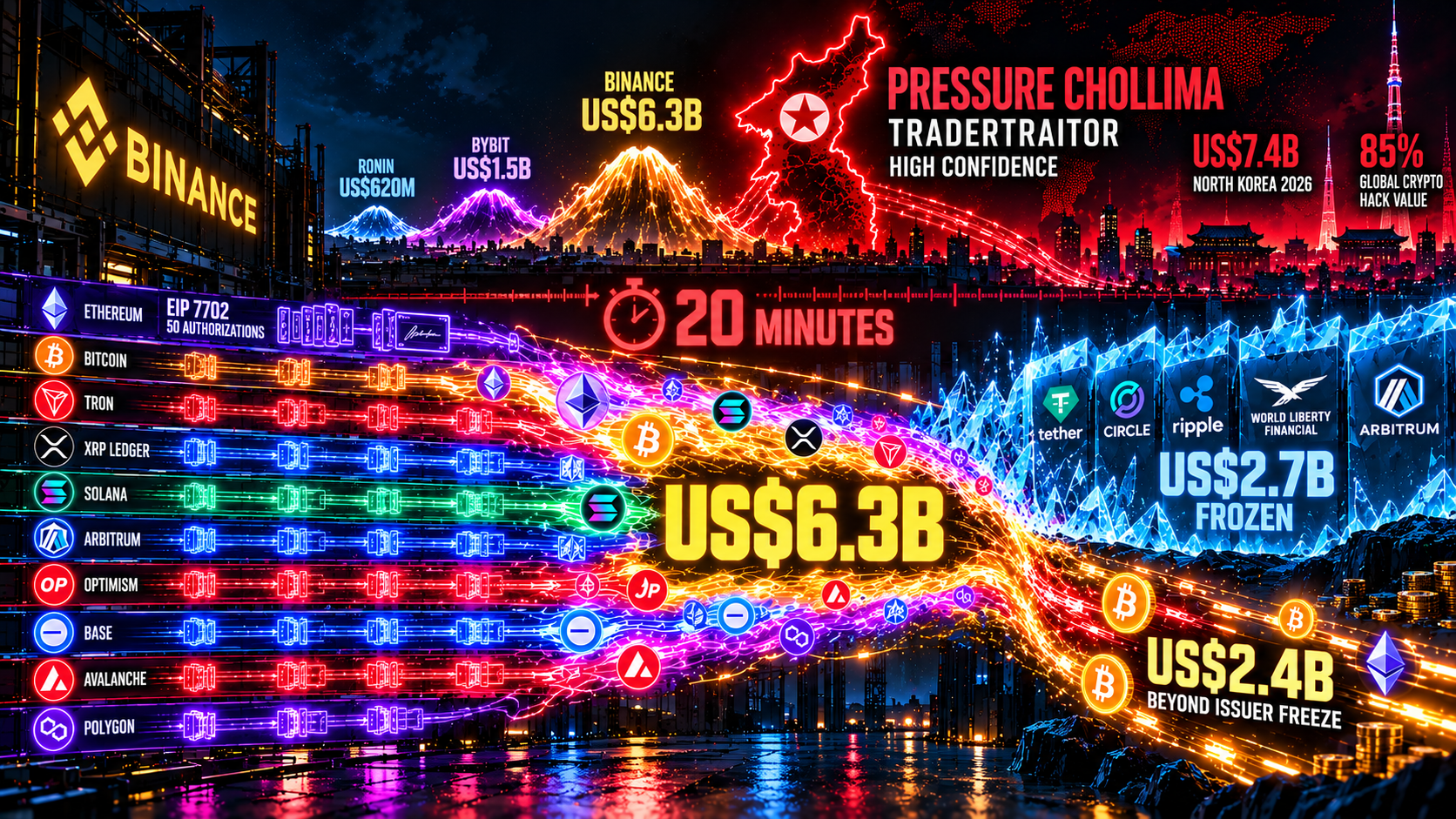
On Ethereum, fifty detonators were already waiting. The attacker had pre-signed fifty authorizations against fifty consecutive nonces, the transaction counts ticking forward inside the Binance hot wallet. It did not need to know which number would come next. One of the fifty only had to match when the right moment arrived. The other chains used different keys and different signing schemes, but the same attacker was about to make their wallets move too.
At 20:05 UTC on October 29, the first wallet opened. Five Binance wallets on the XRP Ledger emptied 233.46 million XRP into a single attacker address in four minutes. Solana and Optimism followed. At 20:20, a Bitcoin hot wallet released 18,270 BTC. Minutes later, Ethereum sent 167,464 ETH and 1.615 billion USDT through the attacker-controlled sweeper. Tron, Arbitrum, and Base joined the burst. Most of US$6.3 billion left Binance in roughly twenty minutes. Then, more than two hours later, Avalanche and Polygon moved too. Whatever Binance had lost control of had not stopped when the first wave ended.
When the first accounting came in, the old record suddenly looked small. Bybit had lost US$1.5 billion eight months earlier, itself an almost incomprehensible number. Binance had just blown through it by more than fourfold in one night. TRM Labs attributes the operation, with high confidence, to PRESSURE CHOLLIMA aka TraderTraitor, North Korea's crypto-theft unit. Chainalysis reached the same conclusion. The FBI had already tied the Bybit heist to the same group. The largest theft in crypto history had taken about as long as an episode of any modern television show.
The scale of this attack is utter insanity. Ethereum accounted for about US$3.79 billion, Bitcoin about US$1.47 billion, Tron about US$628 million, the XRP Ledger about US$296 million, and Solana about US$96 million, with the rest spread across the smaller networks. These were Binance's own wallets, its hot wallets and a smart account, rather than any single customer's balance. Binance has said user funds are safe and has promised to cover every loss. The coming days will show whether that holds.
How the attacker reached those wallets is the question Binance has not answered, and understandably so. It is early, and they need to be cautious with their wording. Precision will be an imperative to explain how the largest crypto heist in history was perpetrated.
On Ethereum the method is visible on-chain. The attacker used EIP-7702, a feature from Ethereum's Pectra upgrade, letting an ordinary wallet borrow the behavior of a smart contract through a signed authorization. A normal account can be told, in effect, to run someone else's code. The attacker used it to turn a Binance hot wallet into a sweeper, one forwarding everything to the attacker and obeying no one else. To be certain the authorization would execute, the attacker pre-signed fifty consecutive nonces, the sequence numbers ordering a wallet's transactions, so whichever number came up next, one signature would match.
EIP-7702 itself did not fail. It did exactly what it was designed to do. The feature expanded what a valid authorization could make an ordinary Ethereum account do. Its own specification treats delegation as security-critical, because the code receiving that authority can gain extraordinary control over the account. In this attack, EIP-7702 did not create the initial access. It magnified what compromised authority could accomplish once the signing path was already under someone else's influence.
At first that read like a single phished authorization, one Binance signer tricked into approving malicious code. The explanation collapses against the other nine chains. In the same window, Binance wallets on Bitcoin, Tron, Solana, and the rest moved funds through ordinary, valid transactions, across different key types and signing schemes with no relationship to EIP-7702. One phished approval does not produce coordinated, correct signatures on ten chains at once. TRM's assessment is the attacker gained command of the machinery producing signatures, the system holding Binance's keys and signing on their behalf, rather than stealing any single key.
Binance's own account points the same way without saying it. The company first suggested the breach began with an engineer's compromised laptop, then disclosed additional points of breach, and said it found no evidence any wallet's private key had leaked. A compromised laptop may explain the door. It does not explain what happened after the attacker walked through it. Ten chains producing valid transactions in concert points much deeper into the machinery, which is why TRM assesses the attacker reached Binance's hot-wallet signing infrastructure rather than simply stealing one private key. Mark Karpeles, who ran Mt. Gox when it failed, told Reuters he believed the attacker reached the keys for at least two wallets. Binance has published no root cause.
This is the lesson Bybit taught in February, read from the other side. That theft did not turn on a stolen key either. The attacker corrupted what the signers saw, serving manipulated content to the interface Bybit used to approve a transfer, so authorized people signed away a cold wallet believing the request was routine. At Binance the signers appear to have been bypassed rather than fooled, the signing system itself producing valid approvals on demand. In both, the cryptography worked exactly as designed. The failure happened before the signature, in the machinery deciding what gets signed.
That moves the real security boundary far past the private key. A signature proves the right key approved a transaction. It cannot prove the transaction deserved approval. The industry spent years guarding the key as the crown jewel, while the policy around it, the systems building a transaction, judging whether it is legitimate, and routing it to a signer, quietly decided how much damage a valid signature could do. PRESSURE CHOLLIMA appears to have learned owning the decision around the key is worth more than stealing the key itself.
The cross-chain spread shows how little the usual defenses helped. Ten blockchains meant different key types, formats, and signing schemes, and still one intrusion produced valid signatures across all of them. Separate keys are not segmentation if a single upstream path can reach every signer. TRM's own guidance after the breach is blunt. Signing infrastructure and approval paths should be separated by chain and wallet tier. Binance has not disclosed what transaction limits, destination controls, velocity thresholds, or independent approvals stood between its wallets and the chains, nor which of them were bypassed. The unanswered question is not only how the attacker reached the signing path. It is how one adversary gained enough authority to make ten blockchains behave as though Binance itself wanted US$6.3 billion to leave.
Whether Binance could have seen this coming has an uncomfortable answer. The strategy was not new. Bybit had taught the same lesson eight months earlier, and every major custodian, Binance most of all, had those months to study what the last record theft exposed. The precedent was fresh and specific. What changed was the instrument. EIP-7702 gave the attacker a new way to abuse valid authority on Ethereum, inside a much larger cross-chain signing compromise. Binance could not have predicted this exact attack. It could reasonably have known the signing path itself had become the battlefield.
Unfortunately blockchain transparency arrived one step too late to matter. The ledgers recorded every transfer with perfect clarity, which wallet moved what, when, and where it went. What they could not record was whether Binance meant for any of these transactions to occur. The transparency showed up exactly where it no longer helped.
The attribution rests on the shape of the operation rather than a confession. PRESSURE CHOLLIMA works to a signature rhythm, and this one matched it. A small Tornado Cash deposit seeds a staging wallet. The team stages for days, testing code against stand-ins. Signatures are gathered in advance and fired in one burst so the theft outruns any human in the loop. TRM points to the April 2026 KelpDAO intrusion as a recent example, and to Bybit before it, where the attacker likewise had an exchange's wallets emptied into addresses it already held.
Pulling this off meant mapping Binance's signing environment, understanding EIP-7702 deeply enough to weaponize it, preparing infrastructure across ten chains, and reducing the execution to something able to run without human improvisation. The on-chain trail exposes only the final thirty-six hours of preparation. Everything before that happened somewhere the blockchain cannot see. The planning, testing, target study, and operational rehearsal required to make ten chains move in concert had already happened before the first staging wallet appeared. Those twenty minutes were only the execution, the last visible step of an operation building for far longer.
What followed was a race against the freeze. Stablecoins are the soft spot in any large theft, because the issuers behind them can freeze a balance on command. Within hours Tether, Circle, and other issuers froze about US$2.67 billion. Arbitrum's Security Council locked roughly US$30 million more. TRM counted close to US$2.7 billion frozen by half past midnight UTC on October 30, and Reuters put it near US$3 billion a day later.
The attacker spent those same hours turning freezable assets into things no issuer could touch. About 325 million USDT was sold to market makers through intent-based contracts for roughly 122,300 ETH, at a discount of more than ten percent to the market, a loss the attacker accepted for the speed. Sixty million USDT went into Aave as collateral to borrow ETH. Three hundred million USDT on Tron went into JustLend. Two hundred million more was pushed through Uniswap by way of intermediary wallets, and the 18,270 BTC began down a peel chain, shedding small amounts across many hops to blur the trail. By TRM's count the attacker still holds more than 420,000 ETH and the full 18,270 BTC, about US$2.4 billion beyond any issuer's reach.
There is an irony in what saved the rest. The roughly US$2.7 billion clawed back was not frozen by code, nor by any property of the blockchains themselves. It was frozen by companies, Tether, Circle, Ripple, and a few others, reaching into their own ledgers and switching balances off. An industry selling itself on permissionless and unstoppable money was rescued, to the degree it was rescued, by the most centralized power inside it. Every freeze recovering funds was also a reminder a stablecoin balance is a permission somebody else can revoke.
Binance's promise to make users whole is where the figures turn uncomfortable. SAFU, the emergency reserve created to protect users in an extreme event, holds roughly US$1 billion. The theft is more than six times larger. Binance has now put considerably more behind its promise. It says it has set aside more than US$6.34 billion through SAFU and its corporate treasury, with more than US$5 billion already held in the exact impacted token assets. That covers roughly eighty percent of the affected amount, and Binance says it is buying the remainder through market and over-the-counter channels.
SAFU alone was never going to absorb a loss this size. The real backstop is Binance itself, its balance sheet rather than its insurance fund. A US$1 billion emergency fund became a US$6.3 billion test of the exchange, and Binance says it will take an initial Proof of Reserves snapshot within twelve hours, with results due Monday, November 2. The heist tested the signing system first. What comes next tests whether the institution behind it can absorb the result.
For the ordinary user, the risk here is easy to misread. The wallets drained were Binance's own, not the personal wallets of its customers. That is not the reassurance it sounds like. Money held on an exchange is not yours in a wallet you control. It is a claim against the exchange itself.
This is the scenario Mt. Gox made infamous from the customer's side of the counter. An exchange is looted, withdrawals become the test, and customers discover whether the balance on their screen is backed by an institution still capable of paying it. Mt. Gox could not. Binance says it can. For now, the customer's protection rests on that claim rather than anything the blockchain can enforce.
The durable lesson is custody. Funds parked on an exchange are the exchange's to secure and the exchange's to lose. Not your keys, not your coins, as the saying goes. Self-custody removes that counterparty risk. A user's funds sitting in a personal wallet, hot or cold, were never inside the Binance signing infrastructure at all. Cold storage adds another layer by reducing the user's own online attack surface, but it answers a smaller question than this heist raises. What failed at Binance was control of the keys. Binance customers had entrusted that control to Binance, and for twenty minutes someone else appears to have decided what Binance's keys would authorize.
Three things make this heist a marker and not only a record.
The first is the target. For years the largest thefts hit bridges and second-tier platforms, the soft edges of the ecosystem. This reached into the signing infrastructure of the largest exchange on earth and moved ten chains in parallel. One of the hardest targets in the industry proved reachable, and the attacker hit the machinery turning Binance's intent into valid transactions. Every custodian running a hot-wallet signing service should read it as a message addressed to them, because the key never had to leak for the money to leave.
The second is EIP-7702. A feature built to make Ethereum accounts more flexible became, in the attacker's hands, a clean way to repoint a wallet at hostile code with one signature. New capability arrives with new abuse, and defenders tend to learn the abuse in production, after it has already been turned on the biggest wallet in the room.
The third is velocity, on both sides. The theft took twenty minutes. The laundering started before most of the world knew anything had happened, and the freezes began nearly as fast, a contest fought live in the open mempool between issuers racing to lock funds and an attacker racing to convert them. A great deal was frozen. More than US$2 billion was not.
The line through these operations is also a line of escalation. Ronin lost about US$620 million in 2022. Bybit lost US$1.5 billion in 2025. Binance has now lost roughly US$6.3 billion. North Korea has been tied to all three. In four and a half years, the amount taken in these defining thefts has risen more than tenfold. What looked like a sequence of spectacular thefts now looks more like a capability compounding.
None of this is theft for its own sake. The Multilateral Sanctions Monitoring Team estimated North Korea stole at least US$1.19 billion in cryptocurrency during all of 2024, roughly one-third of the country's foreign currency revenue for the year. TRM now estimates North Korea has stolen US$7.4 billion in cryptocurrency in 2026, most of it in this one operation, and about eighty-five percent of the value taken in crypto hacks worldwide this year. The Binance theft by itself moved more than five times North Korea's entire estimated haul for 2024.
That is where this stops being a crypto story. Binance sees a security incident. The blockchain sees valid signatures. Stablecoin issuers see balances they can freeze. Pyongyang sees foreign currency.
The industry keeps treating each record theft as an extraordinary failure to survive, while North Korea treats the same industry as infrastructure to exploit. Twenty minutes at Binance broke the record and answered the quieter question underneath it, which side understands this business better.