
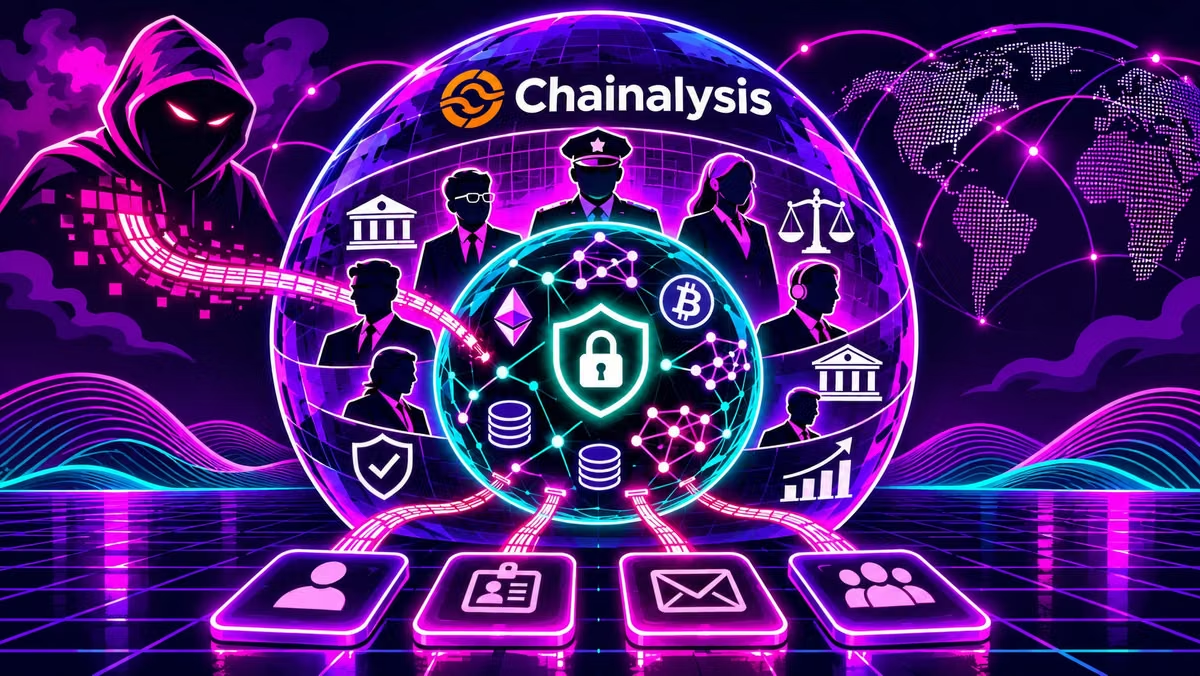
Chainalysis makes its living turning movement into identity. A wallet becomes a cluster, a cluster becomes an entity, and enough evidence can turn an entity into a threat actor an investigator can follow. On October 30, the direction reversed. Chainalysis disclosed an external threat actor had entered its own systems and taken customer identity data using what the company calls offensive agentic techniques. The firm built to identify who is moving through the blockchain now has to explain who moved through its network.
The haul sounds minor at first. Chainalysis claims the attacker reached non-sensitive customer data, specifically user IDs, full names, email addresses, and organization role labels for people with accounts on its platform. The sensitive material held. No investigation content, no graphs, notes, or cases, no transaction or query results, no cleartext passwords, no multi-factor secrets, and no session tokens. On the evidence so far, the attacker took a list of users and little else.
For almost any other company, that would be a routine disclosure. For this one it is not, and the reason is who the users are. Chainalysis is not a consumer social platform. Its customers include law enforcement agencies, government bodies, cryptocurrency exchanges, financial institutions, regulators, and corporate compliance teams. These are people who trace ransom payments, build sanctions cases, investigate fraud, and follow stolen funds across chains.
Chainalysis says more than 1,500 customers use its platform, including nine of the ten largest cryptocurrency exchanges and more than 50 regulators across more than 100 countries. It has not disclosed how many were affected by this breach, and the number may ultimately be small. The exposed records attach names, email addresses, employers, and organizational roles to the people doing that work.
That gives otherwise ordinary identity data a different kind of value. For an affected professional, those details can turn a generic lure into targeted spear-phishing built around a real person, a real employer, and a real role. They can support credential theft, fraudulent authentication prompts, or tailored impersonation. Chainalysis itself warned users to remain hyper-vigilant for unexpected password reset requests and authentication prompts. The breach did not need to expose a case file to reveal useful information about the people working the cases.
Who benefits from a list like that is not hard to imagine. North Korea runs cryptocurrency theft to generate revenue for the Kim regime, and firms like Chainalysis trace where that money goes. Chainalysis was careful to note this breach is unrelated to the recent record theft at Binance, a theft its own industry has tied to North Korea. There is no evidence connecting PRESSURE CHOLLIMA or any other North Korean adversary to this intrusion. An adversary being tracked across the blockchain does not need access to the investigation itself. Information identifying the people doing the tracking can have operational value of its own.
That value goes past phishing a few inboxes. A roster of Chainalysis customers is a map of where investigative capability sits. It shows which agencies and exchanges run blockchain tracing and, by omission, which do not. For an adversary moving stolen funds, that points to the weak crossings, the jurisdictions and venues where the people most likely to follow the money are absent. The same records separate the analyst who builds a case from the executive who signs off on it, letting an adversary approach each one differently. None of it needs a case file. Knowing who is in the room is enough.
The word non-sensitive in the Chainalysis claim is carrying more weight than it can hold. Names and email addresses are low-sensitivity in isolation. Attached to investigators, regulators, financial crime specialists, and compliance personnel, they become metadata about function and proximity to investigative capability. The records do not reveal what an investigator knows. They can reveal who sits close to the work and what role they perform. Data classification measures what a field contains. An adversary cares more about what the field makes possible.
Then there is the method. Chainalysis attributes the intrusion to offensive agentic techniques and places it inside an industry-wide rise in AI-driven attacks. The firm has reason to recognize the technique. In March, at its own conference, Chainalysis launched blockchain intelligence agents, AI built to automate crypto investigations, which the company likened to an experienced analyst working at machine speed. Seven months later, an adversary appears to have turned the same category of tool back on Chainalysis itself. The company now says it is running its own security review with large language models. Offense, defense, and product are all agentic at once.
The wave Chainalysis points to is real, though the AI label gets applied with uneven evidence. In late October, CrowdStrike reported a China-nexus adversary it tracks as VAPOR PANDA had run an offensive framework called ARTEX against more than 200 organizations, a human operator steering AI agents across several engagements at once. CrowdStrike's read is agentic tooling lets a small team pursue a far wider target set than manual operations allow.
The Vercel breach earlier in the year is a softer case. The company traced the intrusion to a compromised third-party AI service, Context.ai. From there the attacker took over an employee's Google Workspace account and pivoted inside. Vercel's bulletin documents the vector and an unusually high operational velocity, but stops short of calling the attack AI-assisted. Guillermo Rauch, the company's chief executive, said separately he strongly suspected AI had accelerated it.
Granting all of that, the framing here still deserves scrutiny. The phrase offensive agentic techniques is doing a great deal of work, and it explains nothing about initial access. Chainalysis acknowledges exploited vulnerabilities but never says which ones, how they were reached, or whether a fix already existed before the intrusion. AI can chain actions, automate decisions, and compress the time between them. AI does not, by itself, create an exploitable path where none exists.
Even Vercel, the softer case, named its entry point, the compromised Context.ai service and a hijacked Workspace account. Chainalysis named the method and withheld the door. At moderate confidence, AI accelerated an intrusion whose real entry point remains undisclosed. The AI-driven label cannot substitute for a root cause Chainalysis has not given.
What Chainalysis sells, underneath the software, is trust. Governments, exchanges, investigators, and regulators rely on it to be a dependable eye on the blockchain, a company whose attribution can survive scrutiny and whose data can carry a case. A breach does not erase the work, but it puts the institution behind it under the same examination it routinely applies elsewhere.
On October 13, seventeen days before disclosing the breach, Chainalysis published an article celebrating Reactor surviving another challenge to its evidentiary reliability. The D.C. Circuit had rejected Sterlingov's argument that Reactor-based expert testimony failed Rule 702 and Daubert, leaving the District Court's admission of the evidence intact. The same appeal separately rejected his challenge over access to Reactor's source code. Chainalysis spent October defending the rigor of what its platform could establish about other people, then ended the month explaining what someone else had reached inside its own systems.
Chainalysis says it notified every customer, that it is still working out which records each organization lost, and that it has brought in outside experts to patch and harden its systems. No threat actor has been publicly identified. Chainalysis has not reported a ransom demand or public release of the stolen data. The scope may grow or stay small.
This is not the first time the hunters have been hunted. In December 2020, FireEye, then among the most respected threat intelligence firms in the world, disclosed a nation state adversary had breached its enterprise network and stolen a large cache of its red team tools. The firm later traced its own intrusion to trojanized SolarWinds Orion updates, and investigating it helped expose the broader supply chain campaign behind it. CrowdStrike associates the related StellarParticle activity with COZY BEAR, a Russia state nexus adversary tied to the Foreign Intelligence Service of the Russian Federation, or SVR. A company able to see into everyone else is worth more to an adversary than almost any client it serves, because a single intrusion yields leverage over the whole network behind it.
Chainalysis spends its days turning blockchain activity into identity. This breach reversed the lens. It exposed part of the human layer surrounding the intelligence. The blockchain maps the money. The breach may have mapped the people.